JEE Main Chemistry — Physical Chemistry previous year questions with solutions.
${\mathrm{PCl}}_{5}\rightleftharpoons {\mathrm{PCl}}_{3}+{\mathrm{Cl}}_{2}{K}_{c}=1.844$ $3.0$ moles of ${\mathrm{PCl}}_{5}$ is introduced in a $1L$ closed reaction vessel at $380K.$ The number of moles of ${\mathrm{PCl}}_{5}$ at equilibrium is $—\times {10}^{-3}$ (Round off to the Nearest Integer)
$2{\mathrm{SO}}_{2}(g)+{O}_{2}(g)\rightleftharpoons 2{\mathrm{SO}}_{3}(g)$ In an equilibrium mixture, the partial pressures are ${P}_{{\mathrm{SO}}_{3}}=43\mathrm{kPa};{P}_{{O}_{2}}=530\mathrm{Pa}$ and ${P}_{{\mathrm{SO}}_{2}}=45\mathrm{kPa}.$ The equilibrium constant ${K}_{P}=_____\times {10}^{-2}.$ (Nearest integer)
Value of ${K}_{P}$ for the equilibrium reaction ${N}_{2}{O}_{4}(g)\rightleftharpoons 2{\mathrm{NO}}_{2(g)}$ at $288K$ is $47.9.$ The ${K}_{C}$ for this reaction at same temperature is (Nearest integer) $(R=0.083L\mathrm{bar}{K}^{-1}{\mathrm{mol}}^{-1})$
A solution is $0.1M$ in ${\mathrm{Cl}}^{-}$ and $0.001M$ in ${\mathrm{CrO}}_{4}^{2-}.$ Solid ${\mathrm{AgNO}}_{3}$ is gradually added to it Assuming that the addition does not change in volume and ${K}_{\mathrm{sp}}(\mathrm{AgCl})=1.7\times {10}^{-10}{M}^{2}$ and ${K}_{\mathrm{sp}}({\mathrm{Ag}}_{2}{\mathrm{CrO}}_{4})=1.9\times {10}^{-12}{M}^{3}.$ Select correct statement from the following:
$10.0\mathrm{ml}$ of ${\mathrm{Na}}_{2}{\mathrm{CO}}_{3}$ solution is titrated against $0.2M\mathrm{HCl}$ solution. The following values were obtained in $5$ readings. $4.8\mathrm{ml},4.9\mathrm{ml},5.0\mathrm{ml},5.0\mathrm{ml}$ and $5.0\mathrm{ml}$ Based on these readings, and convention of titrimetric estimation of concentration of ${\mathrm{Na}}_{2}{\mathrm{CO}}_{3}$ solution is ___ $\mathrm{mM}$. (Round off to the Nearest integer)
The molar conductivity at infinite dilution of barium chloride, sulphuric arid and hydrochloric acid are $280,860$ $426{\mathrm{Scm}}^{2}{\mathrm{mol}}^{-1}$ respectively. The molar conductivity at infinite dilution of barium sulphate is ___ ${\mathrm{Scm}}^{2}{\mathrm{mol}}^{-1}$ ( Round off to the Nearest Integer).
The following data was obtained for chemical reaction given below at $975K$. $2{\mathrm{NO}}_{(g)}+2{H}_{2(g)}\rightarrow {N}_{2(g)}+2{H}_{2}{O}_{(g)}$ $\begin{matrix} & [\mathrm{NO}] & [{H}_{2}] & \mathrm{Rate} \\ & \text{ mol }{L}^{-1} & \text{ mol }{L}^{-1} & {\mathrm{molL}}^{-1}{s}^{-1} \\ (A) & 8\times {10}^{-5} & 8\times {10}^{-5} & 7\times {10}^{-9} \\ (B) & 24\times {10}^{-5} & 8\times {10}^{-5} & 2.1\times {10}^{-8} \\ (C) & 24\times {10}^{-5} & 32\times {10}^{-5} & 8.4\times {10}^{-8}\end{matrix}$ The order of the reaction with respect to $\mathrm{NO}$_____ is [Integer answer]
Which one of the following species doesn't have a magnetic moment of $1.73\mathrm{BM},$ (spin only value)?
An average person needs about $10000\mathrm{kJ}$ energy per day. The amount of glucose (molar mass $=180.0g{\mathrm{mol}}^{-1}$) needed to meet this energy requirement is ______$g.$ (Use : ${\Delta }_{C}H$ (glucose)$=-2700\mathrm{kJ}{\mathrm{mol}}^{-1}$)
A system does $200J$ of work and at the same time absorbs $150J$ of heat. The magnitude of the change in internal energy is ______$J$. (Nearest integer)
For a chemical reaction $A\rightarrow B$, it was found that concentration of $B$ is increased by $0.2\mathrm{mol}{L}^{-1}$ in 30 min. The average rate of the reaction is ________ $\times {10}^{-1}\mathrm{mol}{L}^{-1}{h}^{-1}$. (in nearest integer)
Isotope(s) of hydrogen which emits low energy ${\beta }^{-}$ particles with ${t}_{1/2}$ value $>12$ years is/are
${\mathrm{PCl}}_{5}(g)\rightarrow {\mathrm{PCl}}_{3}(g)+{\mathrm{Cl}}_{2}(g)$ In the above first order reaction the concentration of ${\mathrm{PCl}}_{5}$ reduces from initial concentration $50\mathrm{mol}{L}^{-1}$ to $10\mathrm{mol}{L}^{-1}$ in $120$ minutes at $300K.$ The rate constant for the reaction at $300K$ is $x\times {10}^{-2}{\mathrm{min}}^{-1}.$ The value of $x$ is __________. [Given $\mathrm{log}5=0.6989$]
The decomposition of formic acid on gold surface follows first order kinetics. If the rate constant at $300K$ is $1.0\times {10}^{-3}{s}^{-1}$ and the activation energy ${E}_{a}=11.488\mathrm{kJ}{\mathrm{mol}}^{-1}$, the rate constant at $200K$ is _________ $\times {10}^{-5}{s}^{-1}$. (Round of to the Nearest Integer). (Given $R=8.314J{\mathrm{mol}}^{-1}{K}^{-1}$)
An exothermic reaction $X\rightarrow Y$ has an activation energy $30\mathrm{kJ}{\mathrm{mol}}^{-1}$. If energy change $\Delta E$ during the reaction is $-20\mathrm{kJ}$, then the activation energy for the reverse reaction in $\mathrm{kJ}$ is (Integer answer)
In the sulphur estimation, $0.471g$ of an organic compound gave $1.44g$ of barium sulfate. The percentage of sulphur in the compound is. (Nearest integer) (Atomic Mass of $\mathrm{Ba}=137u$ )
The $\mathrm{pH}$ of a solution obtained by mixing $50\mathrm{mL}$ of $1M\mathrm{HCl}$ and $30\mathrm{mL}$ of $1M\mathrm{NaOH}$ is $x\times {10}^{-4}.$ The value of $x$ is (Nearest integer) $[\mathrm{log}2.5=0.3979]$
$A$ and $B$ decompose via first order kinetics with half-lives $54.0\mathrm{min}$ and $18.0\mathrm{min}$ respectively. Starting from an equimolar non-reactive mixture of $A$ and $B$, the time taken for the concentration of $A$ to become $16$ times that of $B$ is ______ $\mathrm{min}$. (Round off to the Nearest Integer).
The incorrect expression among the following is :
For the reaction, $\mathrm{aA}+\mathrm{bB}\rightarrow \mathrm{cC}+\mathrm{dD},$ the plot of $\mathrm{log}k$ v/s $\frac{1}{T}$ is given below: 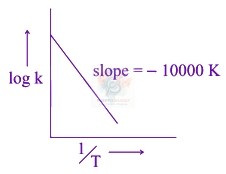 The temperature at which the rate constant of the reaction is ${10}^{-4}{s}^{-1}$ is _____ $K.$ (Rounded-off to the nearest integer) [Given : The rat5e constant of the reaction is ${10}^{-5}{s}^{-1}$ at $500K$.]
For the reaction $2{\mathrm{Fe}}^{3+}(\mathrm{aq})+2{I}^{-}(\mathrm{aq})\rightarrow 2{\mathrm{Fe}}^{2+}(\mathrm{aq})+{I}_{2}(s)$ the magnitude of the standard molar free energy change, ${\Delta }_{r}{G}_{m}^{\circ }=-$______$\mathrm{kJ}$ (Round off to the Nearest Integer). 
The equilibrium constant for the reaction $A(s)\rightleftharpoons M(s)+\frac{1}{2}{O}_{2}(g)$ is ${K}_{p}=4.$ At equilibrium, the partial pressure of ${O}_{2}$ is _____ atm. (Round off to the nearest integer)
The mole fraction of a solute in a $100$ molal aqueous solution ________ $\times {10}^{-2}.$ (Round off to the Nearest Integer). [Given : Atomic masses: $H:1.0u,O:16.0u$]
Assuming ideal behaviour, the magnitude of $\mathrm{log}K$ for the following reaction at $25^{\circ}C$ is $x\times {10}^{-1}.$ The value of $x$ is __________. (Integer answer)$3\mathrm{HC}\equiv {\mathrm{CH}}_{(g)}\rightleftharpoons {C}_{6}{H}_{6(l)}$ [Given: ${\Delta }_{f}G^{\circ}(\mathrm{HC}\equiv \mathrm{CH})=-2.04\times {10}^{5}J{\mathrm{mol}}^{-1};{\Delta }_{f}G^{\circ}({C}_{6}{H}_{6})=-1.24\times {10}^{5}J{\mathrm{mol}}^{-1};R=8.314J{K}^{-1}{\mathrm{mol}}^{-1}$]