JEE Main Chemistry — Physical Chemistry previous year questions with solutions.
The equilibrium constant for the reaction \(\mathrm{SO}_3(\mathrm{g}) \rightleftharpoons \mathrm{SO}_2(\mathrm{~g})+\frac{1}{2} \mathrm{O}_2(\mathrm{~g})\) is \(\mathrm{K}_{\mathrm{c}}=4.9 \times 10^{-2}\). The value of \(\mathrm{K}_{\mathrm{c}}\) for the reaction given below is \(2 \mathrm{SO}_2(\mathrm{~g})+\mathrm{O}_2(\mathrm{~g}) \rightleftharpoons 2 \mathrm{SO}_3(\mathrm{~g})\) is :
Given below are two statements : Statement I : On passing \(\mathrm{HCl}_{(\mathrm{g})}\) through a saturated solution of \(\mathrm{BaCl}_2\), at room temperature white turbidity appears. Statement II : When \(\mathrm{HCl}\) gas is passed through a saturated solution of \(\mathrm{NaCl}\), sodium chloride is precipitated due to common ion effect. In the light of the above statements, choose the most appropriate answer from the options given below :
Given below are two statements : Statement (I) : A Buffer solution is the mixture of a salt and an acid or a base mixed in any particular quantities. Statement (II) : Blood is naturally occurring buffer solution whose \(\mathrm{pH}\) is maintained by \(\mathrm{H}_2 \mathrm{CO}_3 / \mathrm{HCO}_3^- \Theta\) concentrations. In the light of the above statements, choose the correct answer from the options given below :
The $\mathrm{pH}$ of an aqueous solution containing $1M$ benzoic acid $({\mathrm{pK}}_{a}=4.20)$ and $1M$ sodium benzoate is $4.5.$ The volume of benzoic acid solution in $300\mathrm{mL}$ of this buffer solution is __________$\mathrm{mL}$.
Given below are two statements : Statement (I) : Aqueous solution of ammonium carbonate is basic. Statement (II) : Acidic/basic nature of salt solution of a salt of weak acid and weak base depends on ${K}_{a}$ and ${K}_{b}$ value of acid and the base forming it. In the light of the above statements, choose the most appropriate answer from the options given below :
The $\mathrm{pH}$ at which $\mathrm{Mg}(\mathrm{OH}{)}_{2}[{K}_{\mathrm{sp}}=1\times {10}^{-11}]$ begins to precipitate from a solution containing $0.10M$ ${\mathrm{Mg}}^{2+}$ ions is ______.
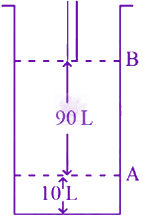 Consider the figure provided. \(1 \mathrm{~mol}\) of an ideal gas is kept in a cylinder, fitted with a piston, at the position A, at \(18^{\circ} \mathrm{C}\). If the piston is moved to position \(\mathrm{B}\), keeping the temperature unchanged, then ' \(x\) ' \(L\) atm work is done in this reversible process. \(x=\) ______ \(\mathrm{L}\) atm. (nearest integer) [Given : Absolute temperature \(={ }^{\circ} \mathrm{C}+273.15, \mathrm{R}=0.08206 \mathrm{~L} \mathrm{~atm} \mathrm{~mol}{ }^{-1} \mathrm{~K}^{-1}\) ]
For a reaction \(\mathrm{A} \xrightarrow{\mathrm{K}_1} \mathrm{~B} \xrightarrow{\mathrm{K}_2} \mathrm{C}\) If the rate of formation of \(B\) is set to be zero then the concentration of \(B\) is given by :
Given below are two statements : Statement I: The rate law for the reaction \(A+B \rightarrow C\) is rate \((r)=k[A]^2[B]\). When the concentration of both A and B is doubled, the reaction rate is increased " \(x\) " times. Statement II : 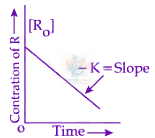 The figure is showing "the variation in concentration against time plot" for a " \(y\) " order reaction. The Value of \(x+y\) is ______
Consider the following single step reaction in gas phase at constant temperature. \(2 \mathrm{~A}_{(\mathrm{g})}+\mathrm{B}_{(\mathrm{g})} \rightarrow \mathrm{C}_{(\mathrm{g})}\) The initial rate of the reaction is recorded as \(\mathrm{r}_1\) when the reaction starts with \(1.5 \mathrm{~atm}\) pressure of \(\mathrm{A}\) and \(0.7 \mathrm{~atm}\) pressure of \(\mathrm{B}\). After some time, the rate \(\mathrm{r}_2\) is recorded when the pressure of \(\mathrm{C}\) becomes \(0.5 \mathrm{~atm}\). The ratio \(\mathrm{r}_1: \mathrm{r}_2\) is ______ \(\times 10^{-1}\). (Nearest integer)
Time required for \(99.9 \%\) completion of a first order reaction is _______ times the time required for completion of \(90 \%\) reaction.(nearest integer)
Consider the following reaction, the rate expression of which is given below \[ \begin{aligned} & \mathrm{A}+\mathrm{B} \rightarrow \mathrm{C} \\ & \text { rate }=\mathrm{k}[\mathrm{A}]^{1 / 2}[\mathrm{~B}]^{1 / 2} \end{aligned} \] The reaction is initiated by taking \(1 \mathrm{M}\) concentration of \(\mathrm{A}\) and \(\mathrm{B}\) each. If the rate constant \((\mathrm{k})\) is \(4.6 \times 10^{-2} \mathrm{~s}^{-1}\), then the time taken for \(\mathrm{A}\) to become \(0.1 \mathrm{M}\) is ______ sec. (nearest integer)
${\mathrm{NO}}_{2}$ required for a reaction is produced by decomposition of ${N}_{2}{O}_{5}$ in ${\mathrm{CCl}}_{4}$ as by equation $2{N}_{2}{O}_{5(g)}\rightarrow 4{\mathrm{NO}}_{2(g)}+{O}_{2(g)}$ The initial concentration of ${N}_{2}{O}_{5}$ is $3\mathrm{mol}{L}^{-1}$ and it is $2.75\mathrm{mol}{L}^{-1}$ after $30$ minutes. The rate of formation of ${\mathrm{NO}}_{2}$ is $x\times {10}^{-3}\mathrm{mol}{L}^{-1}$ $\mathrm{min}-1$, value of $x$ is ________.
For a reaction taking place in three steps at same temperature, overall rate constant $K=\frac{{K}_{1}{K}_{2}}{{K}_{3}}$. If ${\mathrm{Ea}}_{1},{\mathrm{Ea}}_{2}$ and ${\mathrm{Ea}}_{3}$ are $40,50$ and $60\mathrm{kJ}/\mathrm{mol}$ respectively, the overall $\mathrm{Ea}$ is _________ $\mathrm{kJ}/\mathrm{mol}$.
When \(\Delta \mathrm{H}_{\mathrm{vap}}=30 \mathrm{~kJ} / \mathrm{mol}\) and \(\Delta \mathrm{S}_{\mathrm{vap}}=75 \mathrm{~J} \mathrm{~mol}^{-1} \mathrm{~K}^{-1}\), then the temperature of vapour, at one atmosphere is ______ \(\mathrm{K}\).
How can an electrochemical cell be converted into an electrolytic cell?
Match List - I with List - II. \(\begin{array}{ll} \text{List - I} & \text{List - II} \\ \text{Reaction} & \text{Type of redox reaction} \\ \text{(A) } \mathrm{N}_{2(\mathrm{~g})}+\mathrm{O}_{2(\mathrm{~g})} \rightarrow 2 \mathrm{NO}_{(\mathrm{g})} & \text{(I) Decomposition} \\ \text{(B) } 2 \mathrm{~Pb}\left(\mathrm{NO}_3\right)_{2(\mathrm{~s})} \rightarrow 2 \mathrm{PbO}_{(\mathrm{s})}+4 \mathrm{NO}_{2(\mathrm{~g})}+\mathrm{O}_{2(\mathrm{~g})} & \text{(II) Displacement} \\ \text{(C) } 2 \mathrm{Na}_{(\mathrm{s})}+2 \mathrm{H}_2 \mathrm{O}_{\text {(I) }} \rightarrow 2 \mathrm{NaOH}_{(\text {aq. }}+\mathrm{H}_{2(\mathrm{~g})} & \text{(III) Disproportionation} \\ \text{(D) } 2 \mathrm{NO}_{2(\text { g })}+2^{-} \mathrm{OH}( aq. ) \rightarrow \mathrm{NO}_{2(\text { aq. })}^{-}+\mathrm{NO}_{3(\text { aq. })}^{-}+\mathrm{H}_2 \mathrm{O}_{(\mathrm{l})} & \text{(IV) Combination} \end{array}\) Choose the correct answer from the options given below :
The four quantum numbers for the electron in the outer most orbital of potassium (atomic no. $19$) are
The molar conductivity for electrolytes \(A\) and \(B\) are plotted against \(C^{1 / 2}\) as shown below. Electrolytes \(A\) and \(B\) respectively are : 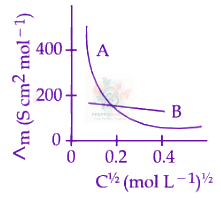
A solution of two miscible liquids showing negative deviation from Raoult's law will have :
Match List I with List II \(\begin{array}{|l|l|l|l|} \hline & \text{ List - I (Element) } & & \text{List - II (Electronic configuration)} \\ \hline \text { A. } & \mathrm{N} & \text { I. } & {[\mathrm{Ar}] 3 \mathrm{~d}^{10} 4 \mathrm{~s}^2 4 \mathrm{p}^5 \mathrm{AR}} \\ \hline \text { B. } & \mathrm{S} & \text { II. } & {[\mathrm{Ne}] 3 \mathrm{~s}^2 3 \mathrm{p}^4} \\ \hline \text { C. } & \mathrm{Br} & \text { III. } & {[\mathrm{He}] 2 \mathrm{~s}^2 2 \mathrm{p}^3} \\ \hline \text { D. } & \mathrm{Kr} & \text { IV. } & {[\mathrm{Ar}] 3 \mathrm{~d}^{10} 4 \mathrm{~s}^2 4 \mathrm{p}^6} \\ \hline \end{array}\) Choose the correct answer from the options given below:
Reduction potential of ions are given below: ${\mathrm{ClO}}_{4}^{-}{\mathrm{IO}}_{4}^{-}{\mathrm{BrO}}_{4}^{-}$ $E^{\circ}=1.19V;E^{\circ}=1.65V;E^{\circ}=1.74V$ The correct order of their oxidising power is:
The quantity of silver deposited when one coulomb charge is passed through \(\mathrm{AgNO}_3\) solution :
The heat of combustion of solid benzoic acid at constant volume is \(-321.30 \mathrm{~kJ}\) at \(27^{\circ} \mathrm{C}\). The heat of combustion at constant pressure is \((-321.30-x \mathrm{R}) \mathrm{kJ}\), the value of \(x\) is _______.