JEE Main Chemistry — Physical Chemistry previous year questions with solutions.
Given below are two statements : Statement I: The rate law for the reaction \(A+B \rightarrow C\) is rate \((r)=k[A]^2[B]\). When the concentration of both A and B is doubled, the reaction rate is increased " \(x\) " times. Statement II : 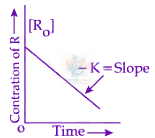 The figure is showing "the variation in concentration against time plot" for a " \(y\) " order reaction. The Value of \(x+y\) is ______
Given below are two statements : Statement I: ${S}_{8}$ solid undergoes disproportionation reaction under alkaline conditions to form ${S}^{2-}$ and ${S}_{2}{O}_{3}^{2-}$ Statement II: ${\mathrm{ClO}}_{4}^{-}$ can undergo disproportionation reaction under acidic condition. In the light of the above statements, choose the most appropriate answer from the options given below:
Given below are two statements : Statement (I) : Potassium hydrogen phthalate is a primary standard for standardisation of sodium hydroxide solution. Statement (II) : In this titration phenolphthalein can be used as indicator. In the light of the above statements, choose the most appropriate answer from the options given below:
Given below are two statements : Statement I : On passing \(\mathrm{HCl}_{(\mathrm{g})}\) through a saturated solution of \(\mathrm{BaCl}_2\), at room temperature white turbidity appears. Statement II : When \(\mathrm{HCl}\) gas is passed through a saturated solution of \(\mathrm{NaCl}\), sodium chloride is precipitated due to common ion effect. In the light of the above statements, choose the most appropriate answer from the options given below :
Given below are two statements: Statement I : Gallium is used in the manufacturing of thermometers. Statement II : A thermometer containing gallium is useful for measuring the freezing point \((256 \mathrm{~K})\) of brine solution. In the light of the above statements, choose the correct answer from the options given below :
Given below are two statements : Statement (I) : Aqueous solution of ammonium carbonate is basic. Statement (II) : Acidic/basic nature of salt solution of a salt of weak acid and weak base depends on ${K}_{a}$ and ${K}_{b}$ value of acid and the base forming it. In the light of the above statements, choose the most appropriate answer from the options given below :
Given below are two statements : Statement (I) : A Buffer solution is the mixture of a salt and an acid or a base mixed in any particular quantities. Statement (II) : Blood is naturally occurring buffer solution whose \(\mathrm{pH}\) is maintained by \(\mathrm{H}_2 \mathrm{CO}_3 / \mathrm{HCO}_3^- \Theta\) concentrations. In the light of the above statements, choose the correct answer from the options given below :
Given below are two statements : One is labelled as Assertion (A) and the other is labelled as Reason (R) Assertion (A) : Enthalpy of neutralisation of strong monobasic acid with strong monoacidic base is always \(-57 \mathrm{~kJ} \mathrm{~mol}^{-1}\). Reason (R) : Enthalpy of neutralisation is the amount of heat liberated when one mole of \(\mathrm{H}^{+}\) ions furnished by acid combine with one mole of \(\mathrm{OH}^{-}\) ions furnished by base to form one mole of water. In the light of the above statements, choose the correct answer from the options given below.
Fuel cell, using hydrogen and oxygen as fuels, A. has been used in spaceship B. has as efficiency of \(40 \%\) to produce electricity C. uses aluminum as catalysts D. is eco-friendry E. is actually a type of Galvanic cell only Choose the correct answer from the options given below:
Frequency of the de-Broglie wave of electron in Bohr's first orbit of hydrogen atom is _______ \(\times 10^{13} \mathrm{~Hz}\) (nearest integer). \(\begin{aligned} & \text { [Given : } \mathrm{R}_{\mathrm{H}}(\text { Rydberg constant })=2.18 \times 10^{-18} \mathrm{~J}, h \text { (Plank's } \\ & \text { constant })=6.6 \times 10^{-34} \mathrm{~J} \text {.s.] } \end{aligned}\)
For the reaction ${N}_{2}{O}_{4}(g)\rightleftharpoons 2{\mathrm{NO}}_{2}(g)$, ${K}_{p}=0.492\mathrm{atm}$ at $300K.{K}_{c}$ for the reaction at same temperature is $______\times {10}^{-2}$. (Given :$R=0.082L\mathrm{atm}{\mathrm{mol}}^{-1}{K}^{-1}$)
For the reaction at $298 \mathrm{~K}, 2 \mathrm{~A}+\mathrm{B} \rightarrow \mathrm{C} . \Delta \mathrm{H}$ $=400 \mathrm{~kJ} \mathrm{~mol}^{-1}$ and $\Delta \mathrm{S}=0.2 \mathrm{~kJ} \mathrm{~mol}^{-1} \mathrm{~K}^{-1}$. The reaction will become spontaneous above $\qquad$ K.
For the given reaction, choose the correct expression of ${K}_{C}$ from the following: ${{\mathrm{Fe}}^{3+}}_{(\mathrm{aq})}+{{\mathrm{SCN}}^{-}}_{(\mathrm{aq})}\rightleftharpoons (\mathrm{FeSCN}{{)}^{2+}}_{(\mathrm{aq})}$
For the given hypothetical reactions, the equilibrium constants are as follows : \(\begin{aligned} & \mathrm{X} \rightleftharpoons \mathrm{Y} ; \mathrm{K}_1=1.0 \\ & \mathrm{Y} \rightleftharpoons \mathrm{Z} ; \mathrm{K}_2=2.0 \\ & \mathrm{Z} \rightleftharpoons \mathrm{W} ; \mathrm{K}_3=4.0 \end{aligned}\) The equilibrium constant for the reaction \(\mathrm{X} \rightleftharpoons \mathrm{W}\) is
For the electro chemical cell \(\begin{gathered} \text { If } \mathrm{E}_{\left(\mathrm{M}^{2+} / \mathrm{M}\right)}^0=0.46 \mathrm{~V} \text { and } \mathrm{E}_{\left(\mathrm{x} / \mathrm{X}^{2-}\right)}^0=0.34 \mathrm{~V} \text {. } \end{gathered}\) Which of the following is correct?
${K}_{a}$ for ${\mathrm{CH}}_{3}\mathrm{COOH}$ is $1.8\times {10}^{-5}$ and ${K}_{b}$ for ${\mathrm{NH}}_{4}\mathrm{OH}$ is $1.8\times {10}^{-5}.$ The $\mathrm{pH}$ of ammonium acetate solution will be
For hydrogen atom, energy of an electron in first excited state is \(-3.4 \mathrm{eV}, \mathrm{K} . \mathrm{E}\). of the same electron of hydrogen atom is \(x \mathrm{eV}\). Value of \(x\) is ______ \(\times 10^{-1} \mathrm{eV}\). (Nearest integer)
For a strong electrolyte, a plot of molar conductivity against (concentration) \({ }^{1 / 2}\) is a straight line, with a negative slope, the correct unit for the slope is
For a sparingly soluble salt \(\mathrm{AB}_2\), the equilibrium concentrations of \(\mathrm{A}^{2+}\) ions and \(B^{-}\)ions are \(1.2 \times 10^{-4} \mathrm{M}\) and \(0.24 \times 10^{-3} \mathrm{M}\), respectively. The solubility product of \(\mathrm{AB}_2\) is :
For a reaction taking place in three steps at same temperature, overall rate constant $K=\frac{{K}_{1}{K}_{2}}{{K}_{3}}$. If ${\mathrm{Ea}}_{1},{\mathrm{Ea}}_{2}$ and ${\mathrm{Ea}}_{3}$ are $40,50$ and $60\mathrm{kJ}/\mathrm{mol}$ respectively, the overall $\mathrm{Ea}$ is _________ $\mathrm{kJ}/\mathrm{mol}$.
$r=k[A]$ for a reaction, $50%$ of $A$ is decomposed in $120$ minutes. The time taken for $90%$ decomposition of $A$ is ______ minutes.
For a reaction \(\mathrm{A} \xrightarrow{\mathrm{K}_1} \mathrm{~B} \xrightarrow{\mathrm{K}_2} \mathrm{C}\) If the rate of formation of \(B\) is set to be zero then the concentration of \(B\) is given by :
For a certain thermochemical reaction $M\rightarrow N$ at $T=400K,{\Delta H}^{o}=77.2\mathrm{kJ}{\mathrm{mol}}^{-1},{\Delta S}^{o}=122{\mathrm{JK}}^{-1}$, $\mathrm{log}$ equilibrium constant $(\mathrm{logK})$ is $-$ _____$\times {10}^{-1}$.
For a certain reaction at $300K,K=10,$ then $\Delta G^{\circ}$ for the same reaction is – ________ $\times {10}^{-1}\mathrm{kJ}{\mathrm{mol}}^{-1}.$ (Given $R=8.314{\mathrm{JK}}^{-1}{\mathrm{mol}}^{-1}$)