JEE Main Chemistry — Physical Chemistry previous year questions with solutions.
Considering acetic acid dissociates in water, its dissociation constant is \(6.25 \times 10^{-5}\). If \(5 \mathrm{~mL}\) of acetic acid is dissolved in 1 litre water, the solution will freeze at \(-x \times 10^{-2}{ }^{\circ} \mathrm{C}\), provided pure water freezes at \(0^{\circ} \mathrm{C}\). \(x=\) ______ . (Nearest integer) Given : \(\begin{aligned} & \left(\mathrm{K}_f\right)_{\text {water }}=1.86 \mathrm{~K} \mathrm{~kg} \mathrm{~mol}^{-1} \text {. } \\ & \text { density of acetic acid is } 1.2 \mathrm{~g} \mathrm{~mol}^{-1} \text {. } \\ & \text { molar mass of water }=18 \mathrm{~g} \mathrm{~mol}^{-1} \text {. } \\ & \text { molar mass of acetic acid=60 } \mathrm{g} \mathrm{mol}^{-1} \text {. } \\ & \text { density of water }=1 \mathrm{~g} \mathrm{~cm}^{-3} \end{aligned}\) Acetic acid dissociates as \(\mathrm{CH}_3 \mathrm{COOH} \rightleftharpoons \mathrm{CH}_3 \mathrm{COO}^{\ominus}+\mathrm{H}^{\oplus}\)
Mass of ethylene glycol (antifreeze) to be added to $18.6\mathrm{kg}$ of water to protect the freezing point at $-24^{\circ}C$ is $\mathrm{kg}$ (Molar mass in ${\mathrm{gmol}}^{-1}$ for ethylene glycol $62,{K}_{f}$ of water $=1.86K\mathrm{kg}{\mathrm{mol}}^{-1}$)
Identify the mixture that shows positive deviations from Raoult's Law
Consider the following reaction \[ \mathrm{A}+\mathrm{B} \rightarrow \mathrm{C} \] The time taken for \(\mathrm{A}\) to become \(1 / 4^{\text {th }}\) of its initial concentration is twice the time taken to become \(1 / 2\) of the same. Also, when the change of concentration of \(B\) is plotted against time, the resulting graph gives a straight line with a negative slope and a positive intercept on the concentration axis. The overall order of the reaction is _______
The rate of first order reaction is $0.04\mathrm{mol}{L}^{-1}{s}^{-1}$ at $10$ minutes and $0.03\mathrm{mol}{L}^{-1}{s}^{-1}$ at $20$ minutes after initiation. Half life of the reaction is ______ minutes. (Given $\mathrm{log}2=0.3010,\mathrm{log}3=0.4771)$ Round off your answer to the nearest integer.
Which of the following statements is not correct about rusting of iron?
Molar ionic conductivities of divalent cation and anion are \(57 \mathrm{~S} \mathrm{~cm}^2 \mathrm{~mol}^{-1}\) and \(73 \mathrm{~S} \mathrm{~cm}^2 \mathrm{~mol}^{-1}\) respectively. The molar conductivity of solution of an electrolyte with the above cation and anion will be :
What pressure (bar) of \(\mathrm{H}_2\) would be required to make emf of hydrogen electrode zero in pure water at \(25^{\circ} \mathrm{C}\) ?
Consider the following redox reaction: ${\mathrm{MnO}}_{4}^{-}+{H}^{+}+{H}_{2}{C}_{2}{O}_{4}\rightleftharpoons {\mathrm{Mn}}^{2+}+{H}_{2}O+{\mathrm{CO}}_{2}$ The standard reduction potentials are given as below $({E}_{\mathrm{red}}^{\circ})$ ${{E}^{0}}_{{\mathrm{MnO}}_{4}^{-}/{\mathrm{Mn}}^{2+}}=+1.51V$; ${{E}^{0}}_{{\mathrm{CO}}_{2}/{H}_{2}{C}_{2}{O}_{4}}=-0.49V$ If the equilibrium constant of the above reaction is given as ${K}_{\mathrm{eq}}={10}^{x}$, then the value of $x=$ _______ (nearest integer)
In an atom, total number of electrons having quantum numbers \(\mathrm{n}=4,\left|\mathrm{~m}_l\right|=1\) and \(\mathrm{m}_{\mathrm{s}}=-\frac{1}{2}\) is ______
According to the wave-particle duality of matter by de-Broglie, which of the following graph plot presents most appropriate relationship between wavelength of electron $(\lambda )$ and momentum of electron $(p)?$
The Molarity \((\mathrm{M})\) of an aqueous solution containing \(5.85 \mathrm{~g}\) of NaCl in \(500 \mathrm{~mL}\) water is : (Given : Molar Mass \(\mathrm{Na}: 23\) and \(\mathrm{Cl}: 35.5 \mathrm{gmol}^{-1}\) )
Total number of ions from the following with noble gas configuration is ${\mathrm{Sr}}^{2+}(Z=38),{\mathrm{Cs}}^{+}(Z=55),{\mathrm{La}}^{2+}(Z=57){\mathrm{Pb}}^{2+}$$(Z=82),{\mathrm{Yb}}^{2+}(Z=70)\text{ and }{\mathrm{Fe}}^{2+}(Z=26)$
$1$ mole of $\mathrm{PbS}$ is oxidised by $X$ moles of ${O}_{3}$ to get $Y$ moles of ${O}_{2}.$ $X+Y=$
A conductivity cell with two electrodes (dark side) are half filled with infinitely dilute aqueous solution of a weak electrolyte. If volume is doubled by adding more water at constant temperature, the molar conductivity of the cell will - 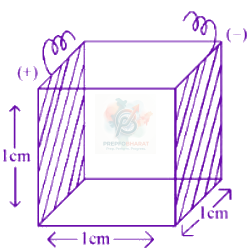
Match List I with List II \(\begin{array}{|l|l|l|l|} \hline & \text{ List - I (Cell) } & & \text{List - II (Use/Property/Reaction)} \\ \hline \text { A. } & \text { Leclanche cell } & \text { I. } & \begin{array}{l} \text { Converts energy of combustion into electrical } \\ \text { energy } \end{array} \\ \hline \text { B. } & \mathrm{Ni}-\mathrm{Cd} \text { cell } & \text { II. } & \begin{array}{l} \text { Does not involve any ion in solution and is used } \\ \text { in hearing aids } \end{array} \\ \hline \text { C. } & \text { Fuel cell } & \text { III. } & \text { Rechargeable } \\ \hline \text { D. } & \text { Mercury cell } & \text { IV. } & \text { Reaction at anode } \mathrm{Zn} \rightarrow \mathrm{Zn}^{2+}+2 \mathrm{e}^{-} \\ \hline \end{array}\) Choose the correct answer from the options given below:
Consider the two different first order reactions given below \(\mathrm{A}+\mathrm{B} \rightarrow \mathrm{C}\) (Reaction 1\()\) \(P \rightarrow Q\) (Reaction 2) The ratio of the half life of Reaction 1 : Reaction 2 is \(5: 2\). If \(t_1\) and \(t_2\) represent the time taken to complete \(2 / 3^{\text {rd }}\) and \(45^{\text {th }}\) of Reaction 1 and Reaction 2, respectively, then the value of the ratio \(t_1: t_2\) is ______ \(\times 10^{-1}\) (nearest integer). [Given : \(\log _{10}(3)=0.477\) and \(\log _{10}(5)=0.699\)]
The heat of solution of anhydrous \(\mathrm{CuSO}_4\) and \(\mathrm{CuSO}_4 \cdot 5 \mathrm{H}_2 \mathrm{O}\) are \(-70 \mathrm{~kJ} \mathrm{~mol}^{-1}\) and \(+12 \mathrm{~kJ} \mathrm{~mol}^{-1}\) respectively. The heat of hydration of \(\mathrm{CuSO}_4\) to \(\mathrm{CuSO}_4 \cdot 5 \mathrm{H}_2 \mathrm{O}\) is \(-x \mathrm{~kJ}\). The value of \(x\) is ______ (nearest integer).
For the reaction at $298 \mathrm{~K}, 2 \mathrm{~A}+\mathrm{B} \rightarrow \mathrm{C} . \Delta \mathrm{H}$ $=400 \mathrm{~kJ} \mathrm{~mol}^{-1}$ and $\Delta \mathrm{S}=0.2 \mathrm{~kJ} \mathrm{~mol}^{-1} \mathrm{~K}^{-1}$. The reaction will become spontaneous above $\qquad$ K.
An ideal gas, \(\overline{\mathrm{C}}_{\mathrm{v}}=\frac{5}{2} \mathrm{R}\), is expanded adiabatically against a constant pressure of 1 atm untill it doubles in volume. If the initial temperature and pressure is \(298 \mathrm{~K}\) and \(5 \mathrm{~atm}\), respectively then the final temperature is _______ \(\mathrm{K}\) (nearest integer). [\(\overline{\mathrm{C}}_{\mathrm{v}}\) is the molar heat capacity at constant volume]
If $5$ moles of an ideal gas expands from $10L$ to a volume of $100L$ at $300K$ under isothermal and reversible condition then work, $w$, is $-xJ$. The value of $x$ is $-$_______. (Given $R=8.314J{K}^{-1}{\mathrm{mol}}^{-1}$)
The enthalpy of formation of ethane \(\left(\mathrm{C}_2 \mathrm{H}_6\right)\) from ethylene by addition of hydrogen where the bond-energies of \(\mathrm{C}-\mathrm{H}, \mathrm{C}-\mathrm{C}, \mathrm{C}=\mathrm{C}, \mathrm{H}-\mathrm{H}\) are \(414 \mathrm{~kJ}, 347 \mathrm{~kJ}, 615 \mathrm{~kJ}\) and \(435 \mathrm{~kJ}\) respectively is \(\qquad\) \(\mathrm{kJ}\)
Two reactions are given below: $2{\mathrm{Fe}}_{(s)}+\frac{3}{2}{O}_{2(g)}\rightarrow {\mathrm{Fe}}_{2}{O}_{3(s)},\Delta {H}^{o}=-822\mathrm{kJ}/\mathrm{mol}$ ${C}_{(s)}+\frac{1}{2}{O}_{2(g)}\rightarrow {\mathrm{CO}}_{(g)},\Delta {H}^{o}=-110\mathrm{kJ}/\mathrm{mol}$ Then enthalpy change for following reaction $3{C}_{(s)}+{\mathrm{Fe}}_{2}{O}_{3(s)}\rightarrow 2{\mathrm{Fe}}_{(s)}+3{\mathrm{CO}}_{(g)}$
For the given hypothetical reactions, the equilibrium constants are as follows : \(\begin{aligned} & \mathrm{X} \rightleftharpoons \mathrm{Y} ; \mathrm{K}_1=1.0 \\ & \mathrm{Y} \rightleftharpoons \mathrm{Z} ; \mathrm{K}_2=2.0 \\ & \mathrm{Z} \rightleftharpoons \mathrm{W} ; \mathrm{K}_3=4.0 \end{aligned}\) The equilibrium constant for the reaction \(\mathrm{X} \rightleftharpoons \mathrm{W}\) is