JEE Main Chemistry — Physical Chemistry previous year questions with solutions.
The ionization energy of sodium in $\mathrm{kJ}{\mathrm{mol}}^{–1}$ . If electromagnetic radiation of wavelength $242\mathrm{nm}$ is just sufficient to ionize sodium atom is ______.(nearest integer)
$9.3g$ of aniline is subjected to reaction with excess of acetic anhydride to prepare acetanilide. The mass of acetanilide produced if the reaction is $100%$ completed is _____$\times {10}^{-1}g$. (Given molar mass in $g{\mathrm{mol}}^{-1}N=14,O=16,C=$$12,H=1)$
When ' \(x\) ' \(\times 10^{-2} \mathrm{~mL}\) methanol (molar mass \(=32 \mathrm{~g}\); density \(=0.792 \mathrm{~g} / \mathrm{cm}^3\)) is added to \(100 \mathrm{~mL}\) water (density \(=1 \mathrm{~g} / \mathrm{cm}^3\)), the following diagram is obtained. 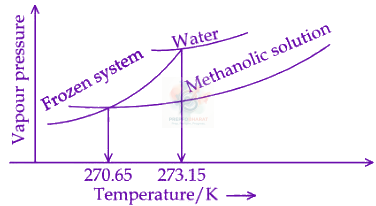 \(x=\) ______ (nearest integer). [Given : Molal freezing point depression constant of water at \(273.15 \mathrm{~K}\) is \(1.86 \mathrm{~K} \mathrm{~kg} \mathrm{~mol}^{-1}\)]
Which of the following electronic configuration would be associated with the highest magnetic moment ?
The following reaction occurs in the Blast furnance where iron ore is reduced to iron metal \(\mathrm{Fe}_2 \mathrm{O}_{3(\mathrm{~s})}+3 \mathrm{CO}_{(\mathrm{g})} \rightleftharpoons \mathrm{Fe}_{(\mathrm{l})}+3 \mathrm{CO}_{2(\mathrm{~g})}\) Using the Le-chatelier's principle, predict which one of the following will not disturb the equilibrium.
The number of moles of methane required to produce \(11 \mathrm{~g} \mathrm{CO}_2(\mathrm{~g})\) after complete combustion is : (Given molar mass of methane in \(\mathrm{g} \mathrm{mol}^{-1}: 16\))
$10\mathrm{mL}$ of gaseous hydrocarbon on combustion gives $40\mathrm{mL}$ of ${\mathrm{CO}}_{2}(g)$ and $50\mathrm{mL}$ of water vapour. Total number of carbon and hydrogen atoms in the hydrocarbon is _______.
Solubility of calcium phosphate (molecular mass, $M$) in water is ${W}_{g}$ per $100\mathrm{mL}$ at $25^{\circ}C.$ Its solubility product at $25^{\circ}C$ will be approximately.
For the reaction ${N}_{2}{O}_{4}(g)\rightleftharpoons 2{\mathrm{NO}}_{2}(g)$, ${K}_{p}=0.492\mathrm{atm}$ at $300K.{K}_{c}$ for the reaction at same temperature is $______\times {10}^{-2}$. (Given :$R=0.082L\mathrm{atm}{\mathrm{mol}}^{-1}{K}^{-1}$)
An artificial cell is made by encapsulating \(0.2 \mathrm{M}\) glucose solution within a semipermeable membrane. The osmotic pressure developed when the artificial cell is placed within a \(0.05 \mathrm{M}\) solution of \(\mathrm{NaCl}\) at \(300 \mathrm{~K}\) is _______ \(\times 10^{-1}\) bar. (nearest integer). [Given : \(\mathrm{R}=0.083 \mathrm{~L} \mathrm{bar} \mathrm{mol}^{-1} \mathrm{~K}^{-1}\)] Assume complete dissociation of \(\mathrm{NaCl}\)
Thiosulphate reacts differently with iodine and bromine in the reactions given below: \(\begin{aligned} & 2 \mathrm{~S}_2 \mathrm{O}_3^{2-}+\mathrm{I}_2 \rightarrow \mathrm{S}_4 \mathrm{O}_6^{2-}+2 \mathrm{I}^{-} \\ & \mathrm{S}_2 \mathrm{O}_3^{2-}+5 \mathrm{Br}_2+5 \mathrm{H}_2 \mathrm{O} \rightarrow 2 \mathrm{SO}_4^{2-}+4 \mathrm{Br}^{-}+10 \mathrm{H}^{+} \end{aligned}\) Which of the following statement justifies the above dual behaviour of thiosulphate?
If $50\mathrm{mL}$ of $0.5M$ oxalic acid is required to neutralise $25\mathrm{mL}$ of $\mathrm{NaOH}$ solution, the amount of $\mathrm{NaOH}$ in $50\mathrm{mL}$ of given $\mathrm{NaOH}$ solution is_______g.
Chlorine undergoes disproportionation in alkaline medium as shown below : ${\mathrm{aCl}}_{2}(g)+{\mathrm{bOH}}^{-}(\mathrm{aq})\rightarrow {\mathrm{cClO}}^{-}(\mathrm{aq})+{\mathrm{dCl}}^{-}(\mathrm{aq})+{\mathrm{eH}}_{2}O(l)$ The values of $a,b,c$ and $d$ in a balanced redox reaction are respectively :
The electronic configuration for Neodymium is: [Atomic Number for Neodymium 60]
The values of conductivity of some materials at $298.15K$ in ${\mathrm{Sm}}^{-1}$ are $2.1\times {10}^{3},1.0\times {10}^{-16},1.2\times 10,3.91,1.5\times {10}^{-2},1\times {10}^{-7},1.0\times {10}^{3}$. The number of conductors among the materials is _____.
The equilibrium \(\mathrm{Cr}_2 \mathrm{O}_7^{2-} \rightleftharpoons 2 \mathrm{CrO}_4^{2-}\) is shifted to the right in :
The correct set of four quantum numbers for the valence electron of rubidium atom $(Z=37)$ is:
An organic compound has \(42.1 \%\) carbon, \(6.4 \%\) hydrogen and remainder is oxygen. If its molecular weight is 342, then its molecular formula is :
A hypothetical electromagnetic wave is show below. 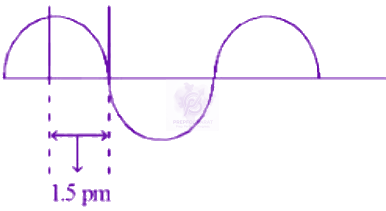 The frequency of the wave is \(x \times 10^{19} \mathrm{~Hz}\). \(x =\) ______ (nearest integer)
For a certain thermochemical reaction $M\rightarrow N$ at $T=400K,{\Delta H}^{o}=77.2\mathrm{kJ}{\mathrm{mol}}^{-1},{\Delta S}^{o}=122{\mathrm{JK}}^{-1}$, $\mathrm{log}$ equilibrium constant $(\mathrm{logK})$ is $-$ _____$\times {10}^{-1}$.
The half-life of radioisotopic bromine - $82$ is $36$ hours. The fraction which remains after one day is _________$\times {10}^{-2}$. (Given antilog $0.2006=1.587)$ Round off to the nearest integer
\(9.3 \mathrm{~g}\) of pure aniline is treated with bromine water at room temperature to give a white precipitate of the product ' \(\mathrm{P}\) '. The mass of product ' \(\mathrm{P}\) ' obtaind is \(26.4 \mathrm{~g}\). The percentage yield is _______ \(\%\).
Identify the incorrect statements regarding primary standard of titrimetric analysis. (A) It should be purely available in dry form. (B) It should not undergo chemical change in air. (C) It should be hygroscopic and should react with another chemical instantaneously and stoichiometrically. (D) It should be readily soluble in water. (E) \(\mathrm{KMnO}_4 ~\&~ \mathrm{NaOH}\) can be used as primary standard. Choose the correct answer from the options given below :
A solution containing \(10 \mathrm{~g}\) of an electrolyte \(\mathrm{AB}_2\) in \(100 \mathrm{~g}\) of water boils at \(100.52^{\circ} \mathrm{C}\). The degree of ionization of the electrolyte \((\alpha)\) is _______ \(\times 10^{-1}\). (nearest integer) [Given : Molar mass of \(\mathrm{AB}_2=200 \mathrm{~g} \mathrm{~mol}^{-1}, \mathrm{~K}_{\mathrm{b}}\) (molal boiling point elevation const. of water) \(=0.52 \mathrm{~K} \mathrm{~kg} \mathrm{~mol}^{-1}\), boiling point of water \(=100^{\circ} \mathrm{C} ; \mathrm{AB}_2\) ionises as \(\left.\mathrm{AB}_2 \rightarrow \mathrm{A}^{2+}+2 \mathrm{~B}^{-}\right]\)