Organic Chemistry PYQ — Page 35
JEE Main Chemistry — Organic Chemistry previous year questions with solutions.
All Organic Chemistry Questions (1783)
The Hinsberg reagent is
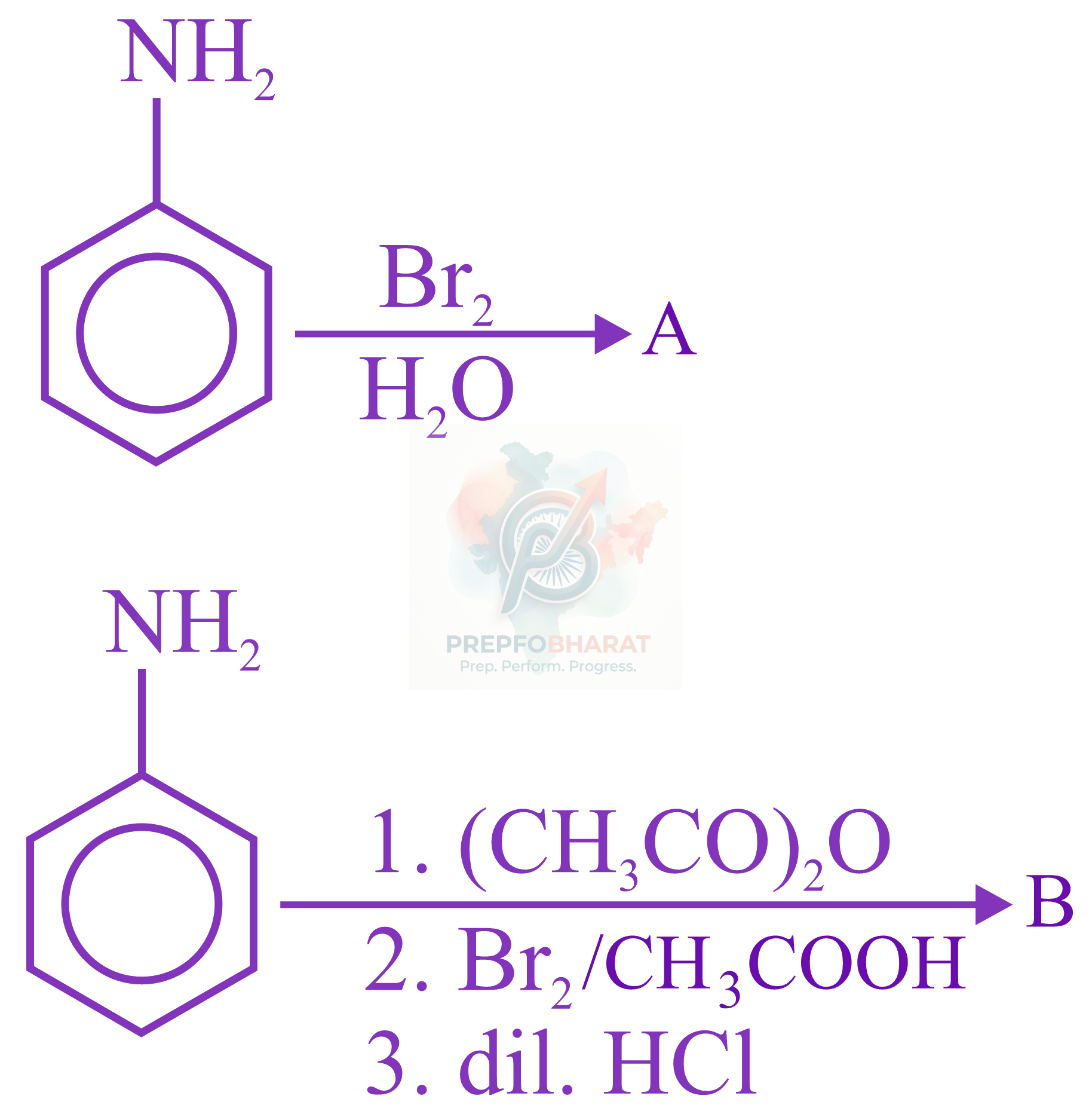 Consider the above reaction, the product $A$ and product $B$ respectively are
Given below are two statements. One is labelled as Assertion $A$ and the other is labelled as Reason $R$. Assertion $A:[6]$ Annulene. $[8]$ Annulene and cis $-[10]$ Annulene, are respectively aromatic, not-aromatic and aromatic. 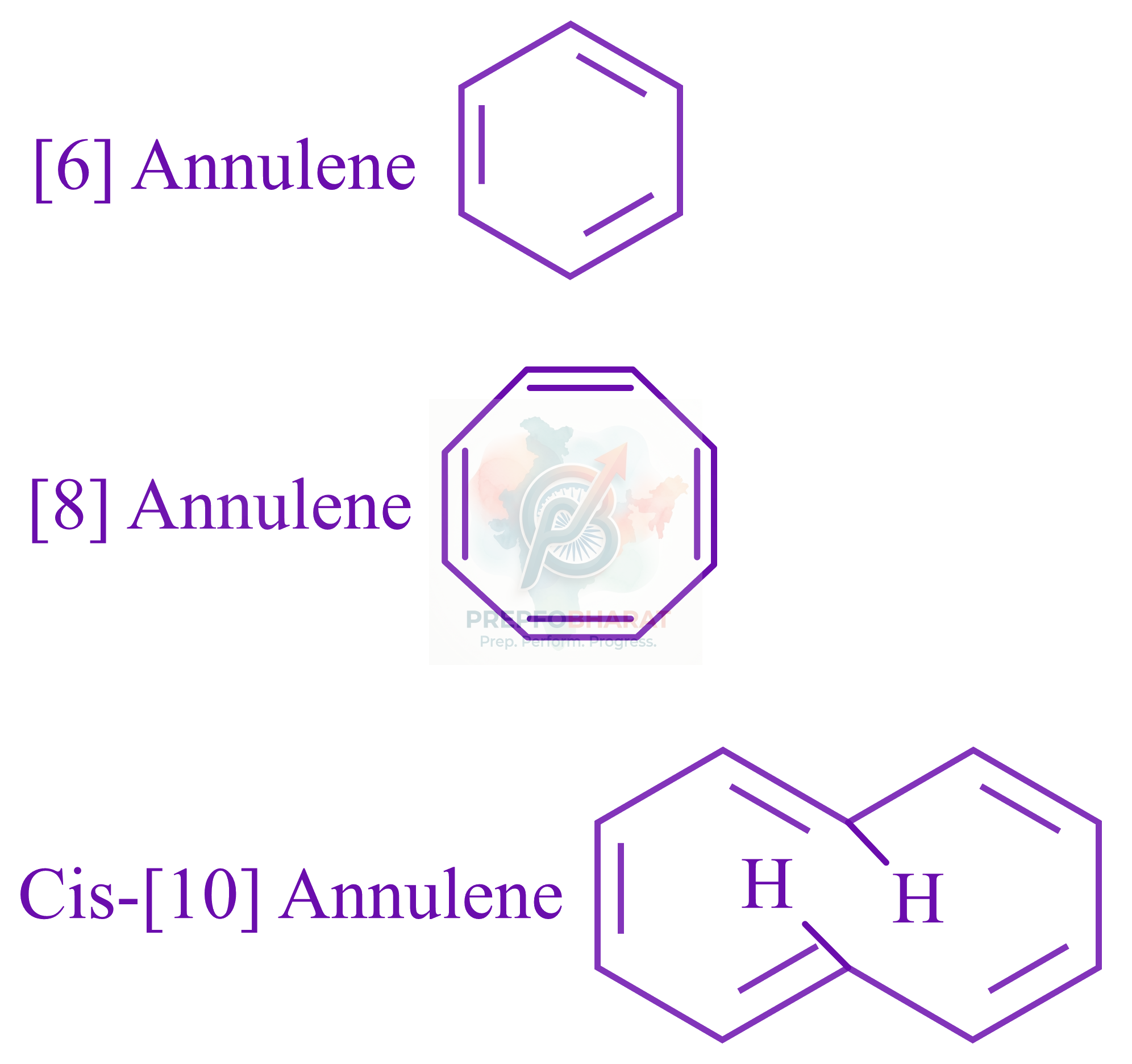 Reason $R$: Planarity is one of the requirements of aromatic systems. In the light of the above statements, choose the most appropriate answer from the options given below.
Which one of the following reactions does not represent correct combination of substrate and product under the given conditions?
$0.25g$ of an organic compound containing chlorine gave $0.40g$ of silver chloride in Carius estimation. The percentage of chlorine present in the compound is [in nearest integer] (Given: Molar mass of $\mathrm{Ag}$ is $108g{\mathrm{mol}}^{-1}$ and that of $\mathrm{Cl}$ is $35.5g{\mathrm{mol}}^{-1}$)
Which technique among the following, is most appropriate in separation of a mixture of $100\mathrm{mg}$ of $p$-nitrophenol and picric acid?
Two statements are given belwo : Statement I : The melting point of monocarboxylic acid with even number of carbon atoms is higher than that of with odd number of carbon atoms acid immediately below and above it in the series. Statement II : The solubility of monocarboxylic acids in water decreases with increase in molar mass. Choose the most appropriate option :
In the following structures, which one is having staggered conformation with maximum dihedral angle?
 In the given conversion the compound $A$ is
The major product in the reaction 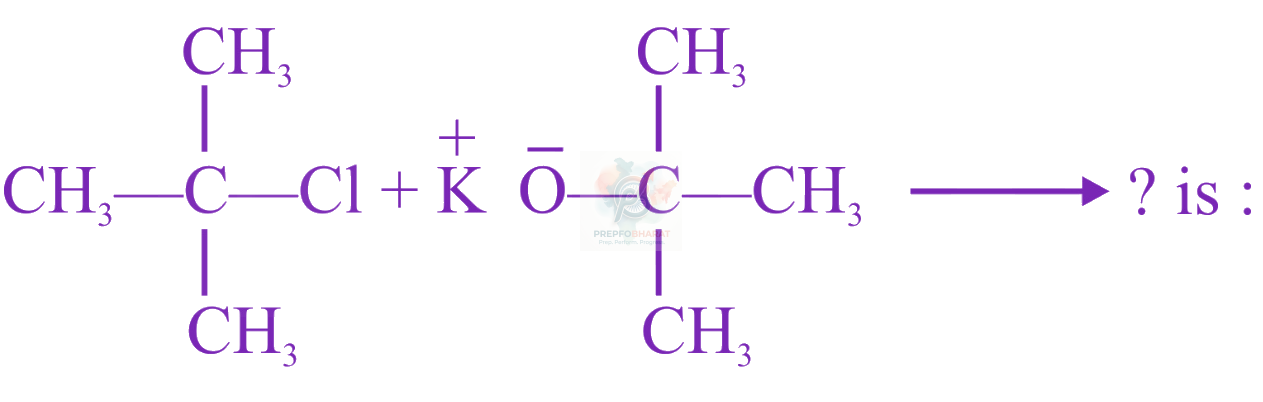
 The stable carbocation formed in the above reaction is :
Stability of $\alpha$ - Helix structure of proteins depends upon
In the presence of sunlight, benzene reacts with ${\mathrm{Cl}}_{2}$ to give product, $X$. The number of hydrogens in $X$ is
Given below are two statements. One is labelled as Assertion $A$ and the other is labelled as Reason $R$. Assertion $A$ : Amylose is insoluble in water. Reason $R$ : Amylose is a long linear molecule with more than $200$ glucose units. In the light of the above statements, choose the correct answer from the options given below.
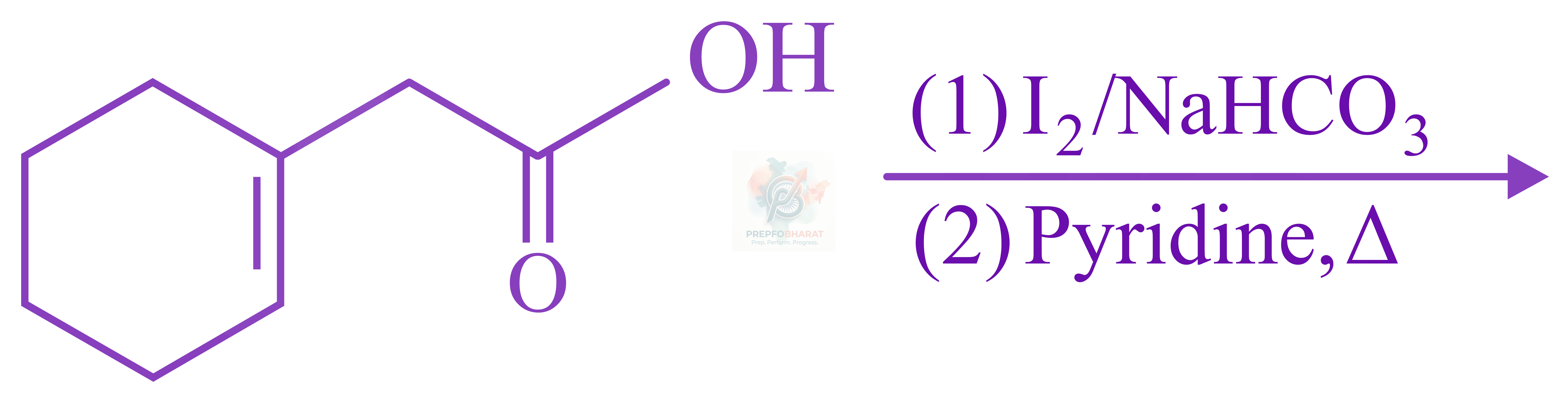 Find out the major product for the above reaction.
Given below are two statements. Statement I: Maltose has two $\alpha -D-\mathrm{glucose}$ units linked at ${C}_{1}$ and ${C}_{4}$ and is a reducing sugar. Statement II: Maltose has two monosaccharides: $\alpha$-$D$-glucose and $\beta$-$D$-glucose linked at ${C}_{1}$ and ${C}_{6}$ and it is a non-reducing sugar. In the light of the above statements, choose the correct answer from the options Question: given below.
Given below are two statements : Statement - I : In Hofmann degradation reaction, the migration of only an alkyl group takes place from carbonyl carbon of the amide to the nitrogen atom. Statement - II : The group is migrated in Hofmann degradation reaction to electron deficient atom. In the light of the above statements, choose the most appropriate answer from the options given below
The major product $P$ of the given reaction is (where, $\mathrm{Me}$ is $-{\mathrm{CH}}_{3}$) 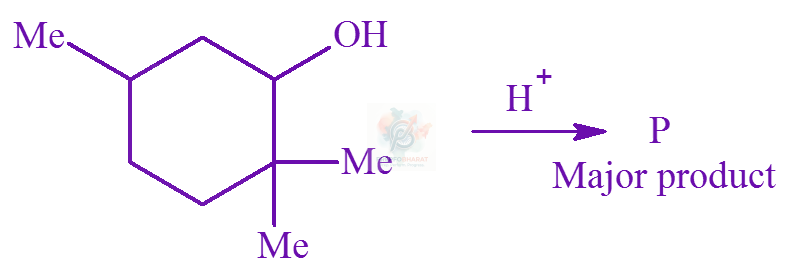
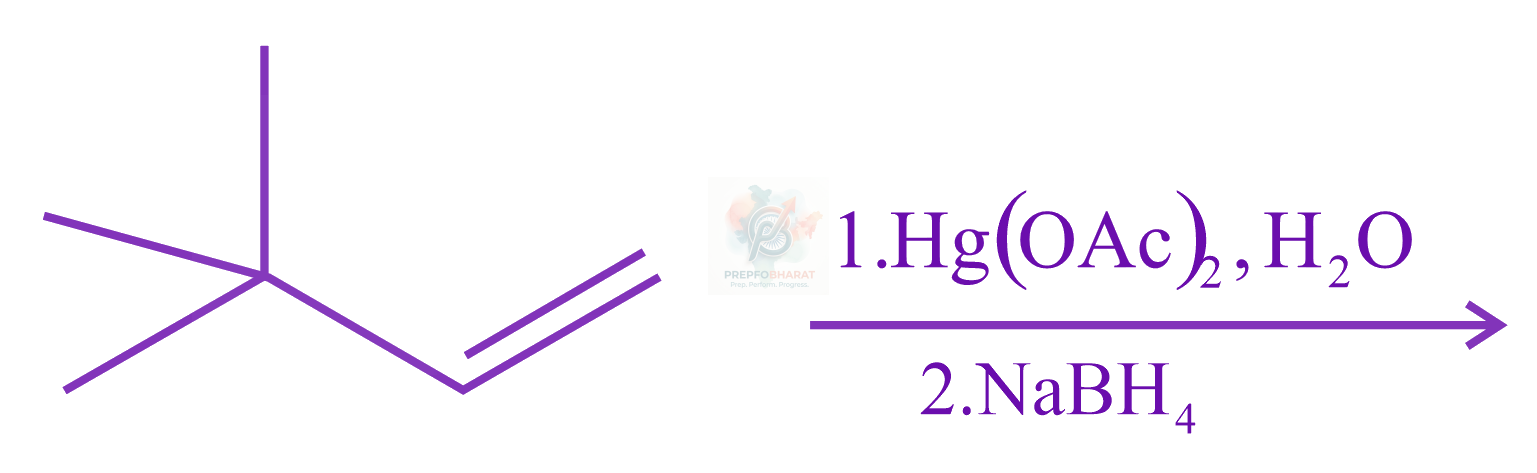
 Considering the above reactions, the compound '$A$' and compound '$B$' respectively are
Which of the following is an example of conjugated diketone?
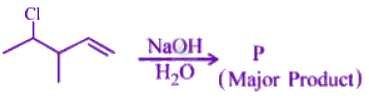 Consider the above reaction. The number of $\pi$ electrons present in the product '$P$' is
With respect to the following reaction, consider the given statements: 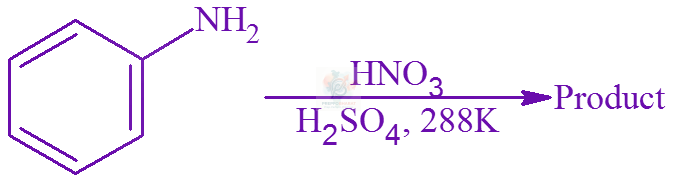 (A) $o$-Nitroaniline and $p$-nitroaniline are the predominant products. (B) $p$-Nitroaniline and $m$-nitroaniline are the predominant products. (C) ${\mathrm{HNO}}_{3}$ acts as an acid. (D) ${H}_{2}{\mathrm{SO}}_{4}$ acts as an acid. Choose the correct option.
In the given reaction, 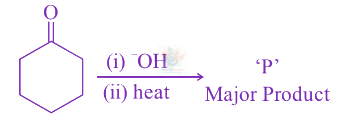 The number of $\pi$ electrons present in the product $'P'$ is ____________.