Organic Chemistry PYQ — Page 34
JEE Main Chemistry — Organic Chemistry previous year questions with solutions.
All Organic Chemistry Questions (1783)
An organic compound '$A$' contains nitrogen and chlorine. It dissolves readily in water to give a solution that turns litmus red. Titration of compound '$A$' with standard base indicates that the molecular weight of '$A$' is $131\pm 2$. When a sample of '$A$' is treated with aq. $\mathrm{NaOH}$, a liquid separates which contains $N$ but not $\mathrm{Cl}$. Treatment of the obtained liquid with nitrous acid followed by phenol gives orange precipitate. The compound '$A$' is
Which one of the following is a water soluble vitamin, that is not excreted easily?
Arrange the following in increasing order of reactivity towards nitration A. $p$-xylene B. bromobenzene C. mesitylene D. nitrobenzene E. benzene Choose the correct answer from the options given below
In bromination of Propyne, with Bromine $1,1,2,2$-tetrabromopropane is obtained in $27%$ yield. The amount of $1,1,2,2$ tetrabromopropane obtained from $1g$ of Bromine in this reaction is_____$\times {10}^{-1}g$ . (Molar Mass : Bromine $=80g/\mathrm{mol}$)
Phenol on reaction with dilute nitric acid, gives two products. Which method will be most efficient for large scale separation?
In the given reaction 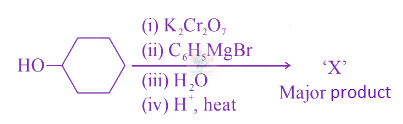 the number of ${\mathrm{sp}}^{2}$ hybridised carbon (s) in compound $'X'$ is _______.
Given below are two statements. Statement I: The presence of weaker $\pi$-bonds make alkenes less stable than alkanes Statement II: The strength of the double bond is greater than that of carbon-carbon single bond. In the light of the above statements, choose the correct answer from the options : given below.
${({C}_{7}{H}_{5}{O}_{2})}_{2}\overset{\mathrm{hv}}{\longrightarrow }[X]\rightarrow 2{\overset{˙}{C}}_{6}{H}_{5}+2{\mathrm{CO}}_{2}$ Consider the above reaction and identify the intermediated '$X$'
A compound '$A$' on reaction with '$X$' and '$Y$ produces the same major product but different by product '$a$' and '$b$'. Oxidation of '$a$' gives a substance produced by ants. 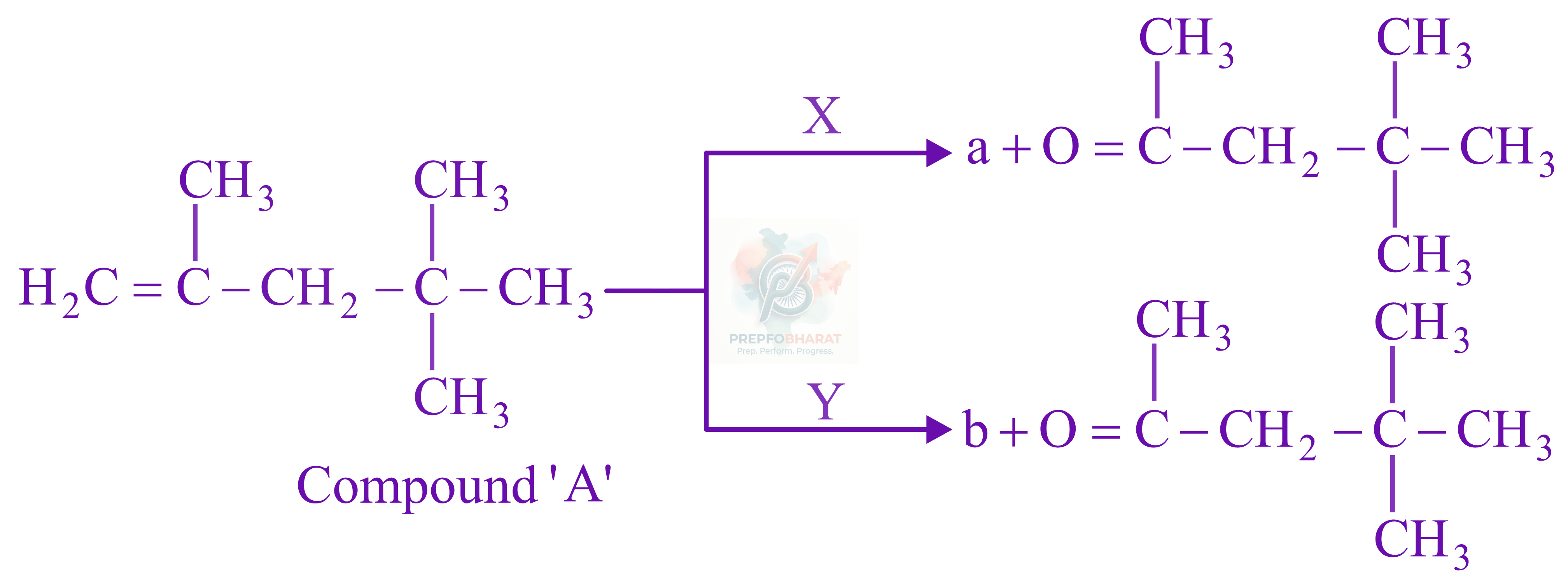 '$X$' and '$Y$' respectively are
Correct structure of $\gamma$-methylcyclohexane carbaldehyde is
Identify the major product $A$ and $B$ for the below given reaction sequence. 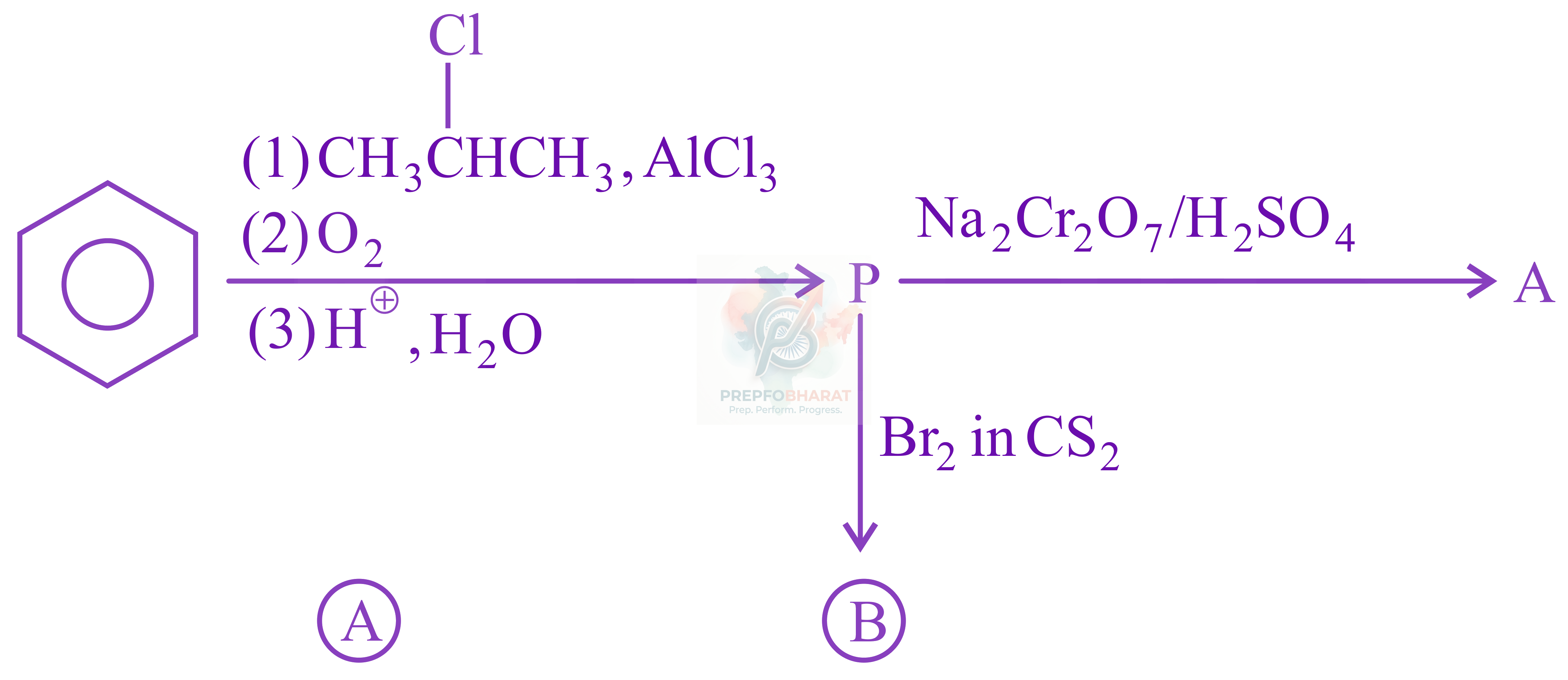
Two isomers $(A)$ and $(B)$ with Molar mass $184g/\mathrm{mol}$ and elemental compositio $C,52.2%;H,49%$ and $\mathrm{Br}42.9%$ gave benzoic acid and $p-$ bromobenzoic acid, respectively on oxidation with ${\mathrm{KMnO}}_{4}$. Isomer $'A'$ is optically active and gives a pale yellow precipitate when warmed with alcoholic ${\mathrm{AgNO}}_{3}$. Isomer $'A'$ and $'B'$ are, respectively :
A primary aliphatic amine on reaction with nitrous acid in cold $(273K)$ and there after raising temperature of reaction mixture to room temperature $(298K)$, gives a/an
A sugar '$X$' dehydrates very slowly under acidic condition to give furfural which on further reaction with resorcinol gives the coloured product after sometime. Sugar '$X$' is
Which of the following is most stable$?$
During halogen test, sodium fusion extract is boiled with concentrated ${\mathrm{HNO}}_{3}$ to
The number of stereoisomers formed in a reaction of $(\pm )\mathrm{PhC}(=O)C(\mathrm{OH})(\mathrm{CN})\mathrm{Ph}$ with $\mathrm{HCN}$ is
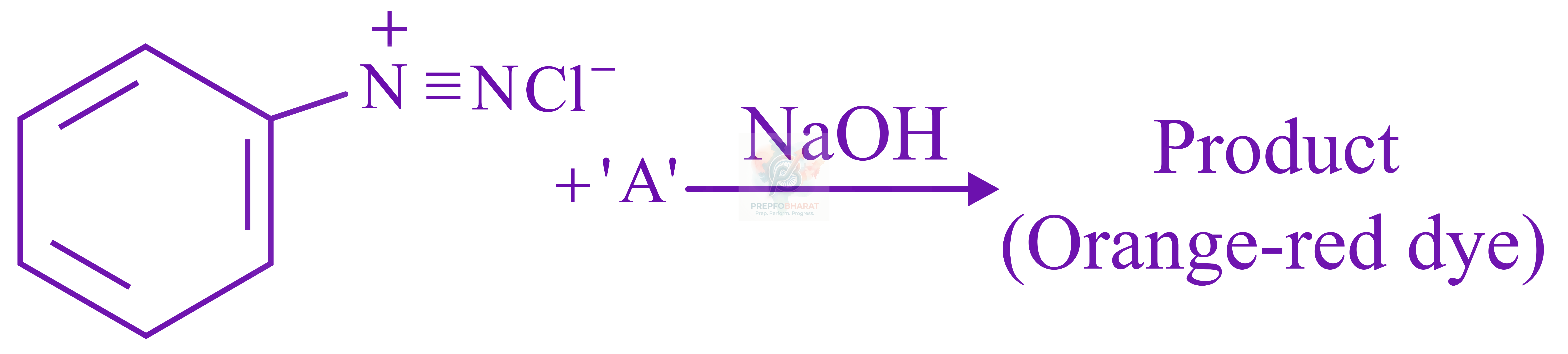 Which among the following represent reagent '$A$'?
The IUPAC name of ethylidene chloride is
Match List-I with List-II. <table class="pyq-table"><tbody><tr><td></td><td>List-I</td><td></td><td>List-II</td></tr><tr><td>A</td><td><img src="https://prepforbharat.s3.ap-south-1.amazonaws.com/exam/615f0e999476412f48314daf/Chemistry/images/Aldehydes_and_Ketones/648b5a6d417cc3fb48d67b3c/question_1__q_648b5a6d417cc3fb48d67b3c__cdn-question-pool.getmarks.app__58dba590-6e0a-401b-a2ba-377ad2198809-image__c897438e5a_final_ppt_sync.png" alt="JEE Main 2022 Chemistry, Aldehydes and Ketones — question figure 1"></td><td>I</td><td>Gatterman Koch reaction</td></tr><tr><td>B</td><td><img src="https://prepforbharat.s3.ap-south-1.amazonaws.com/exam/615f0e999476412f48314daf/Chemistry/images/Aldehydes_and_Ketones/648b5a6d417cc3fb48d67b3c/question_2__q_648b5a6d417cc3fb48d67b3c__cdn-question-pool.getmarks.app__d827c610-4cfe-438e-93c3-55600d7cd3bd-image__60dfe97188_final_ppt_sync.png" alt="JEE Main 2022 Chemistry, Aldehydes and Ketones — question figure 2"></td><td>II</td><td>Etard reaction</td></tr><tr><td>C</td><td><img src="https://prepforbharat.s3.ap-south-1.amazonaws.com/exam/615f0e999476412f48314daf/Chemistry/images/Aldehydes_and_Ketones/648b5a6d417cc3fb48d67b3c/question_3__q_648b5a6d417cc3fb48d67b3c__cdn-question-pool.getmarks.app__ebef09e3-2eb9-48a5-abc0-947f0e8dc5d3-image__8a4974de40_final_ppt_sync.png" alt="JEE Main 2022 Chemistry, Aldehydes and Ketones — question figure 3"></td><td>III</td><td>Stephen reaction</td></tr><tr><td>D</td><td><img src="https://prepforbharat.s3.ap-south-1.amazonaws.com/exam/615f0e999476412f48314daf/Chemistry/images/Aldehydes_and_Ketones/648b5a6d417cc3fb48d67b3c/question_4__q_648b5a6d417cc3fb48d67b3c__cdn-question-pool.getmarks.app__a6792151-d306-4d05-bb10-008c367b8676-image__acfbffbf7b_final_ppt_sync.png" alt="JEE Main 2022 Chemistry, Aldehydes and Ketones — question figure 4"></td><td>IV</td><td>Rosenmund reaction</td></tr></tbody></table>Choose the correct answer from the options given below
Halogenation of which one of the following will yield m-substituted product with respect to methyl group as a major product?
The correct decreasing order of priority of functional groups in naming an organic compound as per IUPAC system of nomenclature is
The correct stability order of the following diazonium salt is 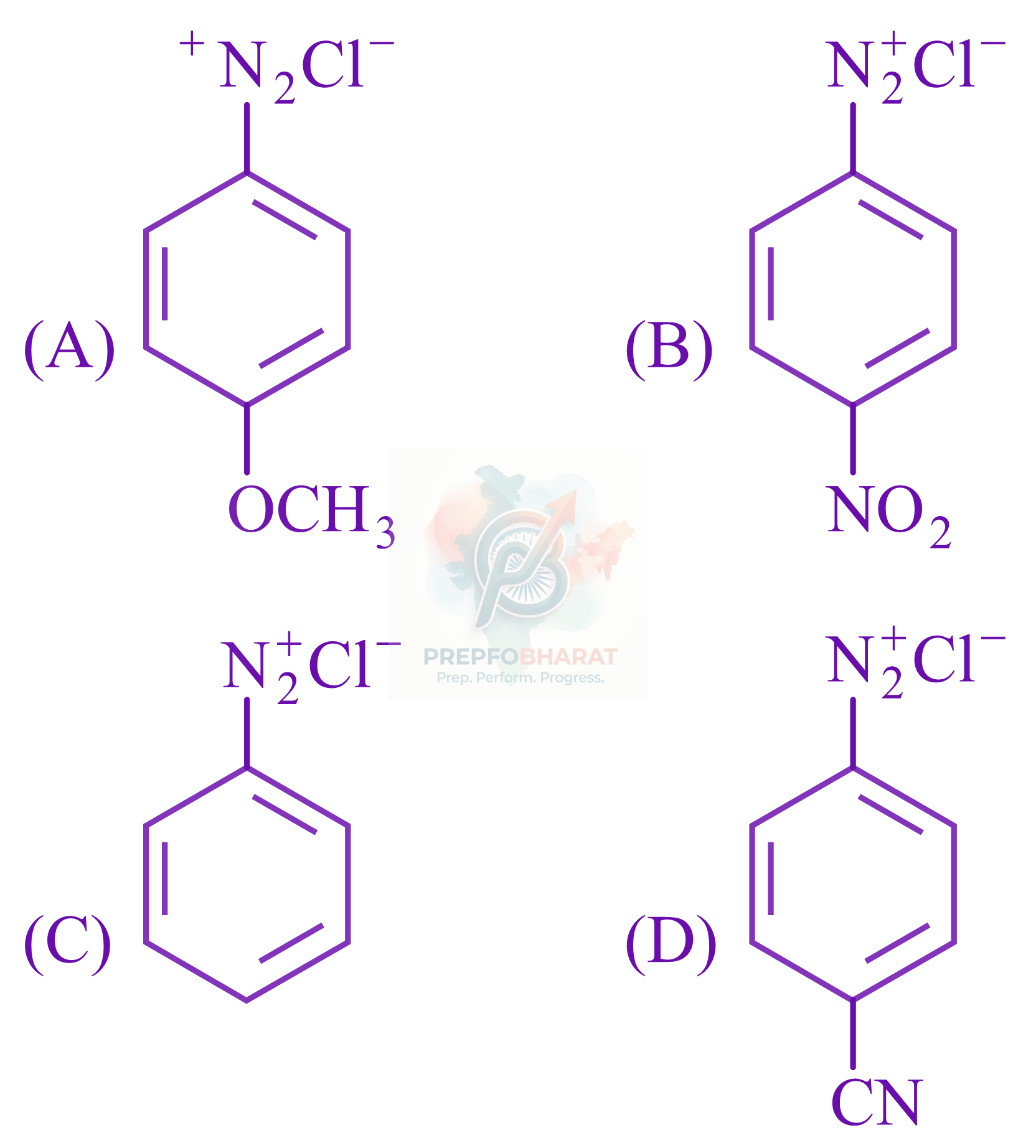
$0.2g$ of an organic compound was subjected to estimation of nitrogen by Dumas method in which volume of ${N}_{2}$ evolved (at STP) was found to be $22.400\mathrm{mL}$. The percentage of nitrogen in the compound is - [nearest integer] (Given: Molar mass of ${N}_{2}$ is $28g{\mathrm{mol}}^{-1}$, Molar volume of ${N}_{2}$ at $\mathrm{STP}:22.4L$)