Organic Chemistry PYQ — Page 36
JEE Main Chemistry — Organic Chemistry previous year questions with solutions.
All Organic Chemistry Questions (1783)
Match List-I with List-II <table class="pyq-table"><tbody><tr><td></td><td>List-I (Mixture)</td><td></td><td>List-II (Purification Process)</td></tr><tr><td>A</td><td>Chloroform & Aniline</td><td>I</td><td>Steam distillation</td></tr><tr><td>B</td><td>Benzoic acid & Napthalene</td><td>II</td><td>Sublimation</td></tr><tr><td>C</td><td>Water & Aniline</td><td>III</td><td>Distillation</td></tr><tr><td>D</td><td>Napthalene & Sodium chloride</td><td>IV</td><td>Crystallisation</td></tr></tbody></table>
Match List-I with List-II <table class="pyq-table"><tbody><tr><td></td><td>List-I</td><td></td><td>List-II</td></tr><tr><td>A</td><td>Benzenesulphonyl chloride</td><td>I</td><td>Test for primary amines</td></tr><tr><td>B</td><td>Hoffmann bromamide reaction</td><td>II</td><td>Anti Saytzeff</td></tr><tr><td>C</td><td>Carbylamine reaction</td><td>III</td><td>Hinsberg reagent</td></tr><tr><td>D</td><td>Hoffmann orientation</td><td>IV</td><td>Known reaction of Isocyanates.</td></tr></tbody></table>Choose the correct answer from the options given below
Given below are two statements : Statement I : On heating with ${\mathrm{KHSO}}_{4}$, glycerol is dehydrated and acrolein is formed. Statement II : Acrolein has fruity odour and can be used to test glycerol's presence. Choose the correct option.
An organic compound '$A$' on reaction with ${\mathrm{NH}}_{3}$ followed by heating gives compound $B$. Which on further strong heating gives compound $C$ $({C}_{8}{H}_{5}{\mathrm{NO}}_{2})$. Compound $C$ on sequential reaction with ethanolic $\mathrm{KOH}$, alkyl chloride and hydrolysis with alkali gives a primary amine. The compound $A$ is
Arrange the following carbocations in decreasing order of stability. 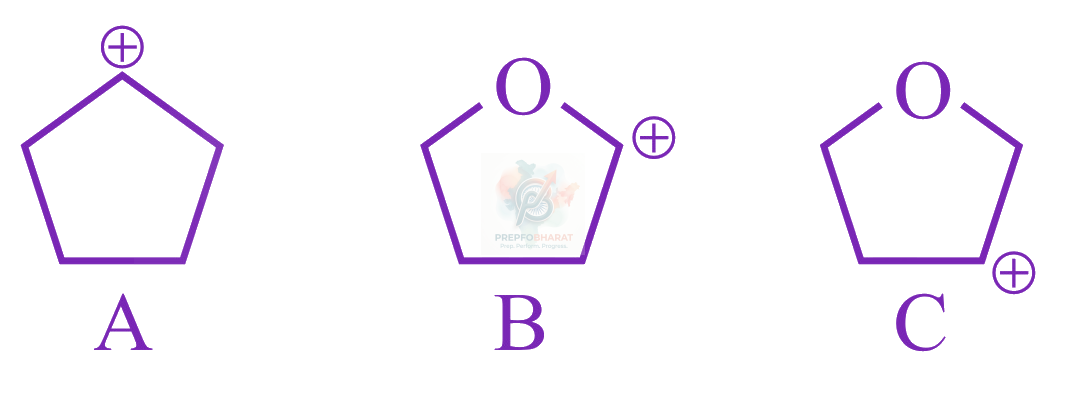
Hex-$4$-ene-$2$-ol on treatment with $\mathrm{PCC}$ gives '$A$'. '$A$' on reaction with sodium hypoiodite gives '$B$', which on further heating with soda lime gives '$C$'. The compound '$C$' is
The final product '$A$' in the following reaction sequence 
The formula of the purple colour formed in Laissaigne's test for sulphur using sodium nitroprusside is
In the given reaction 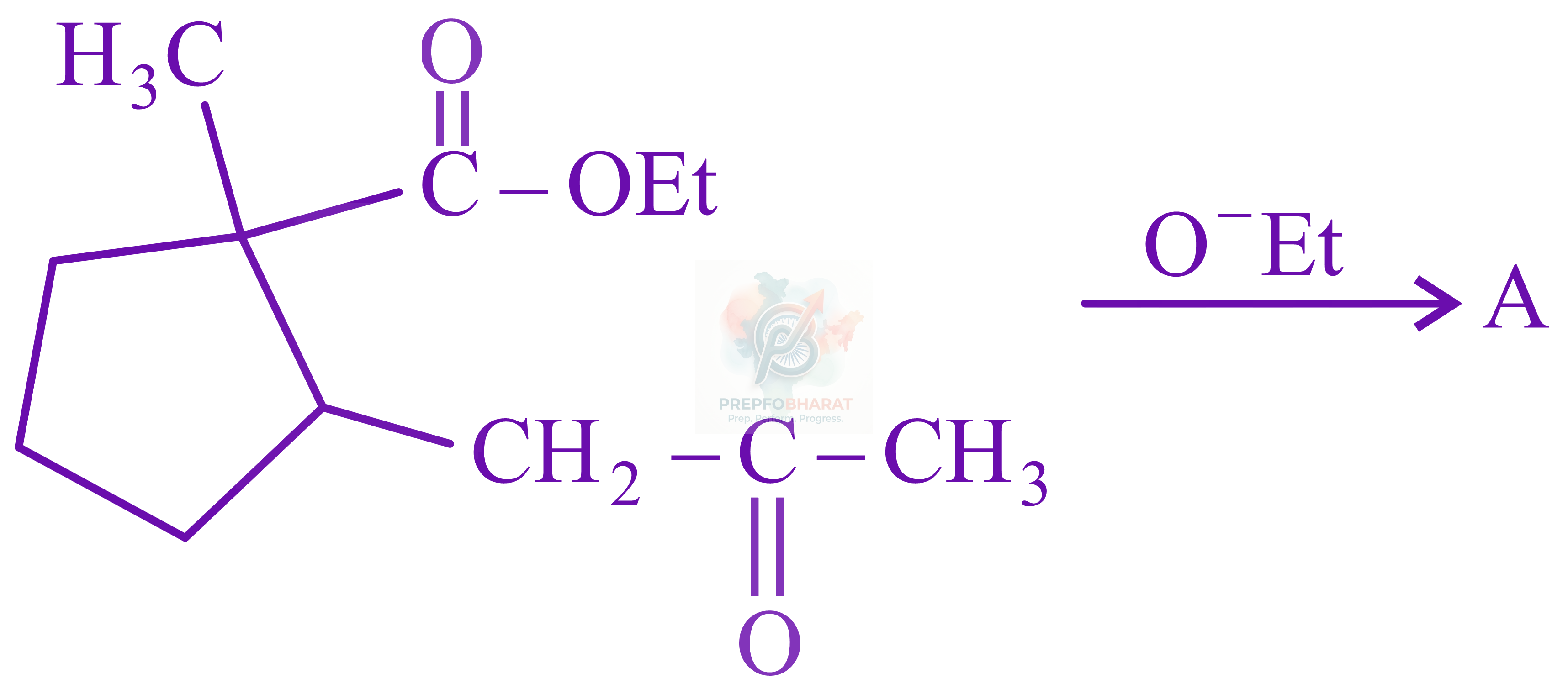 (Where Et is $-{C}_{2}{H}_{5}$) The number of chiral carbon/s in product $A$ is
Given below are two statements: one is labelled as Assertion and the other is labelled as Reason. Assertion: A mixture contains benzoic acid and napthalene. The pure benzoic acid can be separated out by the use of benzene. Reason: Benzoic acid is soluble in hot water. In the light of the above statements, choose the most appropriate answer from the options given below.
Given below are two statements: One is labelled as Assertion $A$ and the other is labelled as Reason $R$ Assertion $A$ : Thin layer chromatography is an adsorption chromatography. Reason $R$ : A thin layer of silica gel is spread over a glass plate of suitable size in thin layer chromatography which acts as an adsorbent. In the light of the above statements, choose the correct answer from the options given below
Total number of isomers (including stereoisomers) obtain on monochlorination of methylcyclohexane is
Which one of the following compounds is inactive towards ${S}_{N}1$ reaction?
Consider the following reaction, $A\rightarrow _{\begin{matrix}2.{\mathrm{CN}}^{-} \\ 3.{H}_{2}O/{H}^{+}/\Delta \end{matrix}}^{1.{\mathrm{Cl}}_{2}/\mathrm{hv}}4-\mathrm{bromophenylacetic}\mathrm{acid}$ What is $A$ in the above reaction?
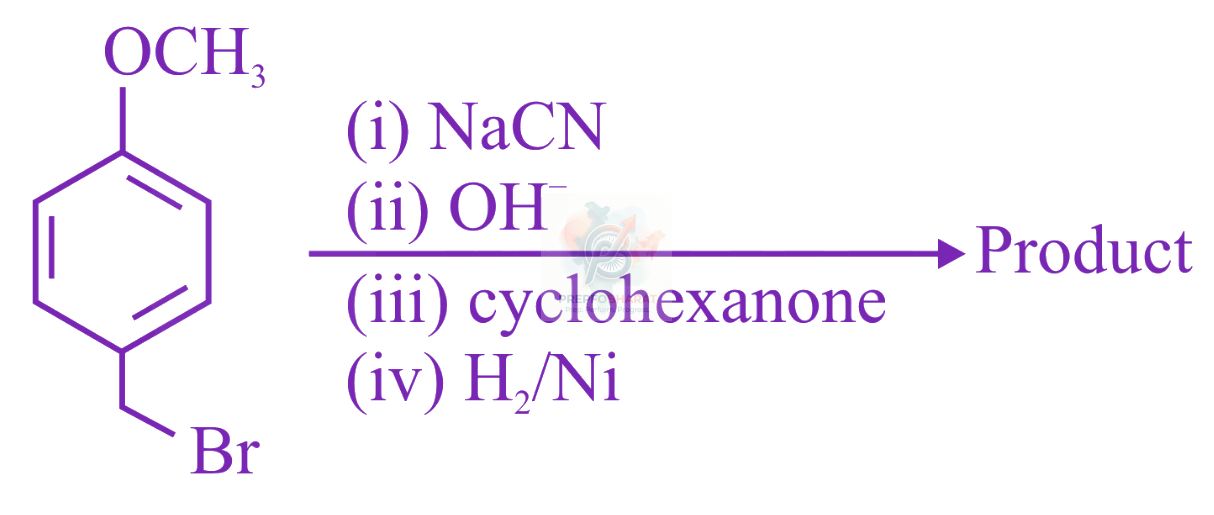 The major product of the above reactions is
The formulas of $A$ and $B$ for the following reaction sequence are 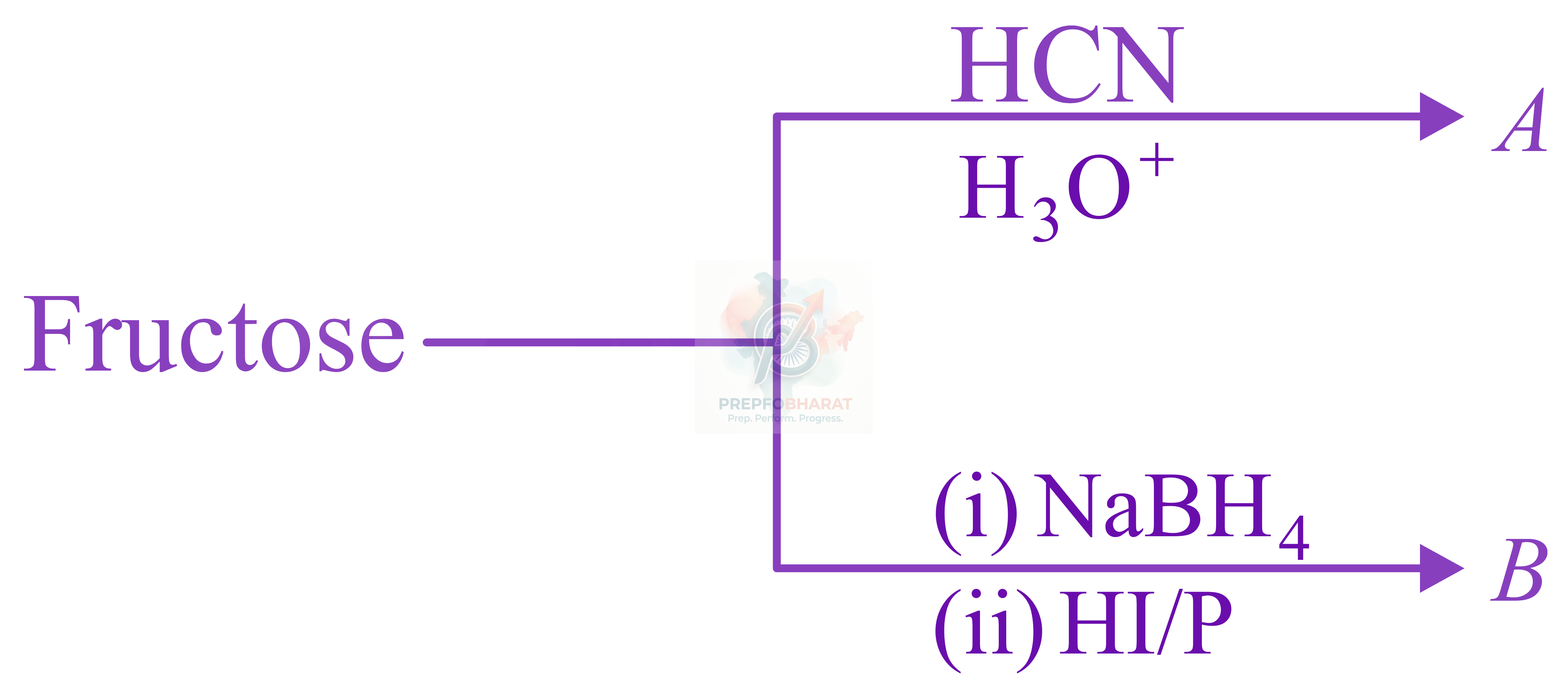
When enthanol is heated with conc. ${H}_{2}{\mathrm{SO}}_{4}$, a gas is produced. The compound formed, when this gas is treated with cold dilute aqueous solution of Baeyer's reagent, is
The difference in the reaction of phenol with bromine in chloroform and bromine in water medium is due to
Major product '$B$' of the following reaction sequence is 
Given below are two statements. Statement I : Phenols are weakly acidic. Statement II : Therefore they are freely soluble in $\mathrm{NaOH}$ solution and are weaker acids than alcohols and water. Choose the most appropriate option
The major product of the following reaction contains____bromine atom(s). 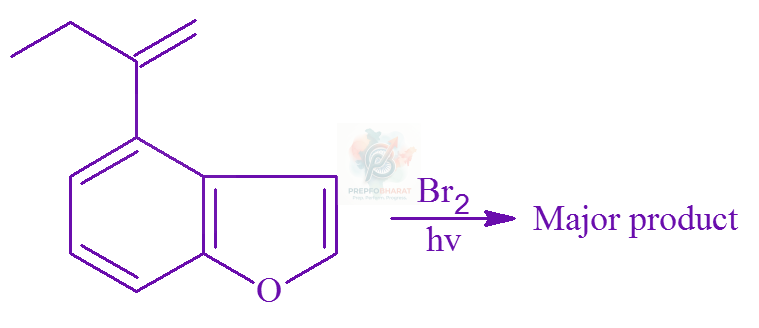
Match List-I with List-II <table class="pyq-table"><tbody><tr><td></td><td>List-I</td><td></td><td>List-II</td></tr><tr><td>A</td><td><img src="https://prepforbharat.s3.ap-south-1.amazonaws.com/exam/615f0e999476412f48314daf/Chemistry/images/Alcohols_Phenols_and_Ethers/648b5a6d417cc3fb48d67bf1/question_1__q_648b5a6d417cc3fb48d67bf1__cdn-question-pool.getmarks.app__116acc6d-c3ed-4635-81e0-bc1365245017-image__ad1e04b958_final_ppt_sync.png" alt="JEE Main 2022 Chemistry, Alcohols Phenols and Ethers — question figure 1"></td><td>I</td><td>${\mathrm{Br}}_{2}$ in ${\mathrm{CS}}_{2}$</td></tr><tr><td>B</td><td><img src="https://prepforbharat.s3.ap-south-1.amazonaws.com/exam/615f0e999476412f48314daf/Chemistry/images/Alcohols_Phenols_and_Ethers/648b5a6d417cc3fb48d67bf1/question_2__q_648b5a6d417cc3fb48d67bf1__cdn-question-pool.getmarks.app__d1bec61a-e4d5-4e89-ae36-7353eb7b5802-image__dea3866f00_final_ppt_sync.png" alt="JEE Main 2022 Chemistry, Alcohols Phenols and Ethers — question figure 2"></td><td>II</td><td>${\mathrm{Na}}_{2}{\mathrm{Cr}}_{2}{O}_{7}/{H}_{2}{\mathrm{SO}}_{4}$</td></tr><tr><td>C</td><td><img src="https://prepforbharat.s3.ap-south-1.amazonaws.com/exam/615f0e999476412f48314daf/Chemistry/images/Alcohols_Phenols_and_Ethers/648b5a6d417cc3fb48d67bf1/question_3__q_648b5a6d417cc3fb48d67bf1__cdn-question-pool.getmarks.app__871dc4ce-2b3f-4687-ac4a-b9b19a44f42e-image__e5c4dec309_final_ppt_sync.png" alt="JEE Main 2022 Chemistry, Alcohols Phenols and Ethers — question figure 3"></td><td>III</td><td>$\mathrm{Zn}$</td></tr><tr><td>D</td><td><img src="https://prepforbharat.s3.ap-south-1.amazonaws.com/exam/615f0e999476412f48314daf/Chemistry/images/Alcohols_Phenols_and_Ethers/648b5a6d417cc3fb48d67bf1/question_4__q_648b5a6d417cc3fb48d67bf1__cdn-question-pool.getmarks.app__04f8eef3-8007-44a7-99e0-9dc0be87e087-image__57c05f0286_final_ppt_sync.png" alt="JEE Main 2022 Chemistry, Alcohols Phenols and Ethers — question figure 4"></td><td>IV</td><td>${\mathrm{CHCl}}_{3}/\mathrm{NaOH}$</td></tr></tbody></table>Question: Choose the correct answer from the options given below
The major product formed in the following reaction, is 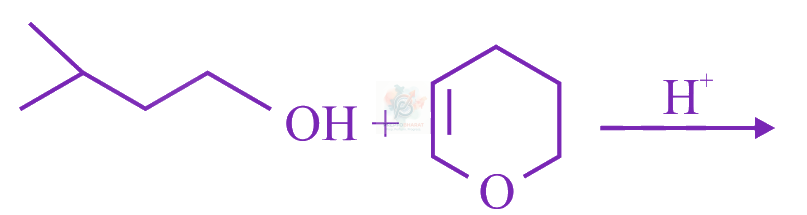
 Consider the above reaction sequence and identify the product $B$.