Organic Chemistry PYQ — Page 32
JEE Main Chemistry — Organic Chemistry previous year questions with solutions.
All Organic Chemistry Questions (1783)
Match List I and List II <table class="pyq-table"><tbody><tr><td>List I</td><td>List II</td></tr><tr><td>Test</td><td>Functional group / Class of Compound</td></tr><tr><td>(A) Molisch's Test</td><td>(I)Peptide</td></tr><tr><td>(B) Biuret Test</td><td>(II)Carbohydrate</td></tr><tr><td>(C) Carbylamine Test</td><td>(III) Primary amine</td></tr><tr><td>(D) Schiff's Test</td><td>(IV) Aldehyde</td></tr></tbody></table>Choose the correct answer from the options given below:
All structures given below are of vitamin $C$. Most stable of them is:
The one that does not stabilize ${2}^{\circ }$ and ${3}^{\circ }$ structures of proteins is
 'X'
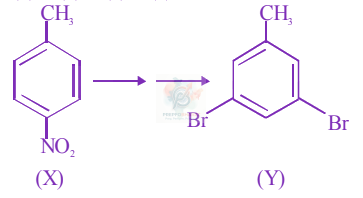 In the above conversion of compound ($X$) to product ($Y$), the sequence of reagents to be used will be:
The major products ‘$A$’ and ‘$B$’, respectively, are 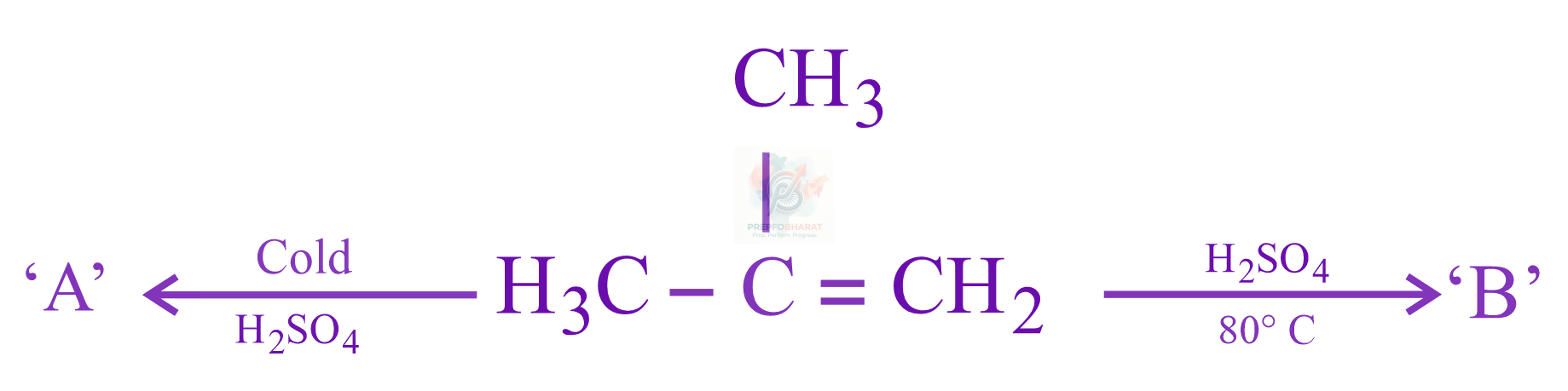
Given below are two statements : Statement I : Tropolone is an aromatic compound and has $8\pi$ electrons. Statement II : $\pi$ electrons of $>C=O$ group in tropolone is involved in aromaticity. In the light of the above statements choose the correct answer from the options given below:
Compound from the following that will not produce precipitate on reaction with ${\mathrm{AgNO}}_{3}$ is
'$A$' and '$B$' respectively are A. $\rightarrow _{(2)\mathrm{Zn}-{H}_{2}O}^{(1){O}_{3}}$ Ethane-$1,2$-dicarbaldehyde $+$Glyoxal/Oxaldehyde B $\rightarrow _{(2)\mathrm{Zn}-{H}_{2}O}^{(1){O}_{3}}5-$ -oxohexanal
Given below are two statements: one is labelled as Assertion $(A)$ and the other is labelled as Reason $(R)$. Assertion $(A)$ : Experimental reaction of ${\mathrm{CH}}_{3}\mathrm{Cl}$ with aniline and anhydrous ${\mathrm{AlCl}}_{3}$ does not give $o$ and $p$-methylaniline. Reason $(R)$ : The $-{\mathrm{NH}}_{2}$ group of aniline becomes deactivating because of salt formation with anhydrous ${\mathrm{AlCl}}_{3}$ and hence yields $m$-methyl aniline as the product. In the light of the above statements, choose the most appropriate answer from the options given below
In the given reaction 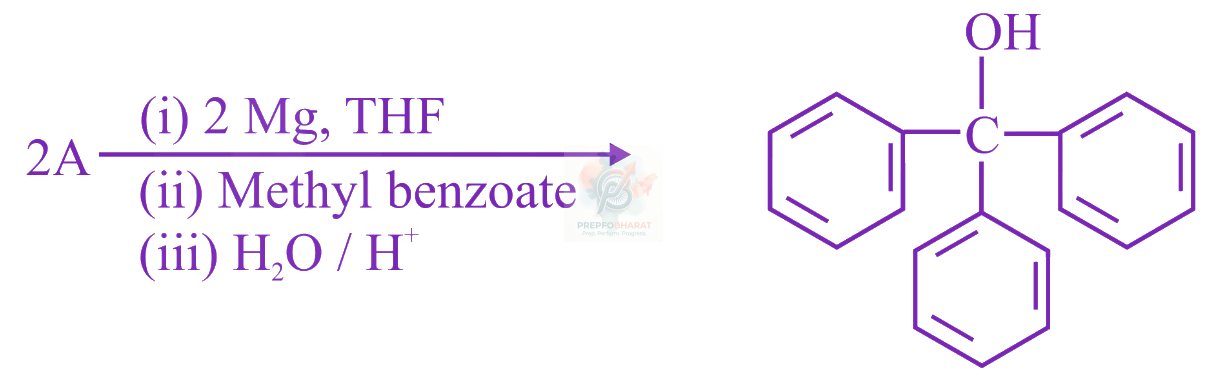 '$A$' can be
Match List-I with List-II <table class="pyq-table"><tbody><tr><td></td><td>List-I</td><td></td><td>List-II</td></tr><tr><td>A</td><td>Glucose $+\mathrm{HI}$</td><td>I</td><td>Gluconic acid</td></tr><tr><td>B</td><td>Glucose $+{\mathrm{Br}}_{2}$ water</td><td>II</td><td>Glucose pentacetate</td></tr><tr><td>C</td><td>Glucose $+$ acetic anhydride</td><td>III</td><td>Saccharic acid</td></tr><tr><td>D</td><td>Glucose $+{\mathrm{HNO}}_{3}$</td><td>IV</td><td>Hexane</td></tr></tbody></table>Choose the correct answer from the options given below
Glycosidic linkage between ${C}_{1}$ of $\alpha$-glucose and ${C}_{2}$ of $\beta$-fructose is found in
Compound $I$ is heated with Conc. $\mathrm{HI}$ to give a hydroxy compound A which is further heated with $\mathrm{Zn}$ dust to give compound $B$. Identify $A$ and $B$. 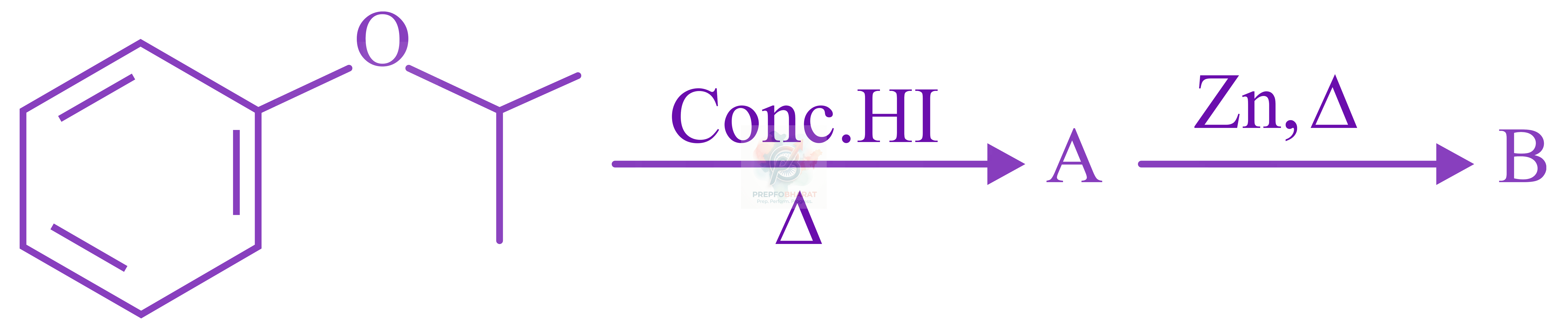
Which of the following reactions will yield benzaldehyde as a product? 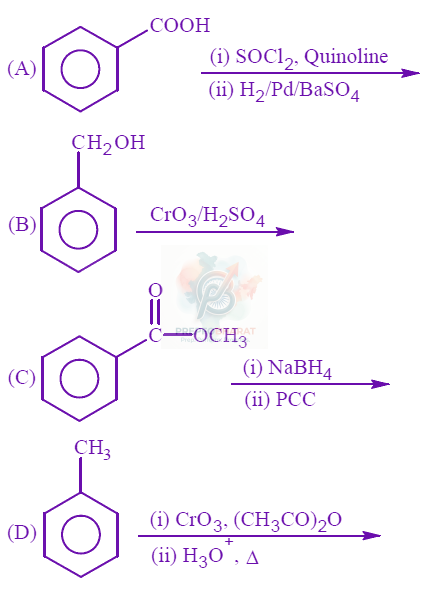
The major product of the following reaction is 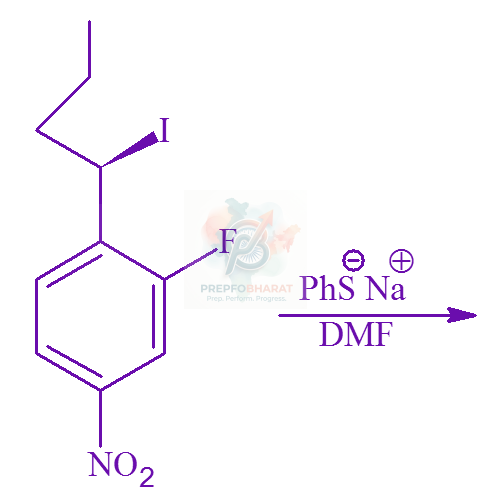
The major product in the given reaction is 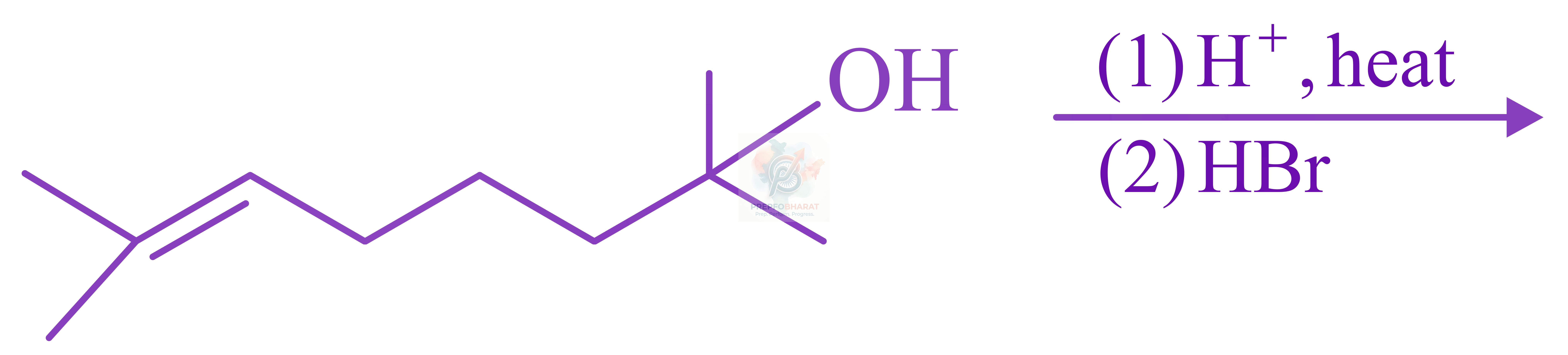
Match List-I with List-II. <table class="pyq-table"><tbody><tr><td></td><td>List-I</td><td></td><td>List-II</td></tr><tr><td>A</td><td><img src="https://prepforbharat.s3.ap-south-1.amazonaws.com/exam/615f0e999476412f48314daf/Chemistry/images/General_Organic_Chemistry/648b5a6d417cc3fb48d67c48/question_1__q_648b5a6d417cc3fb48d67c48__cdn-question-pool.getmarks.app__c428342f-79fb-4645-956e-913ec032a1a6-image__67208d0df2_final_ppt_sync.png" alt="JEE Main 2022 Chemistry, General Organic Chemistry — question figure 1"></td><td>I</td><td>Spiro compound</td></tr><tr><td>B</td><td><img src="https://prepforbharat.s3.ap-south-1.amazonaws.com/exam/615f0e999476412f48314daf/Chemistry/images/General_Organic_Chemistry/648b5a6d417cc3fb48d67c48/question_2__q_648b5a6d417cc3fb48d67c48__cdn-question-pool.getmarks.app__76cf310f-55b5-48ac-b14d-bb20f164b773-image__653fb76719_final_ppt_sync.png" alt="JEE Main 2022 Chemistry, General Organic Chemistry — question figure 2"></td><td>II</td><td>Aromatic compound</td></tr><tr><td>C</td><td><img src="https://prepforbharat.s3.ap-south-1.amazonaws.com/exam/615f0e999476412f48314daf/Chemistry/images/General_Organic_Chemistry/648b5a6d417cc3fb48d67c48/question_3__q_648b5a6d417cc3fb48d67c48__cdn-question-pool.getmarks.app__112a680f-8988-4665-87d4-e6f1290d384f-image__05c5654f8d_final_ppt_sync.png" alt="JEE Main 2022 Chemistry, General Organic Chemistry — question figure 3"></td><td>III</td><td>Non-planar Heterocyclic compound</td></tr><tr><td>D</td><td><img src="https://prepforbharat.s3.ap-south-1.amazonaws.com/exam/615f0e999476412f48314daf/Chemistry/images/General_Organic_Chemistry/648b5a6d417cc3fb48d67c48/question_4__q_648b5a6d417cc3fb48d67c48__cdn-question-pool.getmarks.app__71fed07a-666a-465e-b24e-c8411837ca36-image__15a2cf8b5b_final_ppt_sync.png" alt="JEE Main 2022 Chemistry, General Organic Chemistry — question figure 4"></td><td>IV</td><td>Bicyclo compound</td></tr></tbody></table>Choose the correct answer from the options given below
The reagent, from the following, which converts benzoic acid to benzaldehyde in one step is 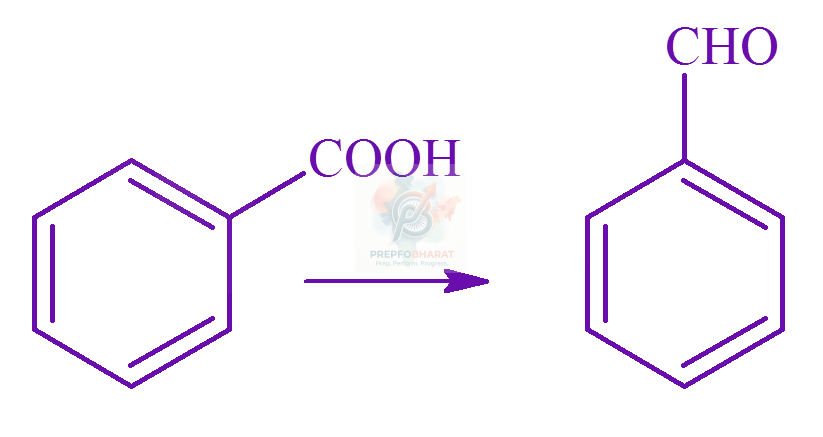
In the following reaction 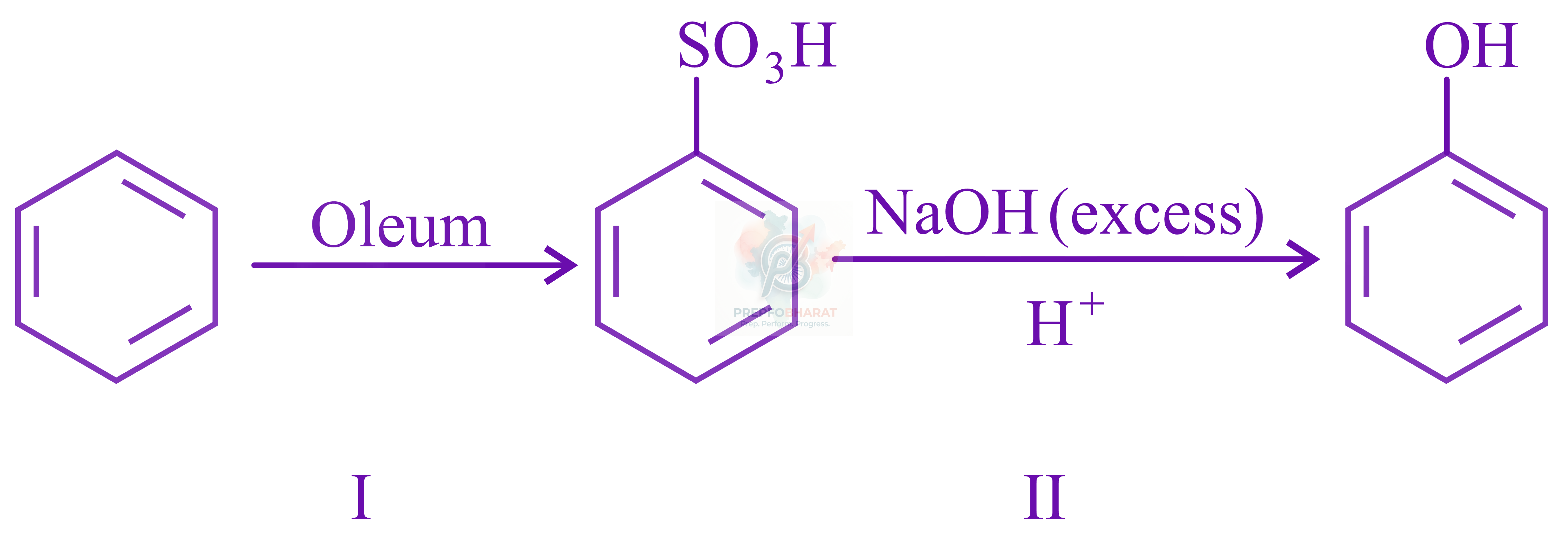 The $%$ yield for reaction $I$ is $60%$ and that of reaction II is $50%$. The overall yield of the complete reaction is$%$
Isobutyraldehyde on reaction with formaldehyde and ${K}_{2}{\mathrm{CO}}_{3}$ gives compound '$A$'. Compound '$A$' reacts with $\mathrm{KCN}$ and yields compound '$B$', which on hydrolysis gives a stable compound '$C$'. The compound '$C$' is
Which among the following pairs of the structures will give different products on ozonolysis? (Consider the double bonds in the structures are rigid and not delocalized.)
Product '$A$' of following sequence of reactions is 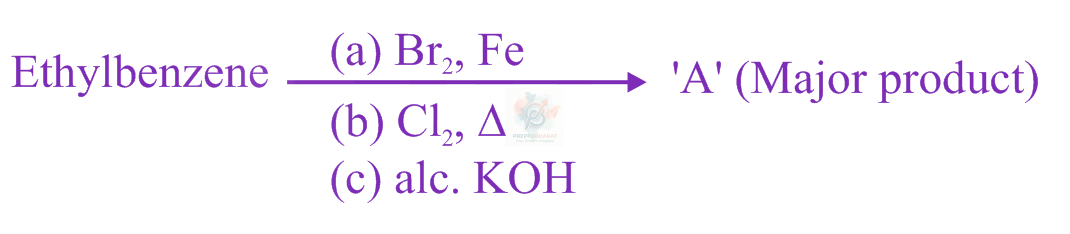
In a linear tetrapeptide (Constituted with different amino acids), (number of amino acids) - (number of peptide bonds) is