Inorganic Chemistry PYQ — Page 43
JEE Main Chemistry — Inorganic Chemistry previous year questions with solutions.
All Inorganic Chemistry Questions (1476)
The reaction of $\mathrm{NO}$ with ${N}_{2}{O}_{4}$ at $250K$ gives :
The incorrect statement is:
${[Pd(F)(Cl)(Br)(I)]}^{2-}$ has $n$ number of geometrical isomers. Then, the spin-only magnetic moment and crystal field stabilization energy $[CFSE]$ of ${[Fe{(CN)}_{6}]}^{n-6}$ , respectively, are: [Note: Ignore the pairing energy]
The relative strength of the interionic/ intermolecular forces in a decreasing order is:
The species that has a spin-only magnetic moment of $5.9\mathrm{BM},$ is : (${T}_{d}=$tetrahedral)
The theory that can completely/properly explain the nature of bonding in $[\mathrm{Ni}{(\mathrm{CO})}_{4}]$ is:
The correct statement with respect to dinitrogen is:
The number of bonds between sulphur and oxygen atoms in ${S}_{2}{O}_{8}^{2-}$ and the number of bonds between sulphur and sulphur atoms in rhombic sulphur, respectively are:
The pair in which both the species have the same magnetic moment (spin only) is:
On heating compound $(A)$ gives a gas $(B)$ which is constituent of air. This gas when treated with ${H}_{2}$ in the presence of a catalyst gives another gas $(C)$ which is basic in nature. $(A)$ should not be :
A metal $(A)$ on heating in nitrogen gas gives compound $B.$ $B$ on treatment with ${H}_{2}O$ gives a colourless gas which when passed through $CuS{O}_{4}$ solution gives a dark blue-violet coloured solution. $A$ and $B$ respectively, are:
In general, the property (magnitudes only) that shows an opposite trend in comparison to other properties across a period is :
The complex that can show $fac$ - and $mer$ -isomers is:
Simplified absorption spectra of three complexes ((i) and (ii) and (iii)) of ${M}^{+n}$ ion are provided below; their ${\lambda }_{\mathrm{max}}$ values are marked as $A,B$ and $C$ respectively. The correct match between the complexes and their ${\lambda }_{\mathrm{max}}$ values is: 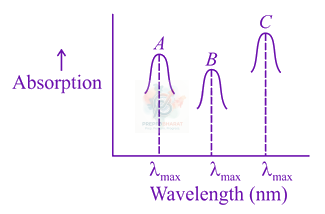 (i) ${[M(\mathrm{NCS}{)}_{6}]}^{(-6+n)}$ (ii) ${[{\mathrm{MF}}_{6}]}^{(-6+n)}$ (iii) ${[M{({\mathrm{NH}}_{3})}_{6}]}^{n+}$
The isomer(s) of $[Co{(N{H}_{3})}_{4}C{l}_{2}]$ that has/ have a $Cl-Co-Cl$ angle of ${90}^{o},$ is/are:
The five successive ionization enthalpies of an element are $800,2427,3658,3502432824\mathrm{kJ}{\mathrm{mol}}^{–1}$ . The number of valence electrons in the element is:
The reaction in which the hybridisation of the underlined atom is affected is
The sum of the total number of bonds between chromium and oxygen atoms in chromate and dichromate ions is ______________.
Within each pair of elements $F$ and $Cl$ , $S$ and $Se$ , and $\text{Li}$and $\mathrm{Na}$ , respectively, the elements that release more energy upon an electron gain are
The atomic radius of $Ag$ is closest to
The atomic number of Unnilumium is ______.
For a ${d}^{4}$ metal ion in an octahedral field, the correct electronic configuration is :
The Crystal Field Stabilization Energy $(\mathrm{CFSE})$ of $[\mathrm{CoF}({H}_{2}O)33]({\Delta }_{0}<P)$ is :
$B$ has a smaller first ionization enthalpy than $Be$. Consider the following statement: (I) it is easier to remove $2p$ electron than$2s$ electron (II) $2p$ electron of $B$ is more shielded from the nucleus by the inner core of electrons than the $2s$ electrons of $Be$ (III) $2s$ electron has more penetration power than $2p$ electron (IV) atomic radius of $B$ is more than $Be$ (atomic number $B:5,Be=4$ ) The correct statements are.