Inorganic Chemistry PYQ — Page 38
JEE Main Chemistry — Inorganic Chemistry previous year questions with solutions.
All Inorganic Chemistry Questions (1476)
Match List - I with List - II: <table class="pyq-table"><tbody><tr><td colspan="2" rowspan="1">List-I (Species)</td><td colspan="2" rowspan="1">List-II (Number of lone pairs of electrons on the central atom)</td></tr><tr><td>(a)</td><td>${\mathrm{XeF}}_{2}$</td><td>(i)</td><td>$0$</td></tr><tr><td>(b)</td><td>${\mathrm{XeO}}_{2}{F}_{2}$</td><td>(ii)</td><td>$1$</td></tr><tr><td>(c)</td><td>${\mathrm{XeO}}_{3}{F}_{2}$</td><td>(iii)</td><td>$2$</td></tr><tr><td>(d)</td><td>${\mathrm{XeF}}_{4}$</td><td>(iv)</td><td>$3$</td></tr></tbody></table>Choose the most appropriate answer from the options given below:
In the given chemical reaction, colors of the${\mathrm{Fe}}^{2+}$ and ${\mathrm{Fe}}^{3+}$ ions, are respectively : $5{\mathrm{Fe}}^{2+}+{\mathrm{MnO}}_{4}^{-}+8{H}^{+}\rightarrow {\mathrm{Mn}}^{2+}+4{H}_{2}O+5{\mathrm{Fe}}^{3+}$
In gaseous triethyl amine the $"-C-N-C-"$ bond angle is $____$degree.
The number of non-ionisable hydrogen atoms present in the final product obtained from the hydrolysis of ${\mathrm{PCl}}_{5}$ is :
A central atom in a molecule has two lone pairs of electrons and forms three single bonds. The shape of this molecule is
Given below are the statements about diborane (a) Diborane is prepared by the oxidation of ${\mathrm{NaBH}}_{4}$ with ${I}_{2}$ (b) Each boron atom is in ${\mathrm{sp}}^{2}$ hybridized state (c) Diborane has one bridged $3$ centre-$2$-electron bond (d) Diborane is a planar molecule The option with correct statement(s) is
Which one of the following lanthanoids does not form ${\mathrm{MO}}_{2}$? [$M$ is lanthanoid metal]
The ionic radius of ${\mathrm{Na}}^{+}$ ions is $1.02\overset{^{\circ}}{A}.$ The ionic radii (in $\overset{^{\circ}}{A}$) of ${\mathrm{Mg}}^{2+}$ and ${\mathrm{Al}}^{3+},$ respectively, are
The ionic radii of ${K}^{+},{\mathrm{Na}}^{+},{\mathrm{Al}}^{3+}$ and ${\mathrm{Mg}}^{2+}$ are in the order :
The correct set from the following in which both pairs are in correct order of melting point is:
Given below are two statements: Statement I: Potassium permanganate on heating at $573K$ forms potassium manganate. Statement II: Both potassium permanganate and potassium manganate are tetrahedral and paramagnetic in nature. In the light of the above statements, choose the most appropriate answer from the options given below:
On treating a compound with warm dil. ${H}_{2}{\mathrm{SO}}_{4}$, gas $X$ is evolved which turns ${K}_{2}{\mathrm{Cr}}_{2}{O}_{7}$ paper acidified with dil. ${H}_{2}{\mathrm{SO}}_{4}$ to a green compound $Y$. $X$ and $Y$ respectively are :
The product obtained from the electrolytic oxidation of acidified sulphate solutions, is :
The first ionization energy of magnesium is smaller, as compared to that of elements $X$ and $Y$, but higher than that of $Z$. The elements $X,Y$ and $Z$, respectively, are :
The total number of unpaired electrons present in the complex ${K}_{3}[\mathrm{Cr}(\text{oxalate}{)}_{3}]$ is______.
The major components of German Silver are :
The ionic radii of ${F}^{-}$ and ${O}^{2-}$ respectively are $1.33$ $A$ and $1.4A$, while the covalent radius of $N$ is $0.74A$ The correct statement for the ionic radius of ${N}^{3-}$ from the following is :
On complete reaction of ${\mathrm{FeCl}}_{3}$ with oxalic acid in aqueous solution containing $\mathrm{KOH}$, resulted in the formation of product $A$. The secondary valency of Fe in the product A is ______ . (Round off to the Nearest Integer).
The ${\mathrm{Eu}}^{2+}$ ion is a strong reducing agent in spite of its ground state electronic configuration (outermost) : [Atomic number of $\mathrm{Eu}=63$ ]
The number of lone pairs of electrons on the central $I$ atom in ${I}_{3}^{-}$ is 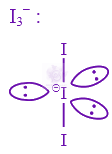
The number of halogen/(s) forming halic $(V)$ acid is __________ .
The correct order of following $3d$ metal oxides, according to their oxidation numbers is : (a) ${\mathrm{CrO}}_{3}$ (b) ${\mathrm{Fe}}_{2}{O}_{3}$ (c) ${\mathrm{MnO}}_{2}$ (d) ${V}_{2}{O}_{5}$ (e) ${\mathrm{Cu}}_{2}O$
Among the following allotropic forms of sulphur, the number of allotropic forms, which will show paramagnetism is _______. (A) $\alpha$-sulphur (B) $\beta$-sulphur (C) ${S}_{2}$-form
Which of the following has the highest lattice energy?