Inorganic Chemistry PYQ — Page 32
JEE Main Chemistry — Inorganic Chemistry previous year questions with solutions.
All Inorganic Chemistry Questions (1476)
What is the correct oder of electron gain enthalpy of $\mathrm{Cl},F,\mathrm{Te},\mathrm{Po}$
In following pairs, the one in which both transition metal ions are colourless is
In which of the following pairs, electron gain enthalpies of constituent elements are nearly the same or identical? (A) $\mathrm{Rb}$ and $\mathrm{Cs}$ (B) Na and $K$ (C) $\mathrm{Ar}$ and $\mathrm{Kr}$ (D) $I$ and $\mathrm{At}$ Choose the correct answer from the options given below
Among ${\mathrm{Co}}^{3+},{\mathrm{Ti}}^{2+},{V}^{2+}$ and ${\mathrm{Cr}}^{2+}$ ions, one if used as a reagent cannot liberate ${H}_{2}$ from dilute mineral acid solution, its spin-only magnetic moment in gaseous state is _____ B.M. (Nearest integer)
Based upon VSEPR theory, match the shape (geometry) of the molecules in List-I with the molecules in List - II and select the most appropriate option. <table class="pyq-table"><tbody><tr><td></td><td>List-I (Shape)</td><td></td><td>List-II (Molecules)</td></tr><tr><td>A</td><td>T-shaped</td><td>I.</td><td>${\mathrm{XeF}}_{4}$</td></tr><tr><td>B</td><td>Trigonal planar</td><td>II.</td><td>${\mathrm{SF}}_{4}$</td></tr><tr><td>C</td><td>Square planar</td><td>III.</td><td>${\mathrm{ClF}}_{3}$</td></tr><tr><td>D</td><td>See-saw</td><td>IV.</td><td>${\mathrm{BF}}_{3}$</td></tr></tbody></table>
Among the following, which is the strongest oxidizing agent?
How many of the following molecules are with non-zero net dipole moment, ${\mathrm{NH}}_{3},\mathrm{HCl},{H}_{2}O,{\mathrm{BeF}}_{2},{\mathrm{BH}}_{3},{\mathrm{CCl}}_{4}$
Which of the following is structure of a separating funnel?
Which of the following will have maximum stabilization due to crystal field?
Consider, ${\mathrm{PF}}_{5},{\mathrm{BrF}}_{5},{\mathrm{PCl}}_{3},{\mathrm{SF}}_{6},{[{\mathrm{ICl}}_{4}]}^{-},{\mathrm{ClF}}_{3}$ and ${\mathrm{IF}}_{5}$ Amongst the above molecule(s) ion(s), the number of molecule(s)/ion(s) having ${\mathrm{sp}}^{3}{d}^{2}$ hybridisation is
The '$f$' orbitals are half and completely filled, respectively in lanthanide ions [Given : Atomic no. $\mathrm{Eu},63:\mathrm{Sm},62:\mathrm{Tm},69;\mathrm{Tb},65;\mathrm{Yb},70;\mathrm{Dy},66$]
Consider the following reaction : $A+\mathrm{alkali}\rightarrow B(\mathrm{Major}Product)$ If $B$ is an oxoacid of phosphorus with no $P-H$ bond, then $A$ is
In the titration of ${\mathrm{KMnO}}_{4}$ and oxalic acid in acidic medium, the change in oxidation number of carbon at the end point is
Consider the species ${\mathrm{CH}}_{4},{\mathrm{NH}}_{4}^{+}$ and ${\mathrm{BH}}_{4}^{-}$. Choose the correct option with respect to the there species:
The products obtained from a reaction of hydrogen peroxide and acidified potassium permanganate are
A white precipitate was formed when ${\mathrm{BaCl}}_{2}$ was added to water extract of an inorganic salt. Further, a gas $'X'$ with characteristic odour was released when the formed white precipitate was dissolved in dilute HCI. The anion present in the inorganic salt is:
Sum of oxidation state (magnitude) and coordination number of cobalt in $\mathrm{Na}[\mathrm{Co}(\mathrm{bpy}){\mathrm{Cl}}_{4}]$ is 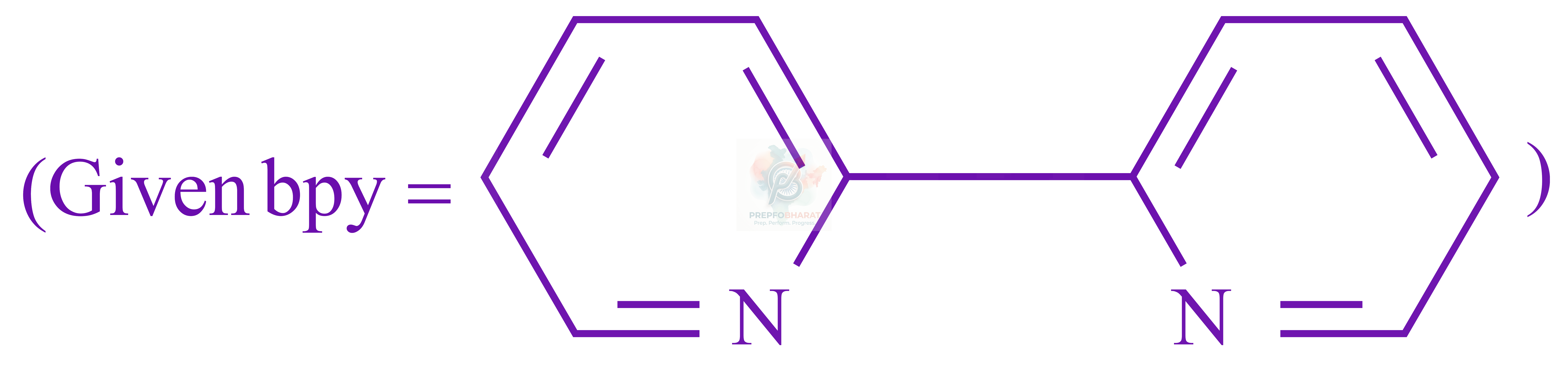
The oxide which contains an odd electron at the nitrogen atom is
Dinitrogen and dioxygen the main constituents of air do not react with each other in atmosphere to form oxides of nitrogen because
The conductivity of a solution of complex with formula ${\mathrm{CoCl}}_{3}{({\mathrm{NH}}_{3})}_{4}$ corresponds to $1:1$ electrolyte, then the primary valency of central metal ion is
Which oxoacid of phosphorous has the highest number of oxygen atoms present in its chemical formula?
Match List-I with List-II <table class="pyq-table"><tbody><tr><td></td><td>List-I</td><td></td><td>List-II</td></tr><tr><td>(A)</td><td>${\mathrm{Cl}}_{2}{O}_{7}$</td><td>(I)</td><td>Amphoteric</td></tr><tr><td>(B)</td><td>${\mathrm{Na}}_{2}O$</td><td>(II)</td><td>Basic</td></tr><tr><td>(C)</td><td>${\mathrm{Al}}_{2}{O}_{3}$</td><td>(III)</td><td>Neutral</td></tr><tr><td>(D)</td><td>${N}_{2}O$</td><td>(IV)</td><td>Acidic</td></tr></tbody></table>Choose the correct answer from the options given below
The correct order of bond orders of ${C}_{2}^{2-},{N}_{2}^{2-}$ and ${O}_{2}^{2-}$ is
The number of paramagnetic species among the following is ${B}_{2},{\mathrm{Li}}_{2},{C}_{2},{C}_{2}^{-},{O}_{2}^{2-},{O}_{2}^{+}$ and ${\mathrm{He}}_{2}^{+}$