Inorganic Chemistry PYQ — Page 23
JEE Main Chemistry — Inorganic Chemistry previous year questions with solutions.
All Inorganic Chemistry Questions (1476)
. Identify the correct order of standard enthalpy of formation of sodium halides.
Highest oxidation state of $\mathrm{Mn}$ is exhibited in ${\mathrm{Mn}}_{2}{O}_{7}$. The correct statements about ${\mathrm{Mn}}_{2}{O}_{7}$ are (A) $\mathrm{Mn}$ is tetrahedrally surrounded by oxygen atoms (B) $\mathrm{Mn}$ is octahedrally surrounded by oxygen atoms (C) Contains $\mathrm{Mn}-O-\mathrm{Mn}$ bridge (D) Contains $\mathrm{Mn}-\mathrm{Mn}$ bond. Choose the correct answer from the options given below
Cobalt chloride when dissolved in water forms pink colored complex $X$ which has octahedral geometry. This solution on treating with cone $\mathrm{HCl}$ forms deep blue complex, $Y$ which has a $Z$ geometry. $X,Y$ and $Z$, respectively, are
The difference between electron gain enthalpies will be maximum between :
Sum of $\pi$-bonds present in peroxodisulphuric acid and pyrosulphuric acid is
The set which does not have ambidentate ligand(s) is
The volume (in $\mathrm{mL}$) of $0.1M{\mathrm{AgNO}}_{3}$ required for complete precipitation of chloride ions present in $20\mathrm{mL}$ of $0.01M$ solution of $[\mathrm{Cr}{({H}_{2}O)}_{5}\mathrm{Cl}]{\mathrm{Cl}}_{2}$ as silver chloride is_______
Given below are two statements : one is labelled as Assertion (A) and the other is labelled as Reason (R). Assertion (A) : ${\mathrm{Cu}}^{2+}$ in water is more stable than ${\mathrm{Cu}}^{+}$. Reason (R) : Enthalpy of hydration for ${\mathrm{Cu}}^{2+}$ is much less than that of ${\mathrm{Cu}}^{+}$. In the light of the above statements, choose the correct answer from the options given below :
Given below are two statements, one is labelled as Assertion A and the other is labelled as Reason R Assertion A :- Carbon forms two important oxides $\mathrm{CO}$ and ${\mathrm{CO}}_{2}$. $\mathrm{CO}$ is neutral whereas ${\mathrm{CO}}_{2}$ is acidic in nature. Reason R : ${\mathrm{CO}}_{2}$ can combine with water in a limited way to form carbonic acid, while $\mathrm{CO}$ is sparingly soluble in water. In the light of the above statements, choose the most appropriate answer from the options given below :-
Bond dissociation energy of $E-H$ bond of the "${H}_{2}E$" hydrides of group $16$ elements (given below), follows order. (A) $O$ (B) $S$ (C) $\mathrm{Se}$ (D) $\mathrm{Te}$
Given below are two statements: one is labelled as Assertion A and the other is labelled as Reason R. Assertion A : The energy required to form ${\mathrm{Mg}}^{2+}$from $\mathrm{Mg}$ is much higher than that required to produce ${\mathrm{Mg}}^{+}$ Reason R:${\mathrm{Mg}}^{2+}$ is small ion and carry more charge than ${\mathrm{Mg}}^{+}$ In the light of the above statements, choose the correct answer from the options given below.
The bond order and magnetic property of acetylide ion are same as that of
For elements $B,C,N\mathrm{Li},\mathrm{Be},O\mathrm{and}F$, the correct order of first ionisation enthalpy is
Match List I with List II <table class="pyq-table"><tbody><tr><td></td><td>List I Complex</td><td></td><td>List II $CFSE$ $({\Delta }_{0})$</td></tr><tr><td>A.</td><td>${[Cu{(N{H}_{3})}_{6}]}^{2+}$</td><td>I.</td><td>$-0.6$</td></tr><tr><td>B.</td><td>${[Ti{({H}_{2}O)}_{6}]}^{3+}$</td><td>II.</td><td>$-2.0$</td></tr><tr><td>C.</td><td>${[Fe{(CN)}_{6}]}^{3-}$</td><td>III.</td><td>$-1.2$</td></tr><tr><td>D.</td><td>${[Ni{F}_{6}]}^{4-}$</td><td>IV.</td><td>$-0.4$</td></tr></tbody></table>Choose the correct answer from the options given below:
Match List I with List II<table class="pyq-table"><tbody><tr><td colspan="2" rowspan="1">LIST-I Complex</td><td colspan="2" rowspan="1">LIST-II Colour</td></tr><tr><td>A.</td><td>$\mathrm{Mg}({\mathrm{NH}}_{4}){\mathrm{PO}}_{4}$</td><td>I.</td><td>brown</td></tr><tr><td>B.</td><td>${K}_{3}[\mathrm{Co}{({\mathrm{NO}}_{2})}_{6}]$</td><td>II.</td><td>white</td></tr><tr><td>C.</td><td>$\mathrm{MnO}{(\mathrm{OH})}_{2}$</td><td>III.</td><td>yellow</td></tr><tr><td>D.</td><td>${\mathrm{Fe}}_{4}{[\mathrm{Fe}{(\mathrm{CN})}_{6}]}_{3}$</td><td>IV.</td><td>blue</td></tr></tbody></table>Choose the correct answer from the options given below:
The correct order of the number of unpaired electrons in the given complexes is (A) $[\mathrm{Fe}(\mathrm{CN}{)}_{6}{]}^{3-}$ (B) ${[{\mathrm{FeF}}_{6}]}^{3-}$ (C) ${[{\mathrm{CoF}}_{6}]}^{3-}$ (D) ${[\mathrm{Cr}(\mathrm{oxalate}{)}_{3}]}^{3-}$ (E) $[\mathrm{Ni}(\mathrm{CO}{)}_{4}]$ Choose the correct answer from the options given below:
Match List-I with List-II. 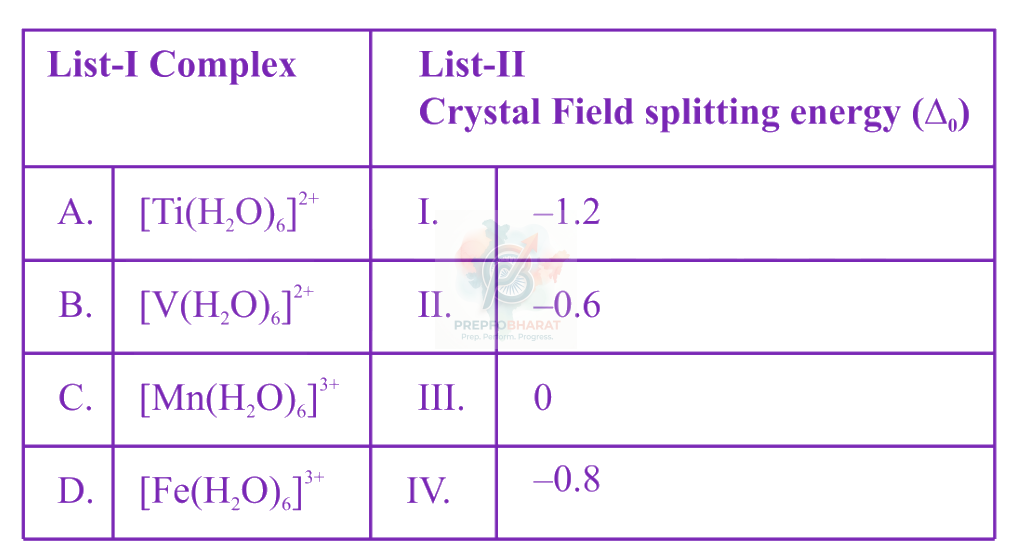 Choose the correct answer from the options given below:
Which of the following complex will show largest splitting of d-orbitals?
The d-electronic configuration of ${[{\mathrm{CoCl}}_{4}]}^{2-}$ in tetrahedral crystal field is ${e}^{m}{t}_{2}^{n}$. The sum of $m$ and number of unpaired electrons is
The primary and secondary valencies of cobalt respectively in $[\mathrm{Co}({\mathrm{NH}}_{3}{)}_{5}\mathrm{Cl}]{\mathrm{Cl}}_{2}$ are:
Identify $X,Y$ and $Z$ in the following reaction. (Equation not balanced) $\mathrm{Cl}\overset{\cdot }{O}+{\mathrm{NO}}_{2}\rightarrow \underset{¯}{X}\overset{{H}_{2}O}{\longrightarrow }\underset{¯}{Y}+\underset{¯}{Z}$
The denticity of the ligand present in the Fehling's reagent is _____ .
The observed magnetic moment of the complex $[\mathrm{Mn}(\mathrm{NCS}{)}_{6}){]}^{x-}$ is $6.06\mathrm{BM}$. The numerical value of $x$ is
Match List I with List II <table class="pyq-table"><tbody><tr><td colspan="2" rowspan="1">List I (molecules/ions)</td><td colspan="2" rowspan="1">List II (No. of lone pairs of ${e}^{-}$ on central atom)</td></tr><tr><td>(A)</td><td>${\mathrm{IF}}_{7}$</td><td>I.</td><td>Three</td></tr><tr><td>(B)</td><td>${\mathrm{ICl}}_{4}^{-}$</td><td>II.</td><td>One</td></tr><tr><td>(C)</td><td>${\mathrm{XeF}}_{6}$</td><td>III.</td><td>Two</td></tr><tr><td>(D)</td><td>${\mathrm{XeF}}_{2}$</td><td>IV.</td><td>Zero</td></tr></tbody></table>Choose the correct answer from the options given below: