Inorganic Chemistry PYQ — Page 20
JEE Main Chemistry — Inorganic Chemistry previous year questions with solutions.
All Inorganic Chemistry Questions (1476)
Sum of oxidation states of bromine in bromic acid and perbromic acid is
Given below are two statements: Statement I : Aqueous solution of ${K}_{2}{\mathrm{Cr}}_{2}{O}_{7}$ is preferred as a primary standard in volumetric analysis over ${\mathrm{Na}}_{2}{\mathrm{Cr}}_{2}{O}_{7}$ aqueous solution. Statement II : ${K}_{2}{\mathrm{Cr}}_{2}{O}_{7}$ has a higher solubility in water than ${\mathrm{Na}}_{2}{\mathrm{Cr}}_{2}{O}_{7}$. In the light of the above statements, choose the correct answer from the options given below:
Which of the following complexes will exhibit maximum attraction to an applied magnetic field?
Which of the following oxides is amphoteric?
The correct order of spin only magnetic moments for the following complex ions is
The magnetic moment is measured in Bohr Magneton (BM). Spin only magnetic moment of $\mathrm{Fe}$ in ${[\mathrm{Fe}{({H}_{2}O)}_{6}]}^{3+}$ and ${[\mathrm{Fe}{(\mathrm{CN})}_{6}]}^{3-}$ complexes respectively is:
The sum of oxidation state of the metals in $\mathrm{Fe}(\mathrm{CO}{)}_{5}$, ${\mathrm{VO}}^{2+}$ and ${\mathrm{WO}}_{3}$ is
An ammoniacal metal salt solution gives a brilliant red precipitate on addition of dimethylglyoxime. The metal ion is :
The incorrect statement from the following for borazine is:
Match the List-I with List-II : <table class="pyq-table"><tbody><tr><td>Cations</td><td>Group reaction</td></tr><tr><td>$P\rightarrow {\mathrm{Pb}}^{2+},{\mathrm{Cu}}^{2+}$</td><td>${H}_{2}S$ gas in presence of dilute $\mathrm{HCl}$</td></tr><tr><td>$Q\rightarrow {\mathrm{Al}}^{3+},{\mathrm{Fe}}^{3+}$</td><td>${({\mathrm{NH}}_{4})}_{2}{\mathrm{CO}}_{3}$ in presence of ${\mathrm{NH}}_{4}\mathrm{OH}$</td></tr><tr><td>$R\rightarrow {\mathrm{Co}}^{2+},{\mathrm{Ni}}^{2+}$</td><td>${\mathrm{NH}}_{4}\mathrm{OH}$ in presence of ${\mathrm{NH}}_{4}\mathrm{CI}$</td></tr><tr><td>$S\rightarrow {\mathrm{Ba}}^{2+},{\mathrm{Ca}}^{2+}$</td><td>${H}_{2}S$ in presence of ${\mathrm{NH}}_{4}\mathrm{OH}$</td></tr></tbody></table>
Given below are two statements: Statement I: Boron is extremely hard indicating its high lattice energy. Statement II: Boron has highest melting and boiling point compared to its other group members. In the light of the above statements, choose the most appropriate answer from the options given below
Which of the following has the highest first ionization energy?
The IUPAC name of ${K}_{3}[\mathrm{Co}({C}_{2}{O}_{4}{)}_{3}]$ is:
Inert gases have positive electron gain enthalpy. Its correct order is
The ratio of sigma and $\pi$ bonds present in pyrophosphoric acid is
Which of the following are the example of double salt? (A) ${\mathrm{FeSO}}_{4}\cdot {({\mathrm{NH}}_{4})}_{2}{\mathrm{SO}}_{4}\cdot 6{H}_{2}O$ (B) ${\mathrm{CuSO}}_{4}\cdot 4{\mathrm{NH}}_{3}\cdot {H}_{2}O$ (C) ${K}_{2}{\mathrm{SO}}_{4}\cdot {\mathrm{Al}}_{2}{({\mathrm{SO}}_{4})}_{3}\cdot 24{H}_{2}O$ (D) $\mathrm{Fe}(\mathrm{CN}{)}_{2}\cdot 4\mathrm{KCN}$ Choose the correct answer.
Which of the following cannot be explained by crystal field theory?
Given below are two statements: Statement I: The decrease in first ionization enthalpy from $B$ to $\mathrm{Al}$ is much larger than that from $\mathrm{Al}$ to $\mathrm{Ga}$. Statement II: The d orbitals in $\mathrm{Ga}$ are completely filled. In the light of the above statements, choose the most appropriate answer from the options given below
${\mathrm{Nd}}^{2+}=______$
The incorrect statement regarding the reaction given below is 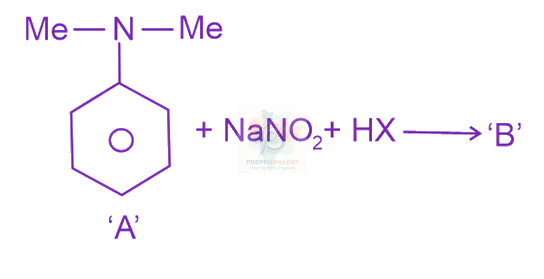
${\mathrm{ClF}}_{5}$ at room temperature is a
According to $\mathrm{MO}$ theory the bond orders for ${{O}_{2}}^{2-}$, $\mathrm{CO}$ and ${\mathrm{NO}}^{+}$ respectively, are
For ${\mathrm{OF}}_{2}$ molecule consider the following: (A) Number of lone pairs on oxygen is $2$. (B) $\mathrm{FOF}$ angle is less than $104.5^{\circ}$. (C) Oxidation state of $O$ is $-2$. (D) Molecule is bent '$V$' shaped. (E) Molecular geometry is linear. Correct options are:
The number of species from the following which have square pyramidal structure is $_______$ ${\mathrm{PF}}_{5},{\mathrm{BrF}}_{4}^{-},{\mathrm{IF}}_{5},{\mathrm{BrF}}_{5},{\mathrm{XeOF}}_{4},{\mathrm{ICl}}_{4}^{-}$