Correct Option (d)
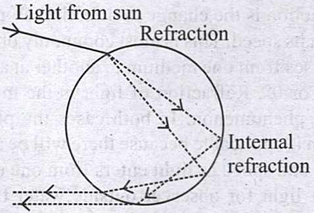
The formation of a rainbow is a result of the combined action of three distinct optical phenomena:
- Refraction: When sunlight enters a raindrop from the air, it bends due to the change in the refractive index of the medium. This initial bending is refraction. Light also undergoes refraction again when it exits the raindrop back into the air.
- Dispersion: Inside the raindrop, white light splits into its constituent colours (spectrum). This occurs because different wavelengths (colours) of light travel at slightly different speeds in water, causing them to bend at different angles during refraction.
- Internal Reflection: After dispersion, the light rays strike the inner surface of the raindrop and undergo internal reflection, redirecting the dispersed colours back towards the observer.
These three processes – refraction, dispersion, and internal reflection – occur sequentially within each raindrop, leading to the separation of sunlight into its spectral colours and the subsequent formation of a rainbow visible to an observer.
Incorrect Options
Options (a), (b), and (c) are incorrect because each omits at least one of the essential physical phenomena required for the complete formation of a rainbow. All three phenomena – dispersion, refraction, and internal reflection – are indispensable for the observation of a rainbow.