Correct Option
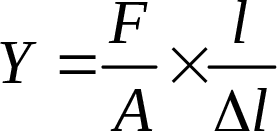
The elongation (ΔL) of a wire under a tensile load (F) is given by Hooke's Law and the definition of Young's Modulus (Y):
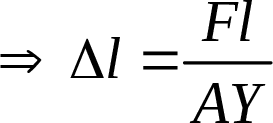
ΔL = (F × L) / (A × Y)
Where:
- F is the applied load.
- L is the original length of the wire.
- A is the cross-sectional area of the wire.
- Y is Young's Modulus of elasticity for the material.
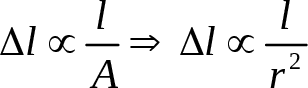
Given that the wires are made of the same material, Young's Modulus (Y) is constant. The load (F) applied is also of the same magnitude for all wires. Therefore, the elongation ΔL is directly proportional to the length (L) and inversely proportional to the cross-sectional area (A):
ΔL ∝ L / A
The cross-sectional area (A) of a wire with diameter (d) is given by A = π(d/2)². Thus, A ∝ d².
Substituting this into the proportionality, we get:
ΔL ∝ L / d²
To find which wire will be elongated maximum, we need to calculate the ratio L/d² for each option:
- Option 1: L = 1m, d = 2mm. Ratio = 1 / (2²) = 1 / 4 = 0.25
- Option 2: L = 2m, d = 2mm. Ratio = 2 / (2²) = 2 / 4 = 0.5
- Option 3: L = 3m, d = 1.5mm. Ratio = 3 / (1.5²) = 3 / 2.25 ≈ 1.33
- Option 4: L = 1m, d = 1mm. Ratio = 1 / (1²) = 1 / 1 = 1
Comparing these values, the ratio L/d² is highest for Option 3 (approximately 1.33). Therefore, the wire with 3m length and 1.5mm diameter will experience the maximum elongation.
Incorrect Options
Options 1, 2, and 4 result in lower values for the L/d² ratio (0.25, 0.5, and 1, respectively) compared to Option 3 (1.33). Since elongation is directly proportional to L/d², these wires will elongate less than the wire described in Option 3 under the same conditions.