Correct Option
Option (d):
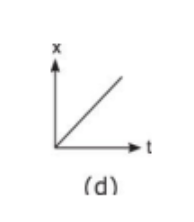
One-dimensional uniform motion is characterized by an object covering equal distances in equal intervals of time, implying a constant velocity. On a distance-time (x-t) graph, this type of motion is represented by a straight line with a constant, non-zero slope. Option (d) depicts such a graph, where the position (x) increases linearly with time (t). The constant positive slope of this straight line indicates a constant positive velocity, which is the definition of uniform motion.
Incorrect Options
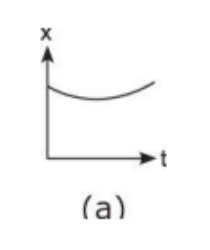
Option (a): This graph shows a curve where the slope is decreasing with time. The slope of an x-t graph represents velocity. A decreasing slope signifies a decreasing velocity, indicating non-uniform motion (deceleration).
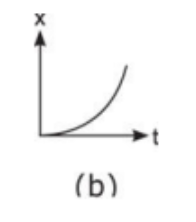
Option (b): This graph shows a curve where the slope is increasing with time. An increasing slope on an x-t graph indicates an increasing velocity, which represents non-uniform motion (acceleration).
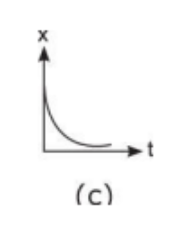
Option (c): This graph shows a curve where the position (x) decreases with increasing time (t). While a decreasing position can represent motion in the negative direction, the curved nature of the graph indicates that the velocity is not constant; its slope is changing. Therefore, it represents non-uniform motion.