Correct Option
Statements 1, 2, and 4 are correct.
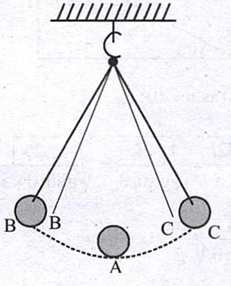
- Statement 1: For a simple pendulum undergoing simple harmonic motion (SHM), the acceleration is directly proportional to its displacement from the mean position and acts in the opposite direction (a = -ω²x). At the mean position, the displacement (x) is zero, which implies that the acceleration is also zero.
- Statement 2: Due to the symmetrical nature of simple harmonic motion, the bob of the pendulum attains any given non-zero speed twice within one complete oscillation cycle: once while moving in one direction and once while moving in the opposite direction at the same displacement magnitude.
- Statement 4: In real-world conditions, a simple pendulum is subject to damping forces such as air resistance and friction at the pivot. These forces cause a continuous loss of mechanical energy from the system, leading to a gradual decrease in the amplitude of oscillation over time.
Incorrect Options
Statement 3 is incorrect.
- Statement 3: At the extreme positions of its oscillation, the bob momentarily comes to rest before reversing its direction; thus, its velocity is zero. However, at these extreme points, the restoring force acting on the bob is maximum, directed towards the mean position. This maximum restoring force results in maximum acceleration, not zero acceleration.
Based on the analysis of the statements:
- Option (a) is incorrect because it excludes statement 4, which is correct.
- Option (b) is incorrect because it includes statement 3, which is incorrect.
- Option (d) is incorrect because it includes statement 3, which is incorrect.