Correct Option (b):
When a bimetallic strip, consisting of two different metals firmly joined together, is heated, it bends due to the difference in their coefficients of linear thermal expansion. The metal with a higher coefficient of linear expansion expands more than the metal with a lower coefficient of linear expansion for the same temperature rise.
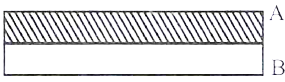
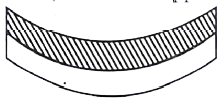
In this scenario, metal A expands more than metal B. Consequently, metal A will attempt to attain a greater length than metal B. Since the two metals are firmly joined, this differential expansion causes the strip to bend. The metal that expands more (metal A) will form the outer, convex side of the curve, while the metal that expands less (metal B) will form the inner, concave side. Option (b) correctly illustrates this bending, with A on the convex side and B on the concave side.
Incorrect Options:
- Option (a) depicts the strip bending in the opposite direction. This configuration would occur if metal B expanded more than metal A.
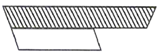
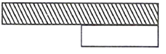
- Options (c) and (d) show the metals separating or not remaining firmly joined. The problem statement specifies that the strips are "firmly jointed together," implying they remain connected and bend as a single unit, not separate.