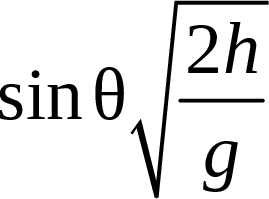
Correct Option
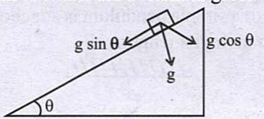
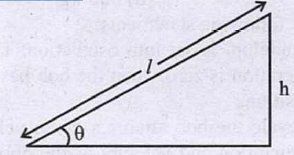
When a body slides down a smooth inclined plane, the component of gravitational force acting along the plane is mg sinθ. Since the plane is smooth, there is no friction. Therefore, the acceleration (a) of the body down the inclined plane is given by: a = (mg sinθ) / m = g sinθ.
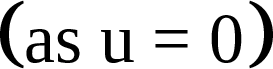
The body starts from rest, so its initial velocity (u) is 0. Let L be the length of the inclined plane. The vertical height (h) is related to L by h = L sinθ, which implies L = h / sinθ.
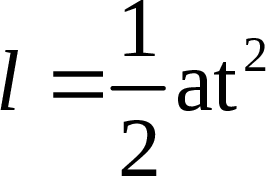
Using the second equation of motion for constant acceleration: L = ut + (1/2)at²
Substituting the values: h / sinθ = (0)t + (1/2)(g sinθ)t² h / sinθ = (1/2)g sinθ t²
Rearranging to solve for t²: t² = (2h) / (g sin²θ)
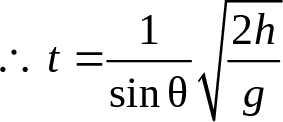
Taking the square root to find t: t = sqrt(2h / (g sin²θ))
Incorrect Options
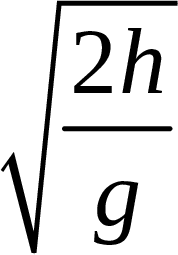
(a) This option represents the time taken for a vertical free fall from height h, where acceleration is g. It does not account for the reduced acceleration (g sinθ) along an inclined plane or the increased distance (L = h/sinθ) covered.
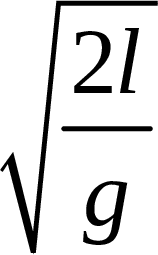
(b) This option incorrectly uses 'h' as the distance covered along the incline and omits the influence of the angle of inclination on acceleration. The acceleration along the incline is g sinθ, not g, and the distance is h/sinθ.
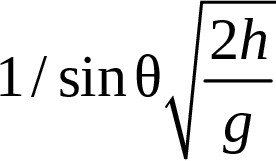
(d) This option contains an incorrect trigonometric relationship. The time taken is inversely proportional to sinθ, specifically to sin²θ under the square root, not directly proportional to sinθ.