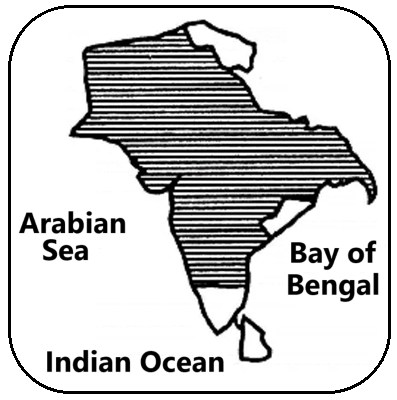
Correct Option (C):
The map accurately depicts the territorial extent of the Mauryan Empire during the reign of Emperor Ashoka, particularly towards the close of his rule. The Mauryan Empire, at its zenith under Ashoka, encompassed a vast area stretching from present-day Afghanistan in the west, across the Indian subcontinent, excluding only the southernmost tip (Tamilakam region), and extending into parts of present-day Bangladesh in the east. The inclusion of regions like Gandhara, Kalinga (after its conquest), and a significant portion of the Deccan plateau aligns with the historical boundaries of Ashoka's empire.
Incorrect Options:
Option (1): Kanishka's empire (Kushan Empire) primarily covered parts of Central Asia, Afghanistan, Pakistan, and northern India, extending roughly up to Varanasi or Pataliputra. Its territorial reach was significantly smaller and did not include the vast southern and eastern regions shown in the map.
Option (2): Samudragupta's empire (Gupta Empire) was predominantly centered in northern and central India. While he conducted military campaigns into South India (Dakshinapatha expedition), he did not annex these kingdoms into his direct administration. The map shows a much larger, contiguous empire, including the Deccan and parts of Afghanistan, which was not the extent of the Gupta Empire under Samudragupta.
Option (4): The empire of Thaneswar, which later expanded under Harsha, was primarily confined to northern India, extending from Punjab to Bengal and parts of central India. It did not include the Deccan plateau or the regions beyond the Indus River (present-day Afghanistan and Pakistan) as depicted in the map. Its territorial extent was considerably smaller than the empire shown.