Algebra PYQ — Page 38
CUET UG Mathematics — Algebra previous year questions with solutions.
All Algebra Questions (1106)
The feasible region of an LPP Max $Z = 3x + 2y$ subject to $x \geq 0, y \geq 0, x - 2y \leq 3$ is:
A manufacturing company makes two models M$_1$ and M$_2$ of a product. Each piece of M$_1$ requires 9 labour hours for fabricating and one labour hour for finishing. Each piece of M$_2$ require 12 labour hours for fabricating and 3 labour hours for finishing. For fabricating and finishing, the maximum labour hours available are 180 and 30 respectively. The company makes a profit of Rs.800 on each piece of M$_1$ and Rs.1200 on each piece of M$_2$ The above Linear Programming Problem [LPP] is given by
Choose the wrong statement from the following :
The feasible region for an LPP is shown below. Let $Z = 3x - 4y$ be the objective function. Maximum of Z occurs at : 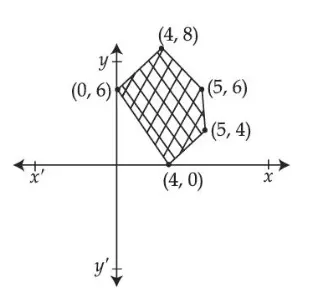
The set of values of K for which the system of equations $\begin{bmatrix} 2 & 3 & 1 \\ 4 & 5 & 0 \\ 1 & K & 3 \end{bmatrix} \begin{bmatrix} x \\ y \\ z \end{bmatrix} = \begin{bmatrix} 5 \\ 6 \\ 7 \end{bmatrix}$ gives a unique solution is :
If A and B are invertible matrices of order 3, $|A| = 2$ and $|(AB)^{-1}| = -\frac{1}{6}$, then the value of $|B|$ is :
Let A be the square matrix of order 3, then |kA|, where k is a scalar, is equal to:
The region represented by the system of inequalities $x, y \geq 0$ ; $2x + 3y \geq 4$ ; $x \geq 1$ is :
Urn I contains 6 red balls and 4 black balls and Urn II contains 4 red balls and 6 black balls. One ball is drawn at random from Urn I and placed in Urn II. If one ball is drawn at random from Urn II, then the probability that it is a red ball is :
If matrix A is of order $2 \times 3$ and B of order $3 \times 2$, then
If the matrix $A = \begin{bmatrix} \cos\theta & \sin\theta \\ -\sin\theta & \cos\theta \end{bmatrix}$, then $A^2$ is equal to:
If order of matrix A is $m \times p$ and order of matrix B is $p \times n$, then what is the order of matrix AB ?
If $f: R \to R$ is defined by $f(x) = \sin x + x$, then $f(f(x))$ is:
If a set P contains 5 elements and the set Q contains 8 elements, then the number of one-one functions from A to B is :
If the points (2, 1), $(-1, 4)$ and (a, 3) are collinear then the value/(s) of a is/(are) :
In $\triangle ABC$ :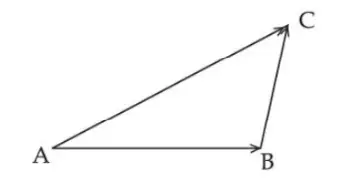 (A) $\vec{AB} + \vec{BC} + \vec{CA} = \vec{O}$ (B) $\vec{AB} + \vec{BC} - \vec{AC} = \vec{O}$ (C) $\vec{AB} + \vec{BC} - \vec{CA} = \vec{O}$ (D) $\vec{AB} - \vec{CB} + \vec{CA} = \vec{O}$ (E) $\vec{AB} - \vec{CB} - \vec{CA} = \vec{O}$ Choose the correct answer from the options given below :
The sum of the products of elements of any row with the cofactors of corresponding elements is equal to :
Let R be a relation on the set of natural numbers N defined by nRm if n divides m. Then R is : (A) Reflexive Relation (B) Symmetric Relation (C) Transitive Relation (D) Identity Relation Choose the **correct** answer from the options given below :
If A is a square matrix of order 3, then |adj A| is equal to:
Let X be the random variable with probability distribution given by the following table. | X | 0 | 1 | 2 | 3 | |---|---|---|---|---| | P(X = x) | $\frac{1}{8}$ | k | $\frac{3}{8}$ | $\frac{1}{8}$ | The value of $P(X \leq 1)$ is:
A man is known to speak truth 4 out of 5 times. He throws a die and reports that five appears. Then the probability that actual five appears on the dice is
If $A^2 - A + I = O$, where O is the zero matrix and I is the identity matrix, then $A^{-1}$ is
A. A relation $R$ on a set $A$ is called an equivalence relation, if it is reflexive, symmetric and transitive. B. The function $f : R \to R$ defined by $f(x) = e^x$ is not one-one. C. The one-one function is also known as injective function. D. The onto function is also known as subjective function. E. A function $f : X \to Y$ is said to be many-one, if two or more than two elements in set $X$ have the different image in set $Y$. Choose the correct answer from the option given below:
The corner points of the feasible region for an L.P.P. are $(0, 10)$, $(5, 5)$, $(15, 15)$ and $(0, 20)$. If the objective function is $z = px + qy$; $p, q > 0$, then the condition on $p$ and $q$ so that the maximum of $z$ occurs at $(15, 15)$ and $(0, 20)$ is