Molecular Basis of Inheritance PYQ — Page 2
NEET UG Zoology — Molecular Basis of Inheritance previous year questions with solutions.
All Molecular Basis of Inheritance Questions (182)
What is the role of RNA polymerase III in the process of transcription in Eukaryotes?
Which one of the following acts as an inducer for lac operon?
Expressed Sequence Tags (ESTs) refers to
Given below are two statements: Statement I: RNA mutates at a faster rate. Statement II: Viruses having RNA genome and shorter life span mutate and evolve faster. In the light of the above statements, choose the correct answer from the options given below:
The last chromosome sequenced in Human Genome Project was :
Name the component that binds to the operator region of an operon and prevents RNA polymerase from transcribing the operon.
Given below are two statements: Statement I: In prokaryotes, the positively charged DNA is held with some negatively charged proteins in a region called nucleoid. Statement II: In eukaryotes, the negatively charged DNA is wrapped around the positively charged histone octamer to form nucleosome. In the light of the above statements, choose the correct answer from the options given below:
The salient features of genetic code are : (A) The code is palindromic (B) UGA act as initiator codon (C) The code is unambiguous and specific (D) The code is nearly universal Choose the most appropriate answer from the options given below :
Given below are two statements : Statement I: The process of copying genetic information from one strand of the DNA into RNA is termed as transcription. Statement II : A transcription unit in DNA is defined primarily by the three regions in the DNA, i.e., a promotor, the structural gene and a terminator. In the light of the above statements, choose the correct answer from the options given below :
Given below are two statements : Statement I : DNA polymerases catalyse polymerisation only in one direction, that is $5^{\prime} \rightarrow 3^{\prime}$ Statement II : During replication of DNA, on one strand the replication is continuous while on other strand it is discontinuous. In the light of the above statements, choose the correct answer from the options given below :
Read the following statements and choose the set of correct statements: (a) Euchromatin is loosely packed chromatin. (b) Heterochromatin is transcriptionally active. (c) Histone octamer is wrapped by negatively charged DNA in the nucleosome. (d) Histones are rich in lysine and arginine. (e) A typical nucleosome contains 400bp of DNA helix. Choose the correct answer from the options given below:
If the length of a DNA molecule is $1.1$ metres, what will be the approximate number of base pairs?
If a geneticist uses the blind approach for sequencing the whole genome of an organism, followed by assignment of function to different segments, the methodology adopted by him is called as:
Match List - I with List - II : 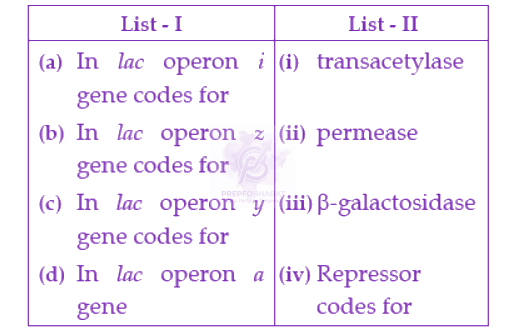 Choose the correct answer from the options given below :
DNA Polymorphism forms the basis of:
In lac operon, $z$ gene codes for :
In an E. coli strain, i gene gets mutated, and its product cannot bind the inducer molecule. If the growth medium is provided with lactose, what will be the outcome?
If DNA contained sulphur instead of phosphorus and proteins contained phosphorus instead of sulfur, what would have been the outcome of Hershey and Chase experiment?
Against the codon 5' UAC 3', what would be the sequence of anticodon on tRNA ?
The process of translation of mRNA to proteins begins as soon as :
Ten E. coli cells with $N15$-dsDNA are incubated in medium containing $N14$ nucleotide. After $60$ minutes, how many E. coli cells will have DNA totally free from $N15$?
If $A$ and $C$ make $30 \%$ and $20 \%$ of DNA, respectively, what will be the percentage composition of $\mathrm{T}$ and $\mathrm{G}$ ?
Match List-I with List-II : \(\begin{array}{|l|l|} \hline \text { List - I } & \text { List - II } \\ \hline \text { (a) Bacteriophage } \phi \times 174 & \text { (i) } 48502 \text { base pairs } \\ \text { (b) Bacteriophage lambda } & \text { (ii) } 5386 \text { nucleotides } \\ \text { (c) Escherichia coli } & \text { (iii) } 3.3 \times 109 \text { base pairs } \\ \text { (d) Haploid content of human DNA } & \text { (iv) } 4.6 \times 106 \text { base pairs } \\ \hline \end{array}\) Choose the correct answer from the options given below:
Complete the flow chart on central dogma. 