Physical Chemistry PYQ — Page 22
NEET UG Chemistry — Physical Chemistry previous year questions with solutions.
All Physical Chemistry Questions (571)
The mass of carbon anode consumed (giving only carbon dioxide) in the production of $270 \mathrm{~kg}$ of a aluminium metal from bauxite by the Hall process is: (Atomic mass : A1 = 27)
A solution has a 1 : 4 mole ratio of pentane to hexane. The vapour pressures of the pure hydrocarbons at $20^{\circ} \mathrm{C}$ are 440 $\mathrm{mm} \mathrm{Hg}$ for pentane and $120 \mathrm{~mm} \mathrm{Hg}$ for hexane. the mole fraction of pentane in the vapour phase would be:
A nuclide of an alkaline earth metal under goes radioactive decay by emission of the $\alpha$-particles in succession. The group of the periodic table to which the resulting daughter element would belong is:
The reaction occurs spontaneously if :
The energy of second Bohr orbit of the hydrogen atom is $-328 \mathrm{~kJ} \mathrm{~mol}^{-1}$; hence the energy of fourth Bohr orbit would be
Which of the following pairs of a chemicals reaction is certain to result in a spontaneous reactions?
Equilibrium constants $\mathrm{K}_1$ and $\mathrm{K}_2$ for the following equilibria: 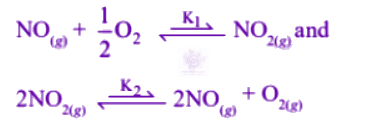 are related as:
The mole friction of the solute in one molal aqueous solution is:
The vapour pressure of two liquids $P$ and $\mathrm{Q}$ are 80 and 60 torr respectively. The total vapour pressure of solution obtained by mixing 3 mole of $\mathrm{P}$ and $2 \mathrm{~mol}$ of $\mathrm{Q}$ would be:
Copper has face centered cubic (fcc) lattice with interatomic spacing equal to $2.54 Å$. The value of lattice constant for this lattice is:
The rate of reaction between two reactants $\mathrm{A}$ and $\mathrm{B}$ decreases by a factor of 4 if the concentration of reactant $B$ is doubled. The order of this reaction iwth respect is reactant $\mathrm{B}$ is:
For a first order reaction $\mathrm{A} \rightarrow \mathrm{B}$ the reaction rate at reactant concentration of $0.01 \mathrm{M}$ is found to be $2.0 \times 10^{-5} \mathrm{~mol} \mathrm{~L}^{-1}$ $\mathrm{s}^{-1}$. The half life period of the reaction is:
A solution of urea (mol. mass $\left.56 \mathrm{~g} \mathrm{~mol}^{-1}\right)$ boils at $100.18^{\circ} \mathrm{C}$ at the atmospheric pressure. If $\mathrm{K}_f$ and $\mathrm{K}_b$ for water for 1.86 and $0.512 \mathrm{Kkmol}^{-1}$ respectively, the above solution will freeze at:
At $25^{\circ} \mathrm{C}$, the dissociation constant of a base, $\mathrm{BOH}$, is $1.0 \times 10^{-12}$. The concentration of hydroxyl ions in $0.01 \mathrm{M}$ aqueous solution of the base would be:
$4.5 \mathrm{~g}$ of aluminium (at mass $27 \mathrm{amu}$ ) is deposited at cathode from $\mathrm{Al}^{3+}$ solution by a certain quality of electric charge. The volume of hydrogen produced at STP from $\mathrm{H}^{+}$ions in solution by the same quantity of electric charge will be:
The solubility product of a sparingly soluble salt $\mathrm{AX}_2$ is $3.2 \times 10^{-11}$. Its solubility (in moles/litre) is:
The rate of a first order reaction is $1.5 \times$ $10^{-2} \mathrm{~mol} \mathrm{~L}^{-1} \mathrm{~min}^{-1}$ at $0.5 \mathrm{M}$ concentration of the reactant. The half life of the reaction is:
The rapid change of $\mathrm{pH}$ near the stoichiometric point of an acid base titration is the basis of indicator detection, $\mathrm{pH}$ of the solution is related to ratio of the concentration of the conjugate acid (Hln) and base $\left(\mathrm{In}^{-}\right)$forms of the indicator by the expression:
The maximum number of molecules is present in:
The frequency radiation emitted when the electron falls from $\mathrm{n}=4$ to $n=1$ in a hydrogen atom will be (Given ionization energy of $\mathrm{H}=2.18 \times 10^{-18} \mathrm{~J} \mathrm{atom}^{-1}$ and $h$ $\left.=6.625 \times 10^{-34} \mathrm{Js}\right)$ :
The standard e.m.f of a galvanic cell involving cell reaction with $\mathrm{n}=2$ is found to be $0.295 \mathrm{~V}$ at $25^{\circ} \mathrm{C}$. The equilibrium constant of the reaction would be: (Given $\mathrm{F}=96500 \mathrm{C} \mathrm{mol}^{-1}, \mathrm{R}=8.314 \mathrm{~J}$ $\mathrm{K}^{-1} \mathrm{~mol}^{-1}$
Which is the best description of the behaviour of bromine in the reaction given below? $$ \mathrm{H}_2 \mathrm{O}+\mathrm{Br}_2 \rightarrow \mathrm{HOBr}+\mathrm{HBr} $$
If the bond energies of $\mathrm{H}-\mathrm{H}, \mathrm{Br}-\mathrm{Br}$, and $\mathrm{H}-\mathrm{Br}$ are 433,192 and $364 \mathrm{~kJ} /\mathrm{mol}^{-1}$ respectively, the $\Delta \mathrm{H}^{\circ}$ for the reaction $\mathrm{H}_{2(g)}+\mathrm{Br}_{2(g)} \rightarrow 2 \mathrm{HBr}_{(g)}$ is:
Considering entropy (S) as a thermodynamic parameter, the criterion for the spontaneity of any process is: