NEET UG Chemistry — Inorganic Chemistry previous year questions with solutions.
According to MO theory which of the following lists ranks the nitrogen species in terms of increasing bond order ?
Which of the following molecules acts as a Lewis acid ?
Which of the following complex ions is expected to absorb visible light ? (At. no. $\mathrm{Zn}=30, \mathrm{Sc}=21, \mathrm{Ti}=22, \mathrm{Cr}=24$ )
Among the following which is the strongest oxidising agent?
The state of hybridisation of $\mathrm{C}_2, \mathrm{C}_3, \mathrm{C}_5$ and $\mathrm{C}_6$ of the hydrocarbon, 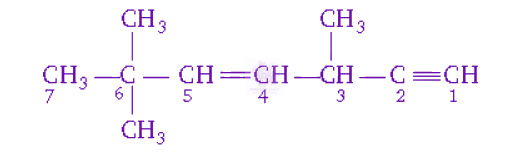 is in the following sequence
Which of the following does not show optical isomerism - (en = Ethylenediamine)
Which of the following does not show optical isomerism? (en = ethylenediamine)
Which of the following complex ions is expected to absorb visible light ? (At no. $\mathrm{Zn}=30, \mathrm{Sc}=21, \mathrm{Ti}=22, \mathrm{Cr}=24$ )
Which one of the elements with the following outer orbital configurations may exhibit the largest number of oxidation states ?
Out of $\mathrm{TiF}_6^{2-}, \mathrm{CoF}_6^{3-}, \mathrm{Cu}_2 \mathrm{Cl}_2$ and $\mathrm{NiCl}_4^{2-}$ ( $\mathrm{Z}$ of $\mathrm{Ti}=22, \mathrm{Co}=27, \mathrm{Cu}=29, \mathrm{Ni}=28$ ) the colourless species are
The correct order of decreasing second ionisation enthalpy of Ti(22), V (23), Cr (24) and $\mathrm{Mn}(25)$ is
The alkali metals form salt-like hydrides by the direct synthesis at elevated temperature. The thermal stability of these hydrides decreases in which of the following orders?
Acetophenone when reacted with a base, $\mathrm{C}_2 \mathrm{H}_5 \mathrm{ONa}$, yields a stable compound which has the structure
Which one of the following arrangements does not give the correct picture of the trends indicated against it?
With which one of the following elements silicon should be doped so as to give ptype of semiconductor?
The value of equilibrium constant of the reaction $\mathrm{HI}(g) \rightleftharpoons \frac{1}{2} \mathrm{H}_2(g)+\frac{1}{2} \mathrm{I}_2$ is 8.0 The equilibrium constant of the reaction $\mathrm{H}_2(g)+\mathrm{I}_2(g) \rightleftharpoons 2 \mathrm{HI}(g)$ will be
The correct order of increasing bond angles in the following triatomic species is
The correct order of decreasing second ionisation enthalpy of Ti (22), V (23), Cr (24) and $\mathrm{Mn}(25)$ is
Four diatomic species are listed below the different sequences. Which of these presents the correct order of their increasing bond order?
In which of the following coordination entities the magnitude of $\Delta_o$ (CFSE in octahedral field) will be maximum? (Atomic number $\mathrm{Co}=27$ )
In which of the following coordination entities the magnitude of $\Delta \mathrm{O}$ (CFSE in octahedral field) will be maximum (at. no. $\mathrm{Co}=27$ )?
Volume occupied by one molecule of water (density $=1 \mathrm{~g} \mathrm{~cm}^{-3}$ ) is
In the hydrocarbon $$ \underset{8}{\mathrm{CH}_3}-\mathrm{CH}=\underset{4}{\mathrm{CH}}=\mathrm{CH}_3-\mathrm{CH}_2-\mathrm{C} \equiv \mathrm{CH}_1 $$ The state of hybridization of carbons 1,3 and 5 are in the following sequence
Which of the following complexes exhibits the highest paramagnetic behaviour? Where gly = glycine, en = ethylenediamine and bpy = bipyridyl moities). (At. number $\mathrm{Ti}$ $=22, \mathrm{~V}=23, \mathrm{Fe}=26, \mathrm{Co}=27$ )