In C4 plants, initial fixation of carbon dioxide occurs in mesophyll cells. The primary acceptor of CO2 is phosphoenol pyruvate or PEP. It combines with carbon dioxide in the presence of PEP carboxylase or PEPcase to form oxaloacetate. C4 plants are more efficient in picking up CO2 even when it is found in low concentration because of the high affinity of PEPcase. Related Theory The two key restrictions slow down photosynthesis in C3 cycle: (i) Rubisco aims to fix carbon dioxide, but can also fix oxygen molecules, which creates a toxic two-carbon compound. Rubisco fixes oxygen about 20 percent of the time, initiating a process called photorespiration that recycles the toxic compound. Photorespiration costs the plant energy it could have used to photosynthesize. (ii) When stomata are open to let carbon dioxide in, they also let water vapor out, leaving C3 plants at a disadvantage in drought and high-temperature environments.
Photosynthesis in C_4 plants is relatively less limited by atmospheric CO_2 levels because:
NEET UG 2005 — Botany Photosynthesis in Higher Plants
Photosynthesis in C4 plants is relatively less limited by atmospheric CO2 levels because:
Held on 30 Apr 2005 · Verified 9 Jul 2026.
Options
- A
effective pumping of CO2 into bundle sheath cells
- B
rubisco in C4 plants has higher affinity, for CO2
- C
four carbon acids has the primary initial CO2 fixation products
- D
the primary fixation of CO2 is mediated via PEP carboxylase.
Did you get this right?
Sign in to track your attempts and accuracy.
Your note
Sign in to keep a private note on this question. Nothing you write is ever public.
NEET UG Photosynthesis in Higher Plants in other years
More NEET UG Photosynthesis in Higher Plants questions
Match List I with List II: $\begin{array}{|l|l|l|l|}\hline & \text{List - I} & & \text{List - II} \\\hline \text{A}. & \text{Chlorophyll a} & \text{(i)} & \text{Yellow-green} \\\hline \text{B.} & \text{Chlorophyll b} & \text{(ii)} & \text{Yellow} \\\hline \text{C.} & \text{Xanthophylls} & \text{(iii)} & \text{Blue-green} \\\hline \text{D.} & \text{Carotenoids} & \text{(iv)} & \text{Yellow to Yellow-orange} \\\hline\end{array}$ Choose the option with all correct matches.
Which of the following statements about RuBisCO is true?
Observe the given figure. Identify the different stages labelled with alphabets by selecting the correct option. 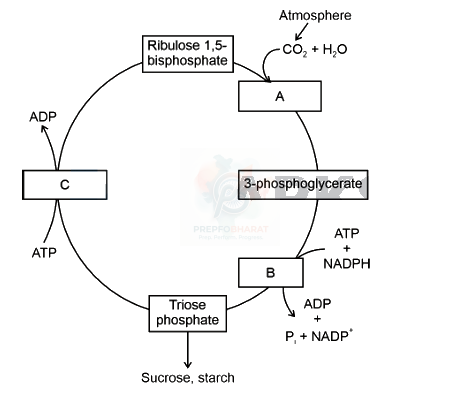
How many molecules of ATP and NADPH are required for every molecule of $\mathrm{CO}_2$ fixed in the Calvin cycle?
Given below are two statements: Statement I: In $\mathrm{C}_3$ plants, some $\mathrm{O}_2$ binds to RuBisCO, hence $\mathrm{CO}_2$ fixation is decreased. Statement II: In $\mathrm{C}_4$ plants, mesophyll cells show very little photorespiration while bundle sheath cells do not show photorespiration. In the light of the above statements, choose the correct answer from the options given below:
Other Botany topics for NEET UG
Keep practicing Photosynthesis in Higher Plants
Work through every NEET UG Photosynthesis in Higher Plants PYQ, year by year.