Prolonged liberal irrigation of agricultural fields create the problem of salinity. Since, all surface ground water contains salts to varying degrees, irrigation is the primary cause which brings salinity to the field. Related Theory Salinity and alkalinity problems are most likely to occur under 2 conditions: (i) Intrusion of salt water into low-lying areas near oceans and seas. (ii) Irrigated soils in semi-arid and arid regions (less than 500 mm annual rainfall) where rainfall or irrigation isn't sufficient to leach accumulated salts out of the root zone. The salts are released by decomposing rock and other parent material below the subsoil and are also brought in by irrigation water and additions of chemical fertilizers and manure.
Prolonged liberal irrigation of agricultural fields is likely to create the problem of:
NEET UG 2005 — Botany Ecosystem
2005mcqhard
Prolonged liberal irrigation of agricultural fields is likely to create the problem of:
Official previous-year question
Held on 30 Apr 2005 · Verified 9 Jul 2026.
Options
- A
acidity
- B
aridity
- C
salinity
- D
metal toxicity.
Did you get this right?
Sign in to track your attempts and accuracy.
Your note
Sign in to keep a private note on this question. Nothing you write is ever public.
NEET UG Ecosystem in other years
More NEET UG Ecosystem questions
Given below are two statements: Statement I: In ecosystem, there is unidirectional flow of energy of sun from producers to consumers. Statement II: Ecosystems are exempted from 2nd law of thermodynamics. In the light of the above statements, choose the most appropriate answer from the options given below:
2025medium
Given below are two statements: Statement I : The primary source of energy in an ecosystem is solar energy. Statement II : The rate of production of organic matter during photosynthesis in an ecosystem is called net primary productivity (NPP). In the light of the above statements, choose the most appropriate answer from the options given below:
2025easy
Which of the following is the unit of productivity of an Ecosystem?
2025easy
In an ecosystem if the Net Primary Productivity (NPP) of first trophic level is $100 x\left(\mathrm{kcal} \mathrm{m}^{-2}\right) \mathrm{yr}^{-1}$, what would be the GPP (Gross Primary Productivity) of the third trophic level of the same ecosystem?
2024hard
Consider the pyramid of energy of an ecosystem given below: 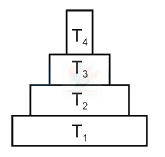 If $T_4$ is equivalent to 1000 J , what is the value at $T_1$ ?
2024medium
Other Botany topics for NEET UG
Keep practicing Ecosystem
Work through every NEET UG Ecosystem PYQ, year by year.