Biomolecules PYQ — Page 3
NEET UG Botany — Biomolecules previous year questions with solutions.
All Biomolecules Questions (88)
A healthy person eats the following diet$5 \mathrm{gm}$ raw sugar, $4 \mathrm{gm}$ albumin, $10 \mathrm{gm}$ pure buffalo ghee adultrated with $2 \mathrm{gm}$ vegetable ghee (hydrogenated vegetable oil) and $5 \mathrm{gm}$ lignin. How many calories he is likely to get?
Macromolecule chitin is
The figure shows a hypothetical tetrapeptide portion with parts labelled a-d. Which is the correct option? 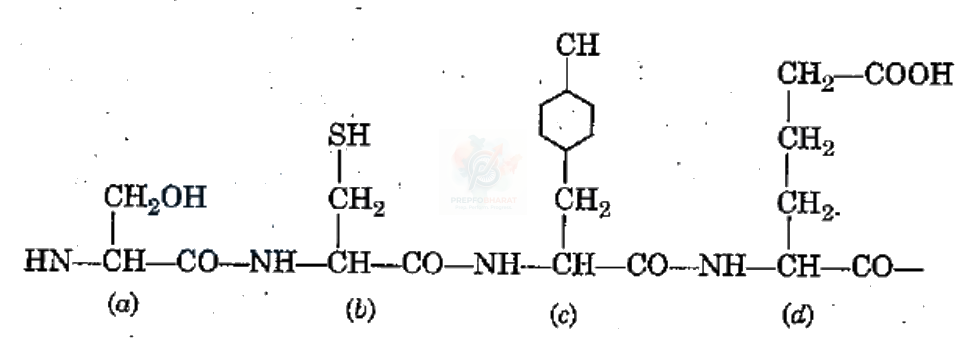
A phosphoglyceride is always made up of
Transition state structure of the substrate formed during an enzymatic reaction is
The essential chemical components of many coenzymes are
Which one is the most abundant protein in the animal world?
Which one out of A-D given below correctly represents the structural formula of the basic amino acid? 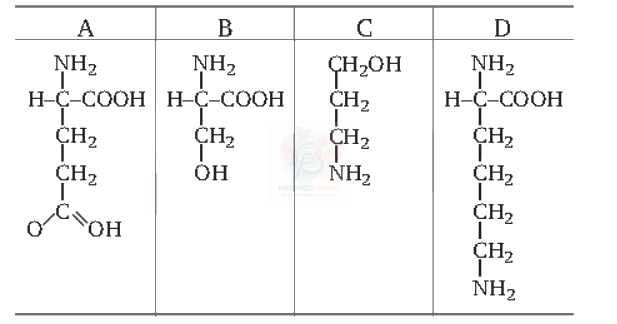
Which one of the following biomolecules is correctly characterised?
Given below is the diagrammatic representation of one of the categories of small molecular weight organic compounds in the living tissues. Identify the category shown and the one blank component $X$ in it 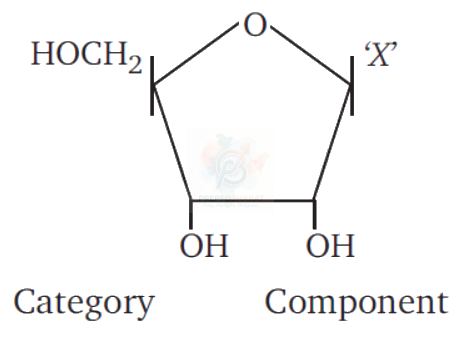 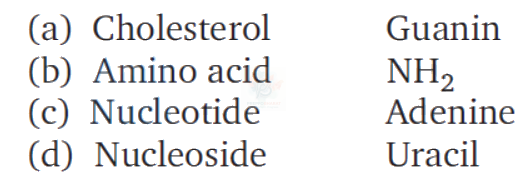
Which one of the following structural formulae of two organic compounds is correctly identified along with its related function? 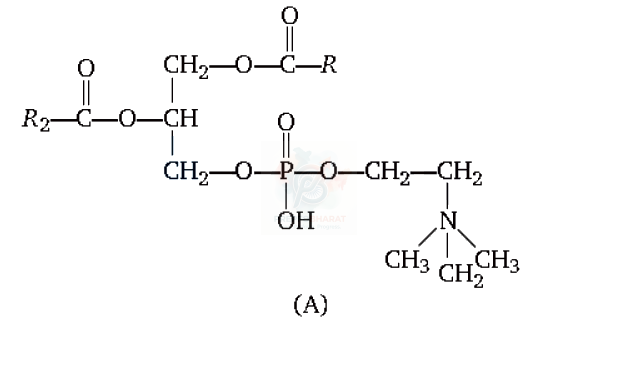 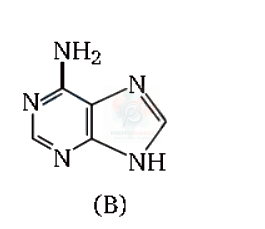
The curve given below shows enzymatic activity with relation to three conditions ( $\mathrm{pH}$, temperature and substrate concentration) What do the two axises ( $X$ and $Y$ ) represent? 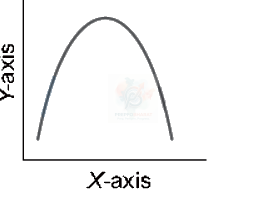 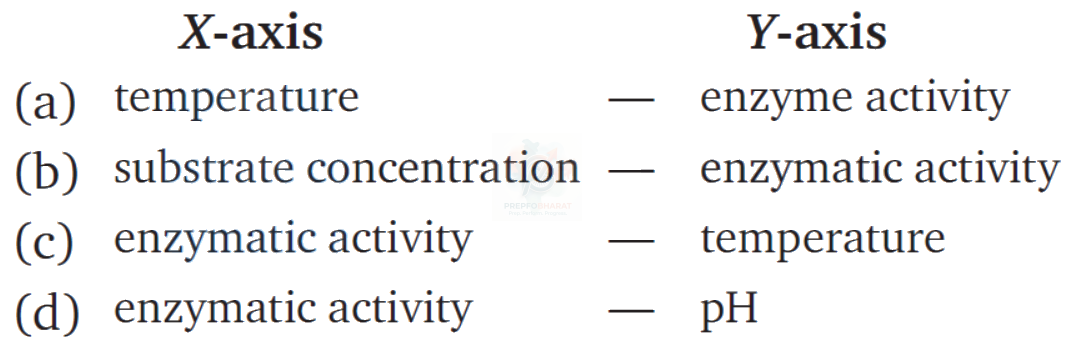
Three of the following statements about enzymes are correct and one is wrong. Which one is wrong?
The figure given below shows the conversion of a substrate into product by an enzyme. In which one of the four options (a-d), the components of reaction labelled as $A, B, C$ and $D$ are identified correctly? 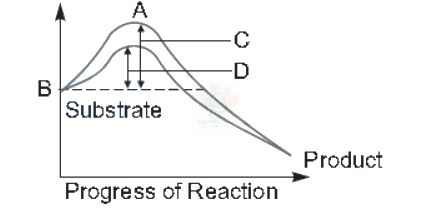$\begin{array}{|c|c|c|c|c|} \hline & A & B & C & D \\ \hline \text{(a)} & \text{Potential energy} & \text{Transition state} & \text{Activation energy with enzyme} & \text{Activation energy without enzyme} \\ \hline \text{(b)} & \text{Transition energy} & \text{Potential energy} & \text{Activation energy without enzyme} & \text{Activation energy with enzyme} \\ \hline \text{(c)} & \text{Potential energy} & \text{Transition state} & \text{Activation energy with enzyme} & \text{Activation energy without enzyme} \\ \hline \text{(d)} & \text{Activation energy with enzyme} & \text{Transition state} & \text{Activation energy without enzyme} & \text{Potential energy} \\ \hline \end{array}$
Which one of the following pair of nitrogenous bases of nucleic acids, is wrongly matched with the category mentioned against it?
A competitive inhibitor of succinic dehydrogenase is
Carbohydrates are commonly found as starch in plant storage organs. Which of the following five properties of starch (a - e) make it useful as a storage material? a. Easily translocated b. Chemical non-reactive c. Easily digested by animals d. Osmotically inactive e. Synthesized during photosynthesis The useful properties are
A competitive inhibitor of succinic dehydrogenase is
Carbohydrates are commonly found as starch in plant storage organs. Which of the following five properties of starch (A-E) make it useful as a storage material? (A) Easily translocated (B) Chemically non-reactive (C) Easily digested by animals (D) Osmotically inactive (E) Synthesized during photosynthesis The useful properties are
Modern detergents contain enzyme preparations of
Which one of the following is a fatsoluble vitamin and its related deficiency disease?
One gene- one enzyme relationship was established for the first time in:
An enzyme that can stimulate germination of barley seeds is:
An organic substance bound to an enzyme and essential for its activity is called: