Chemically, enzymes are generally globular proteins. Enzymes are catalysts that breakdown or synthesize more complex chemical compounds. They speed up the rate of chemical reactions because they lower the energy of activation, the energy that must be supplied in order for molecules to react with one another. Anything that an enzyme normally combines with is called a substrate. Enzymes are very efficient. Enzymes are only present in small amounts in the cell since they are not altered during their reactions. and they are highly specific for their substrate. Each enzyme has an optimum temperature and pH at which it works best. However, at much higher temperature, they are denatured. Related Theory Enzymes speed up the rate of chemical reactions because they lower the energy of activation, the energy that must be supplied in order for molecules to react with one another. Enzymes lower the energy of activation by forming an enzyme-substrate complex allowing products of the enzyme reaction to be formed and released Caution Ribozyme is a form of ribosomal RNA (23 SrRNA) which acts as a catalyst in splicing of RNA during protein synthesis. It is the only non-protein enzyme known so far, rest all the ensymes are proteinaceous
Which of the following statements about enzymes is wrong?
NEET UG 2013 — Botany Biomolecules
Which of the following statements about enzymes is wrong?
Held on 30 Apr 2013 · Verified 9 Jul 2026.
Options
- A
Enzymes are denatured at high temperatures.
- B
Enzymes are mostly proteins but some are lipids also.
- C
Enzymes are highly specific.
- D
Enzymes require optimum pH and temperature for maximum activity.
Did you get this right?
Sign in to track your attempts and accuracy.
Your note
Sign in to keep a private note on this question. Nothing you write is ever public.
NEET UG Biomolecules in other years
More NEET UG Biomolecules questions
Lecithin, a small molecular weight organic compound found in living tissues, is an example of:
Ligases is a class of enzymes responsible for catalysing the linking together of two compounds. Which of the following bonds is not catalysed by it?
Match List-I with List-II. \begin{array}{|l|l|l|l|}\hline & List-I & & List-II \\\hline A. & Primary structure of protein & I. & Human haemoglobin \\\hline B. & Secondary structure of protein & II. & Disulphide bonds \\\hline C. & Tertiary structure of protein & III. & Polypeptide chain \\\hline D. & Quaternary structure of protein & IV. & Alpha helix and \beta sheet \\\hline\end{array} Choose the correct answer from the options given below :
The cofactor of the enzyme carboxypeptidase is:
Match List-I with List-II 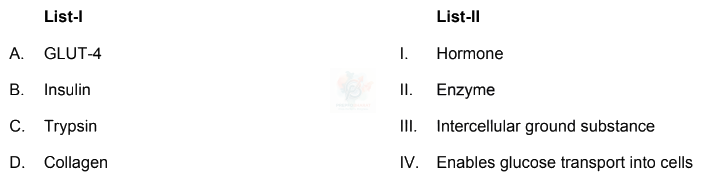 Choose the correct answer from the options given below.
Other Botany topics for NEET UG
Keep practicing Biomolecules
Work through every NEET UG Biomolecules PYQ, year by year.