Competitive Inhibition occurs when the binding of the inhibitor to the active site on the enzyme prevents the binding of the substrate and vice versa. The binding of competitive inhibitors to enzymes are reversible. Non-competitive inhibition occurs when the inhibitor binds to the enzyme at a site away from the active site such that even on binding of the substrate, the enzyme functions less effectively. This type of inhibition is reversible and cannot be overcome by adding a large amount of substrate. Related Theory Enzyme inhibitors prevent the formation of an enzyme-substrate complex and hence prevent the formation of product. Inhibition of enzymes may be either reversible or irreversible depending on the specific effect of the inhibitor being used. Competitive inhibition involves a molecule, other than the substrate, binding to the enzyme's active site. The molecule (inhibitor) is structurally and chemically similar to the substrate and hence able to bind to the active site. The competitive inhibitor blocks the active site and thus prevents substrate binding. As the inhibitor is in competition with the substrate, its effects can be reduced by increasing substrate concentration. Non-competitive inhibition involves a molecule binding to a site other than the active site (an allosteric site). (Ref. to Fig. 27.3) 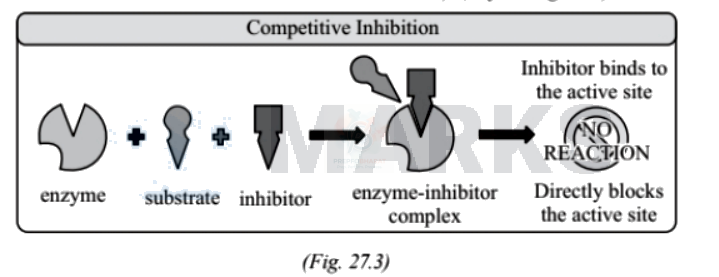
Which one of the following statements regarding enzyme inhibition is correct?
NEET UG 2005 — Botany Biomolecules
Which one of the following statements regarding enzyme inhibition is correct?
Held on 30 Apr 2005 · Verified 9 Jul 2026.
Options
- A
competitive inhibition is seen when a substrate competes with an enzyme for binding to an inhibitor protein
- B
competitive inhibition is seen when the substrate and the inhibitor compete for the active site on the enzyme
- C
non-competitive inhibition of an enzyme can be overcome by adding large amount of substrate
- D
non-competitive inhibitors often bind to the enzyme irreversibly.
Did you get this right?
Sign in to track your attempts and accuracy.
Your note
Sign in to keep a private note on this question. Nothing you write is ever public.
NEET UG Biomolecules in other years
More NEET UG Biomolecules questions
Lecithin, a small molecular weight organic compound found in living tissues, is an example of:
Ligases is a class of enzymes responsible for catalysing the linking together of two compounds. Which of the following bonds is not catalysed by it?
Match List-I with List-II. \begin{array}{|l|l|l|l|}\hline & List-I & & List-II \\\hline A. & Primary structure of protein & I. & Human haemoglobin \\\hline B. & Secondary structure of protein & II. & Disulphide bonds \\\hline C. & Tertiary structure of protein & III. & Polypeptide chain \\\hline D. & Quaternary structure of protein & IV. & Alpha helix and \beta sheet \\\hline\end{array} Choose the correct answer from the options given below :
The cofactor of the enzyme carboxypeptidase is:
Match List-I with List-II 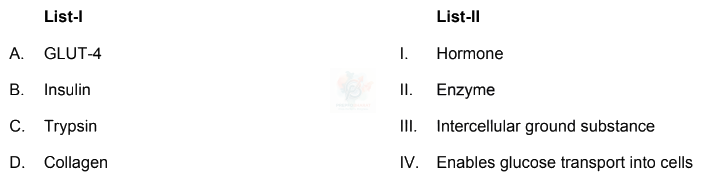 Choose the correct answer from the options given below.
Other Botany topics for NEET UG
Keep practicing Biomolecules
Work through every NEET UG Biomolecules PYQ, year by year.