Optics PYQ — Page 20
JEE Main Physics — Optics previous year questions with solutions.
All Optics Questions (489)
A beam of light consisting of red, green and blue colours is incident on a right-angled prism on face $A B$. The refractive indices of the material for the above red, green and blue colours are $1.39,1.44$ and $1.47$ respectively. A person looking on surface $A C$ of the prism will see 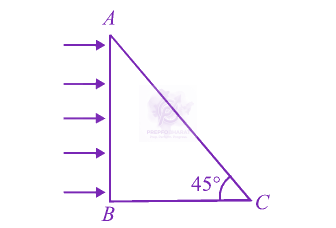
The first diffraction minimum due to the single slit diffraction is seen at $\theta=30^{\circ}$ for a light of wavelength $5000 Å$ falling perpendicularly on the slit. The width of the slit is
In Young's double slit experiment, one of the slit is wider than other, so that the amplitude of the light from one slit is double of that from other slit. If $I_m$ be the maximum intensity, the resultant intensity I when they interfere at phase difference $\phi$ is given by
Let the $x-z$ plane be the boundary between two transparent media. Medium 1 in $z \geq 0$ has a refractive index of $\sqrt{2}$ and medium 2 with $z < 0$ has a refractive index of $\sqrt{3}$. A ray of light in medium 1 given by the vector $\vec{A}=6 \sqrt{3} \hat{i}+8 \sqrt{3} \hat{j}-10 \hat{k}$ is incident on the plane of separation. The angle of refraction in medium 2 is
Direction: The question has a paragraph followed by two statements, Statement $-1$ and statement $-2$. Of the given four alternatives after the statements, choose the one that describes the statements. A thin air film is formed by putting the convex surface of a plane - convex lens over a plane glass plate. With monochromatic light, this film gives an interference pattern due to light reflected from the top (convex) surface and the bottom (glass plate) surface of the film. Statement-1 : When light reflects from the air-glass plate interface, the reflected wave suffers a phase change of $\pi$. Statement-2 : The centre of the interference pattern is dark.
A car is fitted with a convex side-view mirror of focal length $20 \mathrm{~cm}$. A second car $2.8 \mathrm{~m}$ behind the first car is overtaking the first car at relative speed of $15 \mathrm{~m} / \mathrm{s}$. The speed of the image of the second car as seen in the mirror of the first one is :
An initially parallel cylindrical beam travels in a medium of refractive index $\mu(I)=\mu_0+\mu_2 I$, where $\mu_0$ and $\mu_2$ are positive constants and $\mathrm{I}$ is the intensity of the light beam. The intensity of the beam is decreasing with increasing radius. The initial shape of the wave front of the beam is
An initially parallel cylindrical beam travels in a medium of refractive index $\mu(I)=\mu_0+\mu_2 I$, where $\mu_0$ and $\mu_2$ are positive constants and $\mathrm{I}$ is the intensity of the light beam. The intensity of the beam is decreasing with increasing radius. The speed of light in the medium is
An initially parallel cylindrical beam travels in a medium of refractive index $\mu(I)=\mu_0+\mu_2 I$, where $\mu_0$ and $\mu_2$ are positive constants and $\mathrm{I}$ is the intensity of the light beam. The intensity of the beam is decreasing with increasing radius. As the beam enters the medium, it will
In an optics experiment, with the position of the object fixed, a student varies the position of a convex lens and for each position, the screen is adjusted to get a clear image of the object. A graph between the object distance $u$ and the image distance $v$, from the lens, is plotted using the same scale for the two axes. A straight line passing through the origin and making an angle of $45^{\circ}$ with the x-axis meets the experimental curve at $P$. The coordinates of $P$ will be
A mixture of light, consisting of wavelength $590 \mathrm{~nm}$ and an unknown wavelength, illuminates Young's double slit and gives rise to two overlapping interference patterns on the screen. The central maximum of both lights coincide. Further, it is observed that the third bright fringe of known light coincides with the $4^{\text {th }}$ bright fringe of the unknown light. From this data, the wavelength of the unknown light is
A transparent solid cylindrical rod has a refractive index of $\frac{2}{\sqrt{3}}$. It is surrounded by air. A light ray is incident at the mid point of one end of the rod as shown in the figure. The incident angle $\theta$ for which the light ray grazes along the wall of the rod is 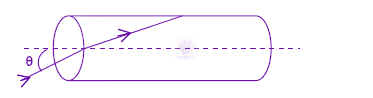
An experiment is performed to find the refractive index of glass using a travelling microscope. In this experiment distance are measured by
A student measures the focal length of convex lens by putting an object pin at a distance 'u' from the lens and measuring the distance ' $v$ ' of the image pin. The graph between ' $u$ ' and ' $v$ ' plotted by the student should look like
Two lenses of power $-15 \mathrm{~D}$ and $+5 \mathrm{~D}$ are in contact with each other. The focal length of the combination is
In a Young's double slit experiment the intensity at a point where the path difference is $\frac{\lambda}{6}$ ($\lambda$ being the wavelength of the light used) is $\mathrm{I}$. If $\mathrm{I}_0$ denotes the maximum intensity, $\frac{\mathrm{I}}{\mathrm{I}_0}$ is equal to
The refractive index of glass is $1.520$ for red light and $1.525$ for blue light. Let $D_1$ and $D_2$ be an of minimum deviation for red and blue light respectively in a prism of this glass. Then
When an unpolarized light of intensity $I_0$ is incident on a polarizing sheet, the intensity of the light which does not get transmitted is
A thin glass (refractive index 1.5) lens has optical power of $-5 D$ in air. Its optical power in a liquid medium with refractive index $1.6$ will be
If $\mathrm{I}_0$ is the intensity of the principal maximum in the single slit diffraction pattern, then what will be its intensity when the slit width is doubled?
A Young’s double slit experiment uses a monochromatic source. The shape of the interference fringes formed on a screen is
Two point white dots are $1 \mathrm{~mm}$ apart on a black paper. They are viewed by eye of pupil diameter $3 \mathrm{~mm}$. Approximately, what is the maximum distance at which these dots can be resolved by the eye? [ Take wavelength of light $=500 \mathrm{~nm}$ ]
A fish looking up through the water sees the outside world contained in a circular horizon. If the refractive index of water is $4 / 3$ and the fish is $12 \mathrm{~cm}$ below the surface, the radius of this circle in $\mathrm{cm}$ is
A plane convex lens of refractive index $1.5$ and radius of curvature $30 \mathrm{~cm}$ is silvered at the curved surface. Now this lens has been used to form the image of an object. At what distance from this lens an object be placed in order to have a real image of the size of the object?