Optics PYQ — Page 19
JEE Main Physics — Optics previous year questions with solutions.
All Optics Questions (489)
A ray of light of intensity $\mathrm{I}$ is incident on a parallel glass slab at point $\mathrm{A}$ as shown in diagram. It undergoes partial reflection and refraction. At each reflection, $25 \%$ of incident energy is reflected. The rays $\mathrm{AB}$ and $\mathrm{A}^{\prime} \mathrm{B}^{\prime}$ undergo interference. The ratio of $\mathrm{I}_{\max }$ and $\mathrm{I}_{\min }$ is : 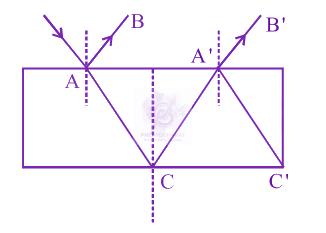
The source that illuminates the double $-$ slit in 'double - slit interference experiment' emits two distinct monochromatic waves of wavelength $500\mathrm{~nm}$ and $600 \mathrm{~nm}$, each of them producing its own pattern on the screen. At the central point of the pattern when path difference is zero, maxima of both the patterns coincide and the resulting interference pattern is most distinct at the region of zero path difference. But as one moves out of this central region, the two fringe systems are gradually out of step such that maximum due to on wavelength coincides with the minimum due to the other and the combined fringe system becomes completely indistinct. This may happen when path difference in $\mathrm{nm}$ is:
A beam of unpolarised light of intensity ${I}_{0}$ is passed through a polaroid $A$ and then through another polaroid $B$ which is oriented so that its principle plane makes an angle of ${\text{45}}^{\text{o}}$ relative to that of $A$. The intensity of the emergent light is:
A light ray falls on a square glass slab as shown in the diagram. The index of refraction of the glass, if total internal reflection is to occur at the vertical face, is equal to : 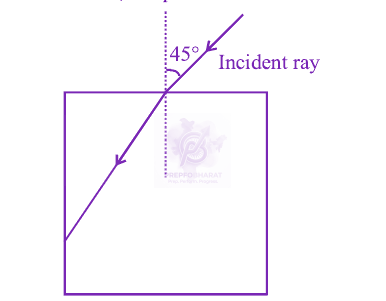
This question has Statement-1 and Statement-2. Of the four choices given after the Statements, choose the one that best describes the two Statements. Statement 1: Very large size telescopes are reflecting telescopes instead of refracting telescopes. Statement 2: It is easier to provide mechanical support to large size mirrors than large size lenses.
This question has Statement-1 and Statement-2. Of the four choices given after the Statements, choose the one that best describes the two Statements. Statement-1: In Young's double slit experiment, the number of fringes observed in the field of view is small with longer wavelength of light and is large with shorter wavelength of light. Statement-2: In the double slit experiment the fringe width depends directly on the wavelength of light.
This question has Statement-1 and Statement-2. Of the four choices given after the Statements, choose the one that best describes the two Statements. Statement-1: Short wave transmission is achieved due to the total internal reflection of the e-m wave from an appropriate height in the ionosphere. Statement-2: Refractive index of a plasma is independent of the frequency of e-m waves.
A thin glass plate of thickness is $\frac{2500}{3} \lambda$ ( $\lambda$ is wavelength of light used) and refractive index $\mu=1.5$ is inserted between one of the slits and the screen in Young's double slit experiment. At a point on the screen equidistant from the slits, the ratio of the intensities before and after the introduction of the glass plate is :
The focal length of the objective and the eyepiece of a telescope are $50 \mathrm{~cm}$ and $5 \mathrm{~cm}$ respectively. If the telescope is focussed for distinct vision on a scale distant $2 \mathrm{~m}$ from its objective, then its magnifying power will be :
This question has Statement-1 and Statements2. Of the four choices given after the Statements, choose the one that best describes the two Statements. Statement-1 : Out of radio waves and microwaves, the radio waves undergo more diffraction. Statement-2 : Radio waves have greater frequency compared to microwaves.
A printed page is pressed by a glass of water. The refractive index of the glass and water is $1.5$ and $1.33$, respectively. If the thickness of the bottom of glass is $1 \mathrm{~cm}$ and depth of water is $5 \mathrm{~cm}$, how much the page will appear to be shifted if viewed from the top ?
Light is incident from a medium into air at two possible angles of incidence (A) $20^{\circ}$ and (B) $40^{\circ}$. In the medium light travels $3.0 \mathrm{~cm}$ in $0.2 \mathrm{~ns}$. The ray will :
A person lives in a high-rise building on the bank of a river $50 \mathrm{~m}$ wide. Across the river is a well lit tower of height $40 \mathrm{~m}$. When the person, who is at a height of $10 \mathrm{~m}$, looks through a polarizer at an appropriate angle at light of the tower reflecting from the river surface, he notes that intensity of light coming from distance $\mathrm{X}$ from his building is the least and this corresponds to the light coming from light bulbs at height ' $\mathrm{Y}$ ' on the tower. The values of $\mathrm{X}$ and $\mathrm{Y}$ are respectively close to (refractive index of water $\simeq \frac{4}{3}$ ) 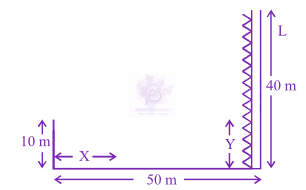
Diameter of a plano - convex lens is $6\mathrm{cm}$ and thickness at the centre is $3\mathrm{mm}$. If the speed of light in the material of lens is $2\times 1{0}^{8}m{s}^{-1}$, the focal length of the lens is:
$n$ identical waves each of intensity $I_0$ interfere with each other. The ratio of maximum intensities if the interference is (i) coherent and (ii) incoherent is :
A glass prism of refractive index $1.5$ is immersed in water (refractive index $\frac{4}{3}$ ) as shown in figure. A light beam incident normally on the face $A B$ is $$ \text { totally reflected to reach the face } B C \text {, if } $$ 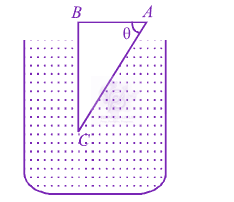
Which of the following processes play a part in the formation of a rainbow? (i) Refraction (ii) Total internal reflection (iii) Dispersion (iv) Interference
Two coherent plane light waves of equal amplitude makes a small angle $\alpha(< < 1)$ with each other. They fall almost normally on a screen. If $\lambda$ is the wavelength of light waves, the fringe width $\Delta x$ of interference patterns of the two sets of waves on the screen is
Two polaroids have their polarizing directions parallel so that the intensity of a transmitted light is maximum. The angle through which either polaroid must be turned if the intensity is to drop by one-half is
In Young's double slit interference experiment, the slit widths are in the ratio $1: 25$. Then the ratio of intensity at the maxima and minima in the interference pattern is
An object $2.4 \mathrm{~m}$ in front of a lens forms a sharp image on a film $12 \mathrm{~cm}$ behind the lens. A glass plate $1 \mathrm{~cm}$ thick, of refractive index $1.50$ is interposed between lens and film with its plane faces parallel to film. At what distance (from lens) should object be shifted to be in sharp focus on film?
We wish to make a microscope with the help of two positive lenses both with a focal length of 20 $\mathrm{mm}$ each and the object is positioned $25 \mathrm{~mm}$ from the objective lens. How far apart the lenses should be so that the final image is formed at infinity?
The maximum number of possible interference maxima for slit separation equal to $1.8 \lambda$, where $\lambda$ is the wavelength of light used, in a Young's double slit experiment is
In a Young's double slit experiment with light of wavelength $\lambda$, fringe pattern on the screen has fringe width $\beta$. When two thin transparent glass (refractive index $\mu$ ) plates of thickness $t_1$ and $t_2$ $\left(t_1>t_2\right)$ are placed in the path of the two beams respectively, the fringe pattern will shift by a distance