JEE Main Physics — Mechanics previous year questions with solutions.
For a particle in uniform circular motion, the acceleration $\vec{a}$ at any point $P(R,\theta )$ on the circular path of radius $R$ is (when $\theta$ is measured from the positive $x$-axis and $v$ is uniform speed):
If $\vec{A}=(2\hat{i}+3\hat{j}-\hat{k})m$ and $\vec{B}=(\hat{i}+2\hat{j}+2\hat{k})m$. The magnitude of component of vector $\vec{A}$ along vector $\vec{B}$ will be _____ $m$.
The radius of gyration of a cylindrical rod about an axis of rotation perpendicular to its length and passing through the center will be _____ $m.$ Given, the length of the rod is $10\sqrt{3}m$.
Which of the following relations is true for two unit vector $\hat{A}$ and $\hat{B}$ making an angle $\theta$ to each other?
Two vectors $\vec{A}$ and $\vec{B}$ have equal magnitudes. If magnitude of $\vec{A}+\vec{B}$ is equal to two times the magnitude of $\vec{A}-\vec{B}$, then the angle between $\vec{A}$ and $\vec{B}$ will be
The moment of inertia of a uniform thin rod about a perpendicular axis passing through one end is ${I}_{1}$. The same rod is bent into a ring and its moment of inertia about a diameter is ${I}_{2}$. If $\frac{{I}_{1}}{{I}_{2}}$ is $\frac{x{\pi }^{2}}{3}$, then the value of $x$ will be ______.
Match List-I with List-II <table class="pyq-table"><tbody><tr><td></td><td>List-I</td><td></td><td>List-II</td></tr><tr><td>(A)</td><td>Moment of inertia of solid sphere of radius $R$ about any tangent.</td><td>(I)</td><td>$\frac{5}{3}{\mathrm{MR}}^{2}$</td></tr><tr><td>(B)</td><td>Moment of inertia of hollow sphere of radius $(R)$ about any tangent.</td><td>(II)</td><td>$\frac{7}{5}{\mathrm{MR}}^{2}$</td></tr><tr><td>(C)</td><td>Moment of inertia of circular ring of radius $(R)$ about its diameter.</td><td>(III)</td><td>$\frac{1}{4}{\mathrm{MR}}^{2}$</td></tr><tr><td>(D)</td><td>Moment of inertia of circular disc of radius $(R)$ about any diameter.</td><td>(IV)</td><td>$\frac{1}{2}{\mathrm{MR}}^{2}$</td></tr></tbody></table>
A $\sqrt{34}m$ long ladder weighing $10\mathrm{kg}$ leans on a frictionless wall. Its feet rest on the floor $3m$ away from the wall as shown in the figure. If ${F}_{f}$ and ${F}_{w}$ are the reaction forces of the floor and the wall, then ratio of $\frac{{F}_{w}}{{F}_{f}}$ will be : (Use $g=10m{s}^{-2}$.) 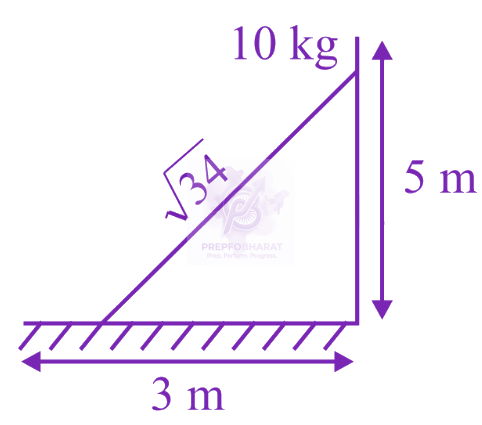
A wire of length $L$ and radius $r$ is clamped rigidly at one end. When the other end of the wire is pulled by a force $F$, its length increases by $5\mathrm{cm}$. Another wire of the same material of length $4L$ and radius $4r$ is pulled by a force $4F$ under same conditions. The increase in length of this wire is _____ $\mathrm{cm}$.
The distance of the Sun from earth is $1.5\times {10}^{11}m$ and its angular diameter is $2000''$ when observed from the earth. The diameter of the Sun will be
Assume there are two identical simple pendulum Clocks-$1$ is placed on the earth and Clock-$2$ is placed on a space station located at a height h above the earth surface. Clock-$1$ and Clock-$2$ operate at time periods $4s$ and $6s$ respectively. Then the value of $h$ is - (consider radius of earth ${R}_{E}=6400\mathrm{km}$ and $g$ on earth $10m{s}^{-2}$)
The length of a seconds pendulum at a height $h=2R$ from earth surface will be: (Given: $R=$ Radius of earth and acceleration due to gravity at the surface of earth $g={\pi }^{2}m{s}^{-2}$)
The escape velocity of a body on a planet $A$ is $12\mathrm{km}{s}^{-1}$. The escape velocity of the body on another planet $B$, whose density is four times and radius is half of the planet $A$, is
Two objects of equal masses placed at certain distance from each other attracts each other with a force of $F$. If one-third mass of one object is transferred to the other object, then the new force will be
The height of any point $P$ above the surface of earth is equal to diameter of earth. The value of acceleration due to gravity at point $P$ will be : (Given $g=$acceleration due to gravity at the surface of earth).
The approximate height from the surface of earth at which the weight of the body becomes $\frac{1}{3}$ of its weight on the surface of earth is : [Radius of earth $R=6400\mathrm{km}$ and $\sqrt{3}=1.732$]
Identify the pair of physical quantities which have different dimensions:
A fly wheel is accelerated uniformly from rest and rotates through $5\mathrm{rad}$ in the first second. The angle rotated by the fly wheel in the next second, will be :
A ball of mass $0.15\mathrm{kg}$ hits the wall with its initial speed of $12m{s}^{-1}$ and bounces back without changing its initial speed. If the force applied by the wall on the ball during the contact is $100N$. calculate the time duration of the contact of ball with the wall.
The dimensions of $(\frac{{B}^{2}}{{\mu }_{0}})$ will be (if ${\mu }_{0}$: permeability of free space and $B:$magnetic field)
The distance of the Sun from earth is $1.5\times {10}^{11}m$ and its angular diameter is $2000''$ when observed from the earth. The diameter of the Sun will be
If $Z=\frac{{A}^{2}{B}^{3}}{{C}^{4}}$, then the relative error in $Z$ will be
The diameter of an air bubble which was initially $2\mathrm{mm}$, rises steadily through a solution of density $1750 \mathrm{~kg} / \mathrm{m}^3$ at the rate of $0.35 \mathrm{~cm} / \mathrm{s}$. Coefficient of viscosity of the solution is ______ (Assume mass of the bubble to be negligible) (Answer in Poise to the nearest integer)
The maximum error in the measurement of resistance, current and time for which current flows in an electrical circuit are $1%,2%$ and $3%$ respectively. The maximum percentage error in the detection of the dissipated heat will be: