JEE Main Physics — Electromagnetism previous year questions with solutions.
Two metal plates $(A, B)$ are kept horizontally with separation of $\left(\dfrac{12}{\pi}\right)$ cm, with plate A on the top. An atomizer jet sprays oil (density $1.5$ g/cm$^3$) droplets of radius $1$ mm horizontally. All oil droplets carry a charge $5$ nC. The potentials $V_A$ and $V_B$ are required on plates A and B respectively in order to ensure the droplets do not descend. The values of $V_A$ and $V_B$ are _______. (Neglect the air resistance to the droplets and take $g = 10$ m/s$^2$)
A point charge of $10^{-8} \mathrm{C}$ is placed at origin. The work done in moving a point charge $2 \mu \mathrm{C}$ from point $A(4,4,2) \mathrm{m}$ to $B(2,2,1) \mathrm{m}$ is $\_\_\_\_$ J. $\left(\frac{1}{4 \pi \epsilon_{o}}=9 \times 10^{9}\right.$ in SI units $)$
A wire of uniform resistance $\lambda \Omega / \mathrm{m}$ is bent into a circle of radius $r$ and another piece of wire with length $2 r$ is connected between points $A$ and $B(A O B)$ as shown in figure. The equivalent resistance between points $A$ and $B$ is $\_\_\_\_$ $\Omega$. 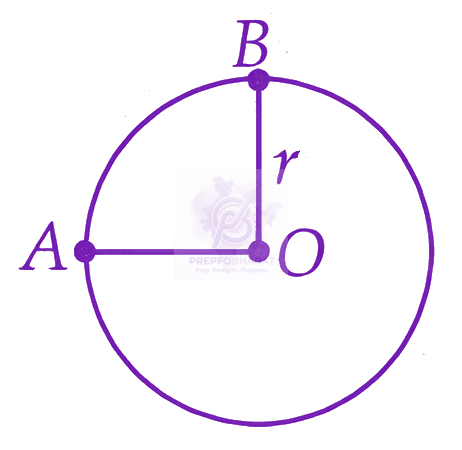
The ratio of speeds of electromagnetic waves in vacuum and a medium, having dielectric constant $k=3$ and permeability of $\mu=2 \mu_{0}$, is ($\mu_{0}=$ permeability of vacuum)
The total length of potentiometer wire AB is 50 cm in the arrangement as shown in figure. If $P$ is the point where the galvanometer shows zero reading then the length $A P$ is $\_\_\_\_$ cm. 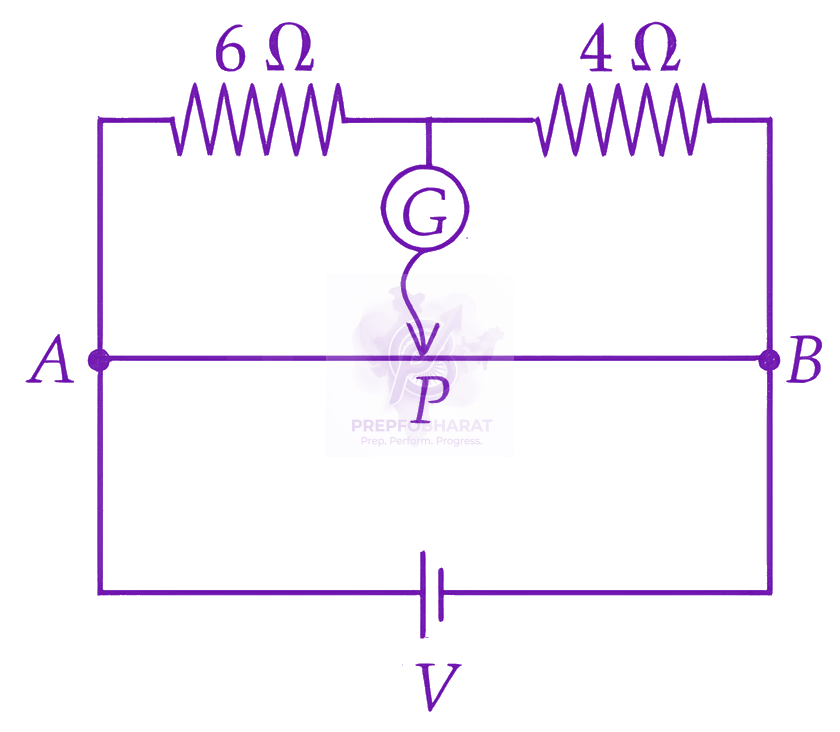
The charge stored by the capacitor $C$ in the given circuit in the steady state is $\_\_\_\_$ $\mu \mathrm{C}$. 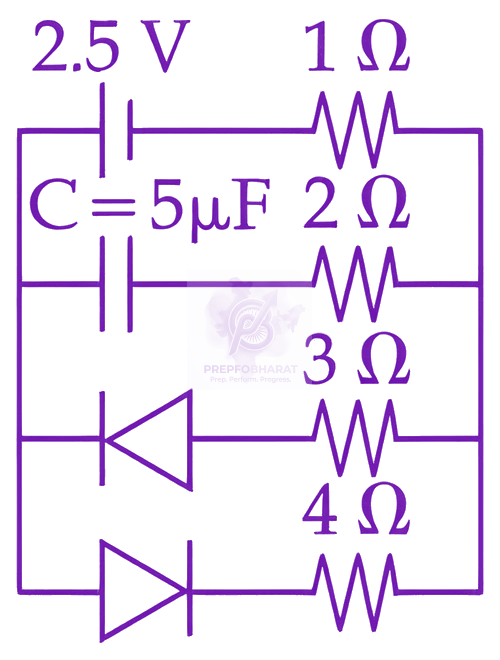
Two charges $7 \mu \mathrm{C}$ and $-2 \mu \mathrm{C}$ are placed at $(-9,0,0) \mathrm{cm}$ and $(9,0,0) \mathrm{cm}$ respectively in an external field $E=\frac{\mathrm{A}}{r^{2}} \hat{r}$, where $A=9 \times 10^{5} \mathrm{~N} / \mathrm{C}. \mathrm{m}^{2}$. Considering the potential at infinity is 0, the electrostatic energy of the configuration is $\_\_\_\_$ J.
Two identical long current carrying wires are bent into the shapes shown in the following figures. If the magnitude of magnetic fields at the centres P and Q of a semicircular arc are $B_1$ and $B_2$ respectively, then the ratio $\dfrac{B_1}{B_2}$ is _______. 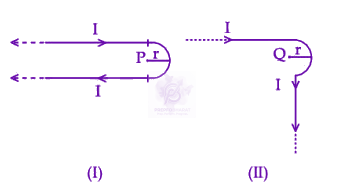
The equivalent resistance between the points $A$ and $B$ in the following circuit is $\frac{x}{5} \Omega$. The value of $x$ is $\_\_\_\_$. 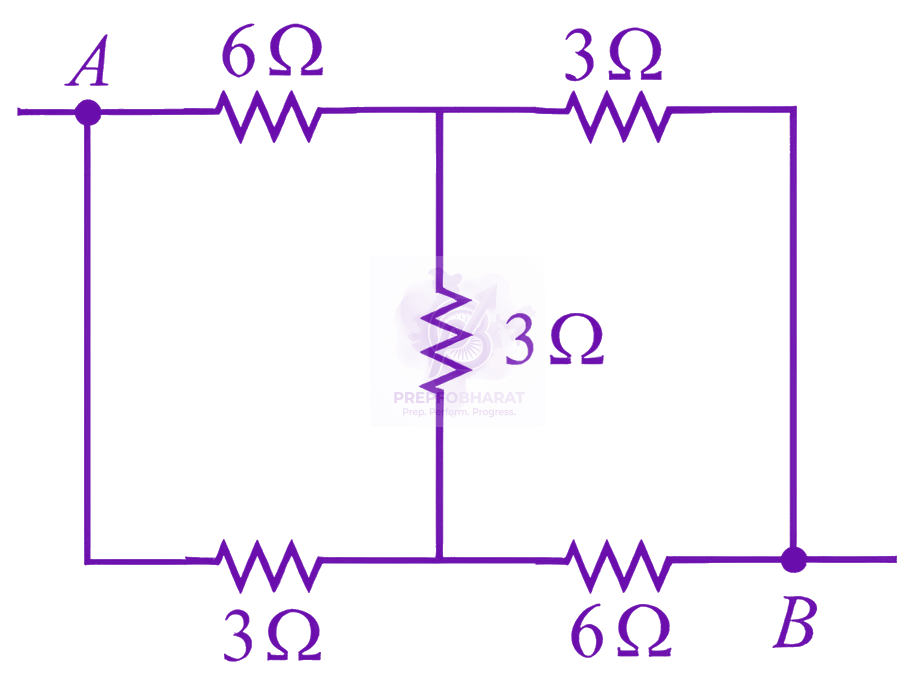
Two resistors $2 \Omega$ and $3 \Omega$ are connected in the gaps of bridge as shown in figure. The null point is obtained with the contact of jockey at some point on wire $X Y$. When an unknown resistor is connected in parallel with $3 \Omega$ resistor, the null point is shifted by 22.5 cm toward $Y$. The resistance of unknown resistor is $\_\_\_\_$ $\Omega$. 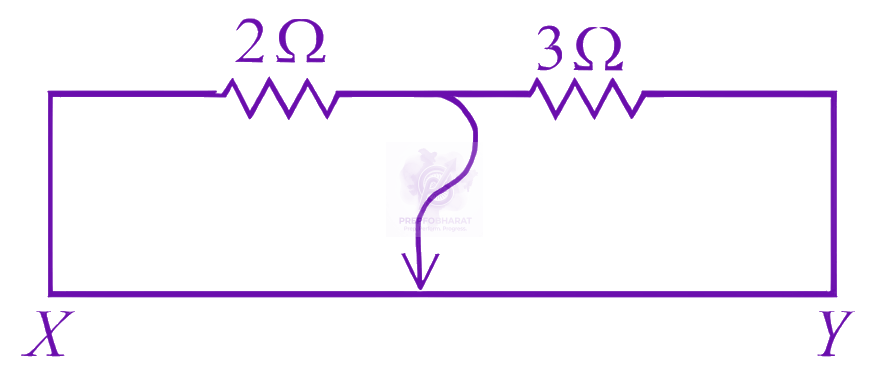
In a meter bridge experiment to determine the value of unknown resistance, first the resistances $2 \Omega$ and $3 \Omega$ are connected in the left and right gaps of the bridge and the null point is obtained at a distance $l \mathrm{~cm}$ from the left. Now when an unknown resistance $x \Omega$ is connected in parallel to $3 \Omega$ resistance, the null point is shifted by 10 cm to the right of wire. The value of unknown resistance $x$ is $\_\_\_\_$ $\Omega$.
A particle of charge $q$ and mass $m$ is projected from origin with an initial velocity $\vec{v} = \left(\dfrac{v_0}{\sqrt{2}}\hat{x} + \dfrac{v_0}{\sqrt{2}}\hat{y}\right)$. There exists a uniform magnetic field $\vec{B} = B_0 \hat{z}$ and a space varying electric field $\vec{E} = E_0 e^{-\lambda x}\hat{x}$ within the region $0 \leq x \leq L$. After travelling a distance such that $x$-coordinate has changed from $x=0$ to $x=L$, the change in the kinetic energy is _______.
In the given circuit below inductance values of $L_1$, $L_2$ and $L_3$ are same. The magnetic energy stored in the entire circuit is $(U_t)$ and that stored in the $L_2$ inductor is $(U_l)$. $U_t / U_l$ is __________. (Ignore the mutual inductance if any) 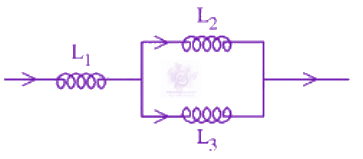
Five positive charges each having charge $q$ are placed at the vertices of a pentagon as shown in the figure. The electric potential $(V)$ and the electric field $(\vec{E})$ at the center $O$ of the pentagon due to these five positive charges are: 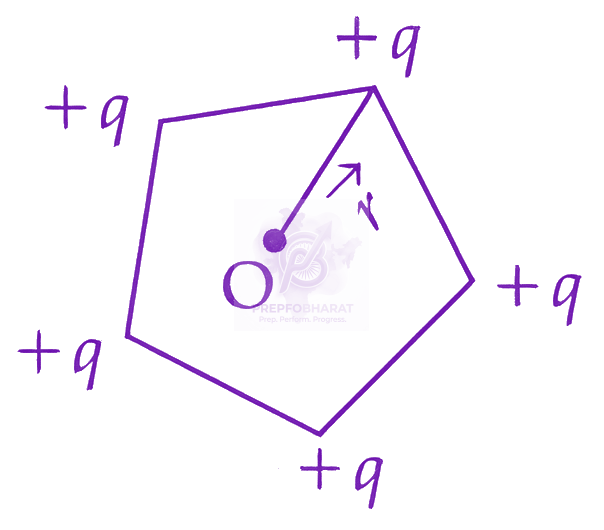
An infinitely long straight wire carrying current $I$ is bent in a planer shape as shown in the diagram. The radius of the circular part is $r$. The magnetic field at the centre $O$ of the circular loop is : 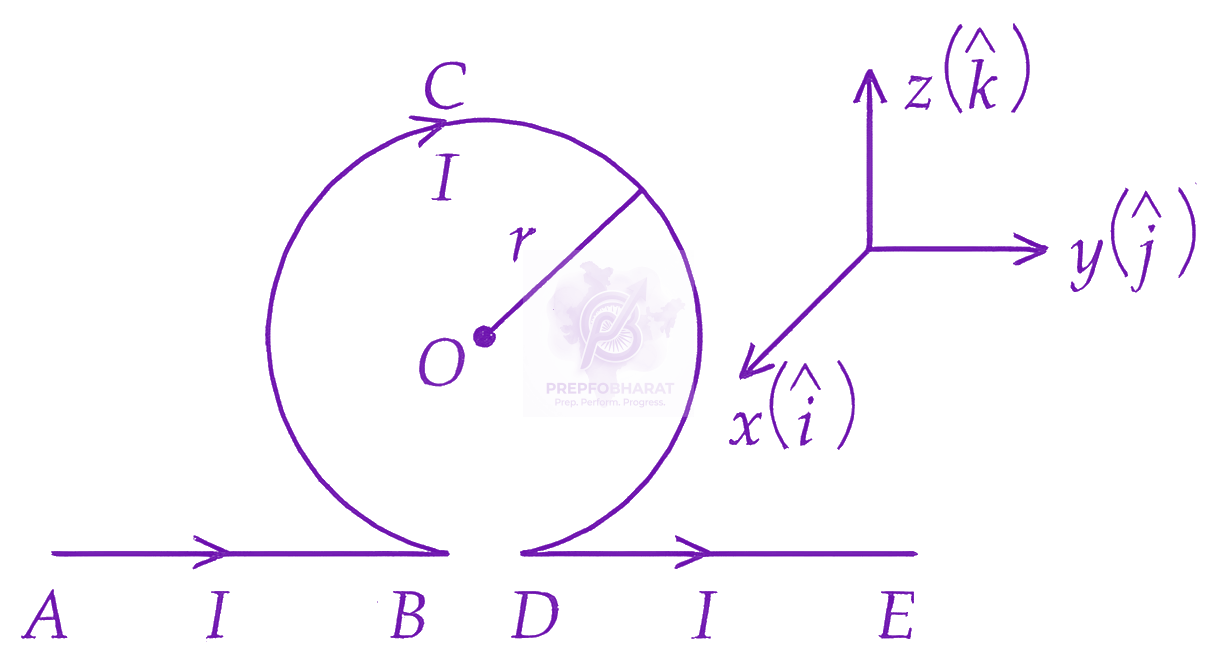
Two point charges $2 q$ and $q$ are placed at vertex $A$ and centre of face $C D E F$ of the cube as shown in figure. The electric flux passing through the cube is : 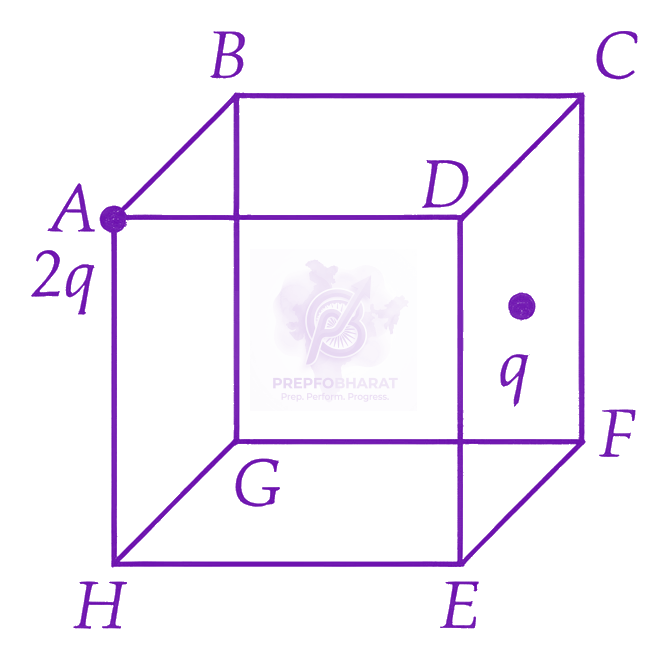
When an external resistance of $5\ \Omega$ is connected across terminals of a cell, a current of $0.25\text{ A}$ flows through it. When the $5\ \Omega$ resistor is replaced by a $2\ \Omega$ resistor, a current of $0.5\text{ A}$ flows through it. The internal resistance of the cell is _______ $\Omega$.
An inductor stores 16 J of magnetic field energy and dissipates 32 W of thermal energy due to its resistance when an a.c. current of 2 A (rms) and frequency 50 Hz flows through it. The ratio of inductive reactance to its resistance is $\_\_\_\_$. $(\pi=3.14)$
Which one of the following is not a measurable quantity?
A displacement current of $4.0$ A can be set up in the space between two parallel plates of $6$ $\mu$F capacitor. The rate of change of potential difference across the plates of the capacitor is nearly $\alpha \times 10^6$ V/s. The value of $\alpha$ is __________.
The electrostatic potential in a charged spherical region of radius $r$ varies as $V=a r^{3}+b$, where $a$ and $b$ are constants. The total charge in the sphere of unit radius is $\alpha \times \pi a \in_{\mathrm{o}}$. The value of $\alpha$ is $\_\_\_\_$. (permittivity of vacuum is $\epsilon_{0}$)
Two point charges $8 \, \mu C$ and $-2 \, \mu C$ are located at $x = 2$ cm and $x = 4$ cm, respectively on the $x$-axis. The ratio of electric flux due to these charges through two spheres of radii $3$ cm and $5$ cm with their centers at the origin is _______.
Two point charges of 1 nC and 2 nC are placed at the two corners of equilateral triangle of side 3 cm. The work done in bringing a charge of 3 nC from infinity to the third corner of the triangle is $\_\_\_\_$ $\mu \mathrm{J}$. $\frac{1}{4 \pi \epsilon_{0}}=9 \times 10^{9} \mathrm{~N}. \mathrm{m}^{2} / \mathrm{C}^{2}$
Electric field in a region is given by $\vec{E}=A x \hat{i}+B y \hat{j}$, where $A=10 \mathrm{~V} / \mathrm{m}^{2}$ and $B=5 \mathrm{~V} / \mathrm{m}^{2}$. If the electric potential at a point $(10,20)$ is 500 V, then the electric potential at origin is $\_\_\_\_$ V.