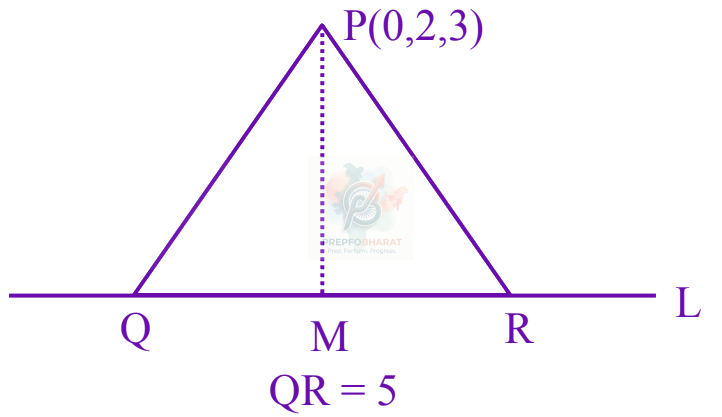
M(5λ−3,2λ+1,3λ−4)
Drs of PM ⇒5λ−3,2λ−1,3λ−7
Drs of line L⇒5,2,3
PM⊥L
⇒(5λ−3)5+(2λ−1)2+(3λ−7)3=0
⇒λ=1
∴M(2,3,−1)
PM=4+1+16=21
Area =21×5×21=nm
2 m−521n=0
JEE Main 2025 — Mathematics Vectors & 3D Geometry
Let the vertices Q and R of the triangle PQR lie on the line 5x+3=2y−1=3z+4,QR=5 and the coordinates of the point P be (0,2,3). If the area of the triangle PQR is nm then :
Held on 2 Apr 2025 · Verified 6 Jul 2026.
m−521n=0
2 m−521n=0
5 m−221n=0
5m−212n=0
Sign in to track your attempts and accuracy.
Sign in to keep a private note on this question. Nothing you write is ever public.
Let $\hat{u}$ and $\hat{v}$ be unit vectors inclined at an acute angle such that $|\hat{u}\times\hat{v}|=\dfrac{\sqrt{3}}{2}$. If $\vec{A}=\lambda\hat{u}+\hat{v}+(\hat{u}\times\hat{v})$, then $\lambda$ is equal to:
Let $\vec{a}, \vec{b}, \vec{c}$ be three vectors such that $\vec{a} \times \vec{b}=2(\vec{a} \times \vec{c})$. If $|\vec{a}|=1,|\vec{b}|=4,|\vec{c}|=2$, and the angle between $\vec{b}$ and $\vec{c}$ is $60^{\circ}$, then $|\vec{a} \cdot \vec{c}|$ is equal to
If the distances of the point $(1,2, a)$ from the line $\frac{x-1}{1}=\frac{y}{2}=\frac{z-1}{1}$ along the lines $\mathrm{L}_{1}: \frac{x-1}{3}=\frac{y-2}{4}=\frac{z-a}{b}$ and $\mathrm{L}_{2}: \frac{x-1}{1}=\frac{y-2}{4}=\frac{z-a}{c}$ are equal, then $a+b+c$ is equal to
If the distance of the point $\mathrm{P}(43, \alpha, \beta), \beta<0$, from the line $\overrightarrow{\mathrm{r}}=4 \hat{i}-\hat{k}+\mu(2 \hat{i}+3 \hat{k}), \mu \in \mathbf{R}$ along a line with direction ratios $3,-1,0$ is $13 \sqrt{10}$, then $\alpha^{2}+\beta^{2}$ is equal to $\_\_\_\_$
Let $\overrightarrow{\mathrm{AB}}=2 \hat{i}+4 \hat{j}-5 \hat{k}$ and $\overrightarrow{\mathrm{AD}}=\hat{i}+2 \hat{j}+\lambda \hat{k}, \lambda \in \mathbb{R}$. Let the projection of the vector $\vec{v}=\hat{i}+\hat{j}+\hat{k}$ on the diagonal $\overrightarrow{\mathrm{AC}}$ of the parallelogram ABCD be of length one unit. If $\alpha, \beta$, where $\alpha>\beta$, be the roots of the equation $\lambda^{2} x^{2}-6 \lambda x+5=0$, then $2 \alpha-\beta$ is equal to
Work through every JEE Main Vectors & 3D Geometry PYQ, year by year.