JEE Main 2021 — Vectors & 3D Geometry
Mathematics Vectors & 3D Geometry questions from JEE Main 2021.
Other Years
42 Vectors & 3D Geometry Questions from 2021
The angle between vectors a=i+j and b=j+k is:
Let $\vec{a}=2\hat{i}+\hat{j}-2\hat{k}$ and $\vec{b}=\hat{i}+\hat{j}$. If $\vec{c}$ is a vector such that $\vec{a}\cdot \vec{c}=|\vec{c}|,|\vec{c}-\vec{a}|=2\sqrt{2}$ and the angle between $(\vec{a}\times \vec{b})$ and $\vec{c}$ is $\frac{\pi }{6}$, then the value of $|(\vec{a}\times \vec{b})\times \vec{c}|$ is:
Let the vectors $(2+a+b)\hat{i}+(a+2b+c)\hat{j}-(b+c)\hat{k},(1+b)\hat{i}+2b\hat{j}-b\hat{k}$ and $(2+b)\hat{i}+2b\hat{j}+(1-b)\hat{k},\forall a,b,c\in R$ be co-planar. Then which of the following is true?
In a triangle $ABC,$ if $|\vec{BC}|=3,|\vec{CA}|=5$ and $|\vec{BA}|=7,$ then the projection of the vector $\vec{BA}$ on $\vec{BC}$ is equal to
Let $\vec{c}$ be a vector perpendicular to the vectors $\vec{a}=\hat{i}+\hat{j}-\hat{k}$ and $\vec{b}=\hat{i}+2\hat{j}+\hat{k}$. If $\vec{c}\cdot (\hat{i}+\hat{j}+3\hat{k})=8$, then the value of $\vec{c}\cdot (\vec{a}\times \vec{b})$ is equal to
The lines $x=ay-1=z-2$ and $x=3y-2=bz-2,(ab\neq 0)$ are coplanar, if:
The angle between the straight lines, whose direction cosines $l,m,n$ are given by the equations $2l+2m-n=0$ and $mn+nl+lm=0$, is:
Let $\vec{a}=2\hat{i}-\hat{j}+2\hat{k}$ and $\vec{b}=\hat{i}+2\hat{j}-\hat{k}.$ Let a vector $\vec{v}$ be in the plane containing $\vec{a}$ and $\vec{b}.$ If $\vec{v}$ is perpendicular to the vector $3\hat{i}+2\hat{j}-\hat{k}$ and its projection on $\vec{a}$ is $19$ units, then $|2\vec{v}{|}^{2}$ is equal to _____.
A hall has a square floor of dimension $10m\times 10m$ (see the figure) and vertical walls. If the angle $GPH$ between the diagonals $AG$ and $BH$ is ${\mathrm{cos}}^{-1}\frac{1}{5},$ then the height of the hall (in meters) is: 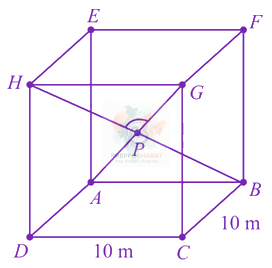
Let $\vec{a}=\hat{i}+5\hat{j}+\alpha \hat{k},\vec{b}=\hat{i}+3\hat{j}+\beta \hat{k}$ and $\vec{c}=-\hat{i}+2\hat{j}-3\hat{k}$ be three vectors such that, $|\vec{b}\times \vec{c}|=5\sqrt{3}$ and $\vec{a}$ is perpendicular to $\vec{b}.$ Then the greatest amongst the values of $|\vec{a}{|}^{2}$ is ________.
Let $a,b$ and $c$ be distinct positive numbers. If the vectors $a\hat{i}+a\hat{j}+c\hat{k},\hat{i}+\hat{k}$ and $c\hat{i}+c\hat{j}+b\hat{k}$ are co-planar, then $c$ is equal to:
Let $\vec{a}=\hat{i}+2\hat{j}-\hat{k},\vec{b}=\hat{i}-\hat{j}$ and $\vec{c}=\hat{i}-\hat{j}-\hat{k}$ be three given vectors. If $\vec{r}$ is a vector such that $\vec{r}\times \vec{a}=\vec{c}\times \vec{a}$ and $\vec{r}\cdot \vec{b}=0,$ then $\vec{r}\cdot \vec{a}$ is equal to
Let $\vec{a},\vec{b},\vec{c}$ be three mutually perpendicular vectors of the same magnitude and equally inclined at an angle $\theta$, with the vector $\vec{a}+\vec{b}+\vec{c}$. Then $36{\mathrm{cos}}^{2}2\theta$ is equal to
In a triangle $ABC$, if $|\vec{BC}|=8,|\vec{CA}|=7,|\vec{AB}|=10$, then the projection of the vector $\vec{AB}$ on $\vec{AC}$ is equal to :
Let $\vec{a}=\hat{i}+\alpha \hat{j}+3\hat{k}$ and $\vec{b}=3\hat{i}-\alpha \hat{j}+\hat{k}$. If the area of the parallelogram whose adjacent sides are represented by the vectors $\vec{a}$ and $\vec{b}$ is $8\sqrt{3}$ square units, then $\vec{a}\cdot \vec{b}$ is equal to ___ .
Let $\vec{a}=2\hat{i}-3\hat{j}+4\hat{k}$ and $\vec{b}=7\hat{i}+\hat{j}-6\hat{k}$ If $\vec{r}\times \vec{a}=\vec{r}\times \vec{b},\vec{r}\cdot (\hat{i}+2\hat{j}+\hat{k})=-3,$ then $\vec{r}\cdot (2\hat{i}-3\hat{j}+\hat{k})$ is equal to:
If the foot of the perpendicular from point $(4,3,8)$ on the line ${L}_{1}:\frac{x-a}{l}=\frac{y-2}{3}=\frac{z-b}{4}$, $l\neq 0$ is $(3,5,7),$ then the shortest distance between the line ${L}_{1}$ and line ${L}_{2}:\frac{x-2}{3}=\frac{y-4}{4}=\frac{z-5}{5}$ is equal to
For real numbers $\alpha$ and $\beta \neq 0,$ if the point of intersection of the straight lines $\frac{x-\alpha }{1}=\frac{y-1}{2}=\frac{z-1}{3}$ and $\frac{x-4}{\beta }=\frac{y-6}{3}=\frac{z-7}{3}$ lies on the plane $x+2y-z=8,$ then $\alpha -\beta$ is equal to :
Let $\vec{p}=2\hat{i}+3\hat{j}+\hat{k}$ and $\vec{q}=\hat{i}+2\hat{j}+\hat{k}$ be two vectors. If a vector $\vec{r}=(\alpha \hat{i}+\beta \hat{j}+\gamma \hat{k})$ is perpendicular to each of the vectors $(\vec{p}+\vec{q})$ and $(\vec{p}-\vec{q})$, and $|\vec{r}|=\sqrt{3}$, then $|\alpha |+|\beta |+|\gamma |$ is equal to
A line $l$ passing through origin is perpendicular to the lines ${l}_{1}:\vec{r}=(3+t)\hat{i}+(-1+2t)\hat{j}+(4+2t)\hat{k}$ ${l}_{2}:\vec{r}=(3+2s)\hat{i}+(3+2s)\hat{j}+(2+s)\hat{k}$ If the co-ordinates of the point in the first octant on ${l}_{2}$ at a distance of $\sqrt{17}$ from the point of intersection of $l$ and ${l}_{1}$ are $(a,b,c)$, then $18(a+b+c)$ is equal to ___ .
Let $O$ be the origin. Let $\vec{OP}=x\hat{i}+y\hat{j}-\hat{k}$ and $\vec{OQ}=-\hat{i}+2\hat{j}+3x\hat{k},x,y\in R,x>0,$ be such that $|\vec{PQ}|=\sqrt{20}$ and the vector $\vec{OP}$ is perpendicular to $\vec{OQ}.$ If $\vec{OR}=3\hat{i}+z\hat{j}-7\hat{k},z\in R,$ is coplanar with $\vec{OP}$ and $\vec{OQ},$ then the value of ${x}^{2}+{y}^{2}+{z}^{2}$ is equal to
Let $\vec{a}=\hat{i}-\alpha \hat{j}+\beta \hat{k},\vec{b}=3\hat{i}+\beta \hat{j}-\alpha \hat{k}$ and $\vec{c}=-\alpha \hat{i}-2\hat{j}+\hat{k},$ where $\alpha$ and $\beta$ are integers. If $\vec{a}\cdot \vec{b}=-1$ and $\vec{b}\cdot \vec{c}=10,$ then $(\vec{a}\times \vec{b})\cdot \vec{c}$ is equal to ______.
Let $\vec{a}=\hat{i}+\hat{j}+\hat{k},\vec{b}$ and $\vec{c}=\hat{j}-\hat{k}$ be three vectors such that $\vec{a}\times \vec{b}=\vec{c}$ and $\vec{a}\cdot \vec{b}=1.$ If the length of projection vector of the vector $\vec{b}$ on the vector $\vec{a}\times \vec{c}$ is $l,$ then the value of $3{l}^{2}$ is equal to _____.
The equation of the line through the point $(0,1,2)$ and perpendicular to the line $\frac{x-1}{2}=\frac{y+1}{3}=\frac{z-1}{-2}$ is :
If vectors $\vec{{a}_{1}}=x\hat{i}-\hat{j}+\hat{k}$ and $\vec{{a}_{2}}=\hat{i}+y\hat{j}+z\hat{k}$ are collinear, then a possible unit vector parallel to the vector $x\hat{i}+y\hat{j}+z\hat{k}$ is:
If the projection of the vector $\hat{i}+2\hat{j}+\hat{k}$ on the sum of the two vectors $2\hat{i}+4\hat{j}-5\hat{k}$ and $-\lambda \hat{i}+2\hat{j}+3\hat{k}$ is $1$, then $\lambda$ is equal to _______.
If $\vec{a}$ and $\vec{b}$ are unit vectors and $(\vec{a}+3\vec{b})$ is perpendicular to $(7\vec{a}-5\vec{b})$ and $(\vec{a}-4\vec{b})$ is perpendicular to $(7\vec{a}-2\vec{b}),$ then the angle between $\vec{a}$ and $\vec{b}$ (in degrees) is _________.
If $\vec{a}=\alpha \hat{i}+\beta \hat{j}+3\hat{k},\vec{b}=-\beta \hat{i}-\alpha \hat{j}-\hat{k}$ and $\vec{c}=\hat{i}-2\hat{j}-\hat{k}$ such that $\vec{a}\cdot \vec{b}=1$ and $\vec{b}\cdot \vec{c}=-3,$ then $\frac{1}{3}((\vec{a}\times \vec{b})\cdot \vec{c})$ is equal to _______.
Let $\alpha$ be the angle between the lines whose direction cosines satisfy the equations $l+m-n=0$ and ${l}^{2}+{m}^{2}-{n}^{2}=0$. Then the value of ${\mathrm{sin}}^{4}\alpha +{\mathrm{cos}}^{4}\alpha$ is :
A vector $\vec{a}$ has components $3p$ and $1$ with respect to a rectangular cartesian system. This system is rotated through a certain angle about the origin in the counter clockwise sense. If, with respect to new system, $\vec{a}$ has components $p+1$ and $\sqrt{10},$ then a value of $p$ is equal to:
If the shortest distance between the straight lines $3(x-1)=6(y-2)=2(z-1)$ and $4(x-2)=2(y-\lambda )=(z-3),\lambda \in R$ is $\frac{1}{\sqrt{38}},$ then the integral value of $\lambda$ is equal to:
Let a vector $\alpha \hat{i}+\beta \hat{j}$ be obtained by rotating the vector $\sqrt{3}\hat{i}+\hat{j}$ by an angle $45^{\circ}$ about the origin in counterclockwise direction in the first quadrant. Then the area (in sq. units) of triangle having vertices $(\alpha ,\beta ),(0,\beta )$ and $(0,0)$ is equal to
Let $\vec{x}$ be a vector in the plane containing vectors $\vec{a}=2\hat{i}-\hat{j}+\hat{k}$ and $\vec{b}=\hat{i}+2\hat{j}-\hat{k}.$ If the vector $\vec{x}$ is perpendicular to $(3\hat{i}+2\hat{j}-\hat{k})$ and its projection on $\vec{a}$ is $\frac{17\sqrt{6}}{2},$ then the value of ${|\vec{x}|}^{2}$ is equal to _______.
Let the position vectors of two points $P$ and $Q$ be $3\hat{i}-\hat{j}+2\hat{k}$ and $\hat{i}+2\hat{j}-4\hat{k}$, respectively. Let $R$ and $S$ be two points such that the direction ratios of lines $PR$ and $QS$ are $(4,-1,2)$ and $(-2,1,-2)$, respectively. Let lines $PR$ and $QS$ intersect at $T$. If the vector $\vec{TA}$ is perpendicular to both $\vec{PR}$ and $\vec{QS}$ and the length of vector $\vec{TA}$ is $\sqrt{5}$ units, then the modulus of a position vector of $A$ is :
If $|\vec{a}|=2,|\vec{b}|=5$ and $|\vec{a}\times \vec{b}|=8,$ then $|\vec{a}\cdot \vec{b}|$ is equal to:
Let $\vec{a}=\hat{i}+2\hat{j}-3\hat{k}$ and $\vec{b}=2\hat{i}-3\hat{j}+5\hat{k}$. If $\vec{r}\times \vec{a}=\vec{b}\times \vec{r},\vec{r}\cdot (\alpha \hat{i}+2\hat{j}+\hat{k})=3$ and $\vec{r}\cdot (2\hat{i}+5\hat{j}-\alpha \hat{k})=-1,\alpha \in R,$ then the value of $\alpha +|\vec{r}{|}^{2}$ is equal to :
Let $\vec{a}$ and $\vec{b}$ be two vectors such that $|2\vec{a}+3\vec{b}|=|3\vec{a}+\vec{b}|$ and the angle between $\vec{a}$ and $\vec{b}$ is $60^{\circ}.$ If $\frac{1}{8}\vec{a}$ is a unit vector, then $|\vec{b}|$ is equal to :
If the shortest distance between the lines $\vec{{r}_{1}}=\alpha \hat{i}+2\hat{j}+2\hat{k}+\lambda (\hat{i}-2\hat{j}+2\hat{k}),\lambda \in R,\alpha >0$ and $\vec{{r}_{2}}=-4\hat{i}-\hat{k}+\mu (3\hat{i}-2\hat{j}-2\hat{k}),\mu \in R$ is $9,$ then $\alpha$ is equal to_____.
Let $a,b\in R.$ If the mirror image of the point $P(a,6,9)$ with respect to the line $\frac{x-3}{7}=\frac{y-2}{5}=\frac{z-1}{-9}$ is $(20,b,-a-9),$ then $|a+b|$ is equal to:
For $p>0,$ a vector ${\vec{v}}_{2}=2\hat{i}+(p+1)\hat{j}$ is obtained by rotating the vector ${\vec{v}}_{1}=\sqrt{3}p\hat{i}+\hat{j}$ by an angle $\theta$ about origin in counter clockwise direction. If $\mathrm{tan}\theta =\frac{(\alpha \sqrt{3}-2)}{(4\sqrt{3}+3)}$, then the value of $\alpha$ is equal to
The distance of the point $P(3,4,4)$ from the point of intersection of the line joining the points $Q(3,-4,-5)$ and $R(2,-3,1)$ and the plane $2x+y+z=7,$ is equal to _____.
Let $\vec{a}$ and $\vec{b}$ be two non-zero vectors perpendicular to each other and $|\vec{a}|=|\vec{b}|$, If $|\vec{a}\times \vec{b}|=|\vec{a}|$, then the angle between the vectors $(\vec{a}+\vec{b}+(\vec{a}\times \vec{b}))$ and $\vec{a}$ is equal to :