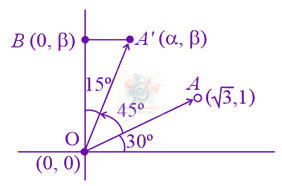
Area of Δ(OA′B)=21OA′cos15∘×OA′sin15∘
=21(OA′)22sin30∘
Now, ∣OA∣=∣OA′∣, since rotation will not change the magnitude.
=(3+1)×81=21 sq. units
JEE Main 2021 — Mathematics Vectors & 3D Geometry
Let a vector αi^+βj^ be obtained by rotating the vector 3i^+j^ by an angle 45∘ about the origin in counterclockwise direction in the first quadrant. Then the area (in sq. units) of triangle having vertices (α,β),(0,β) and (0,0) is equal to
Held on 16 Mar 2021 · Verified 6 Jul 2026.
21
1
21
22
Sign in to track your attempts and accuracy.
Sign in to keep a private note on this question. Nothing you write is ever public.
Let $\hat{u}$ and $\hat{v}$ be unit vectors inclined at an acute angle such that $|\hat{u}\times\hat{v}|=\dfrac{\sqrt{3}}{2}$. If $\vec{A}=\lambda\hat{u}+\hat{v}+(\hat{u}\times\hat{v})$, then $\lambda$ is equal to:
Let $\vec{a}, \vec{b}, \vec{c}$ be three vectors such that $\vec{a} \times \vec{b}=2(\vec{a} \times \vec{c})$. If $|\vec{a}|=1,|\vec{b}|=4,|\vec{c}|=2$, and the angle between $\vec{b}$ and $\vec{c}$ is $60^{\circ}$, then $|\vec{a} \cdot \vec{c}|$ is equal to
If the distances of the point $(1,2, a)$ from the line $\frac{x-1}{1}=\frac{y}{2}=\frac{z-1}{1}$ along the lines $\mathrm{L}_{1}: \frac{x-1}{3}=\frac{y-2}{4}=\frac{z-a}{b}$ and $\mathrm{L}_{2}: \frac{x-1}{1}=\frac{y-2}{4}=\frac{z-a}{c}$ are equal, then $a+b+c$ is equal to
If the distance of the point $\mathrm{P}(43, \alpha, \beta), \beta<0$, from the line $\overrightarrow{\mathrm{r}}=4 \hat{i}-\hat{k}+\mu(2 \hat{i}+3 \hat{k}), \mu \in \mathbf{R}$ along a line with direction ratios $3,-1,0$ is $13 \sqrt{10}$, then $\alpha^{2}+\beta^{2}$ is equal to $\_\_\_\_$
Let $\overrightarrow{\mathrm{AB}}=2 \hat{i}+4 \hat{j}-5 \hat{k}$ and $\overrightarrow{\mathrm{AD}}=\hat{i}+2 \hat{j}+\lambda \hat{k}, \lambda \in \mathbb{R}$. Let the projection of the vector $\vec{v}=\hat{i}+\hat{j}+\hat{k}$ on the diagonal $\overrightarrow{\mathrm{AC}}$ of the parallelogram ABCD be of length one unit. If $\alpha, \beta$, where $\alpha>\beta$, be the roots of the equation $\lambda^{2} x^{2}-6 \lambda x+5=0$, then $2 \alpha-\beta$ is equal to
Work through every JEE Main Vectors & 3D Geometry PYQ, year by year.