Plotting the diagram of the given straight line we get,
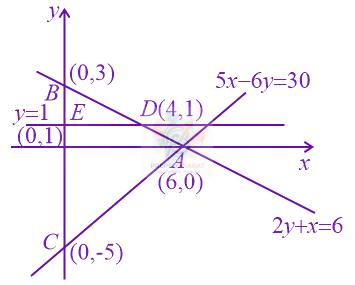
Now by diagram, required probability =ar(ABC)ar(ADEC)
=1−ar(ABC)ar(BDE)
=1−21×8×621×2×4=1−61=65
JEE Main 2022 — Mathematics Probability & Statistics
If a point A(x,y) lies in the region bounded by the y-axis, straight lines 2y+x=6 and 5x−6y=30, then the probability that y<1 is
Held on 27 Jun 2022 · Verified 6 Jul 2026.
61
65
32
76
Sign in to track your attempts and accuracy.
Sign in to keep a private note on this question. Nothing you write is ever public.
If the mean of the data <table class="pyq-table"><tbody><tr><th>Class</th><th>$5-10$</th><th>$10-15$</th><th>$15-20$</th><th>$20-25$</th><th>$25-30$</th><th>$30-35$</th></tr><tr><td>Frequency</td><td>$2$</td><td>$k$</td><td>$28$</td><td>$54$</td><td>$k+1$</td><td>$5$</td></tr></tbody></table> is $21$, then $k$ is one of the roots of the equation :
If the mean and the variance of the data \(\begin{array}{|c|c|c|c|c|} \hline \text{Class} & 4\text{-}8 & 8\text{-}12 & 12\text{-}16 & 16\text{-}20 \\ \hline \text{Frequency} & 3 & \lambda & 4 & 7 \\ \hline \end{array}\) are $\mu$ and 19 respectively, then the value of $\lambda+\mu$ is
The probability distribution of a random variable $X$ is given below : \(\begin{array}{|c|c|c|c|c|c|c|c|c|} \hline X & 4k & \dfrac{30}{7}k & \dfrac{32}{7}k & \dfrac{34}{7}k & \dfrac{36}{7}k & \dfrac{38}{7}k & \dfrac{40}{7}k & 6k \\ \hline P(X) & \dfrac{2}{15} & \dfrac{1}{15} & \dfrac{2}{15} & \dfrac{1}{5} & \dfrac{1}{15} & \dfrac{2}{15} & \dfrac{1}{5} & \dfrac{1}{15} \\ \hline \end{array}\) If $\mathrm{E}(\mathrm{X})=\frac{263}{15}$, then $\mathrm{P}(\mathrm{X}<20)$ is equal to :
A candidate has to go to the examination centre to appear in an examination. The candidate uses only one means of transportation for the entire distance out of bus, scooter and car. The probabilities of the candidate going by bus, scooter and car, respectively, are $\dfrac{2}{5}$, $\dfrac{1}{5}$ and $\dfrac{2}{5}$. The probabilities that the candidate reaches late at the examination centre are $\dfrac{1}{5}$, $\dfrac{1}{3}$ and $\dfrac{1}{4}$ if the candidate uses bus, scooter and car, respectively. Given that the candidate reached late at the examination centre, the probability that the candidate travelled by bus is:
A bag contains 6 blue and 6 green balls. Pairs of balls are drawn without replacement until the bag is empty. The probability that each drawn pair consists of one blue and one green ball is :
Work through every JEE Main Probability & Statistics PYQ, year by year.