Let m_1,m_2 be the slopes of two adjacent sides of a square of side a such that a^2+11a+3(m_1^2+m_2^2)=220. If one vertex of the square is (10( cosα…
JEE Main 2022 — Mathematics Coordinate Geometry
2022mcqhard
Let m1,m2 be the slopes of two adjacent sides of a square of side a such that a2+11a+3(m12+m22)=220. If one vertex of the square is (10(cosα−sinα),10(sinα+cosα)), where α∈(0,2π) and the equation of one diagonal is (cosα−sinα)x+(sinα+cosα)y=10, then 72(sin4α+cos4α)+a2−3a+13 is equal to
Official previous-year question
Held on 29 Jul 2022 · Verified 6 Jul 2026.
Options
A
119
B
128
C
145
D
155
Did you get this right?
Sign in to track your attempts and accuracy.
Solution
Given {m}_{1}&{m}_{2} are slopes of two adjacent sides of square then, m1m2=−1
Also given a2+11a+3(m12+m22)=220
⇒a2+11a+3(m12+m121)=220
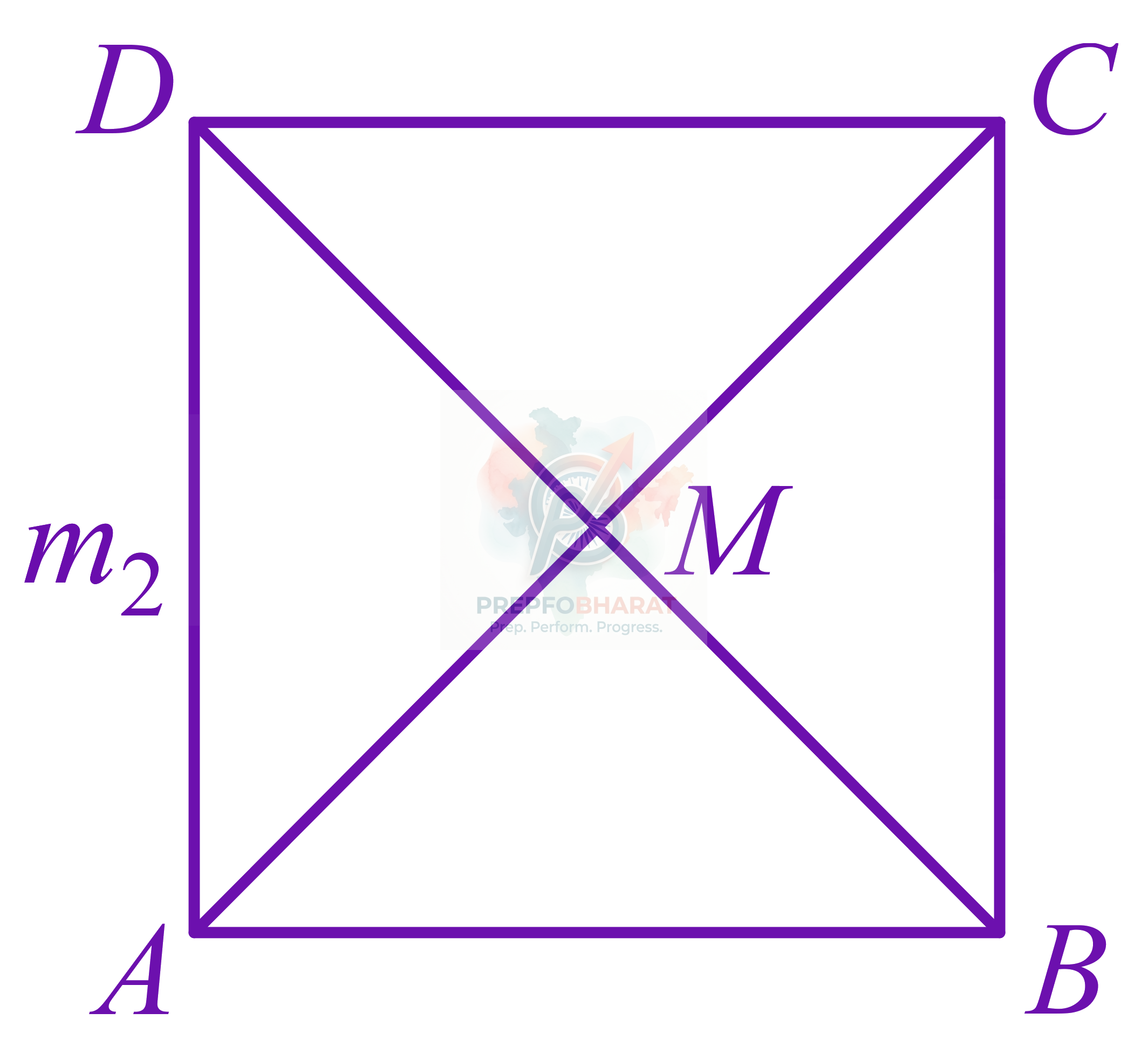
Now on plotting the diagram we get,
Now given equation of AC,
(cosα−sinα)x+(sinα+cosα)y=10
Now by property of square we know that diagonals are perpendicular to each other
So equation of BD will be (sinα+cosα)x+(sinα−cosα)y+λ=0 now is passes through D(10(cosα−sinα),10(sinα−cosα)),
So, equation of BD=(sinα+cosα)x+(sinα−cosα)y=0
Now slope of AB&AD will be given by angle bisector equation of AC&BD