Given, the two adjacent vertices of the rectangle are (−8,5) and (6,5), the y-co-ordinates of both of these points is same this means they lie on the line y=5, which is parallel to the x-axis.
And, we know that the sides of a rectangle are perpendicular to each other, hence the other two sides passing through these vertices are parallel to y-axis.
Also, we know that the equation of a line parallel y-axis is x=k.
Therefore, the equation of the sides of the rectangle passing through (−8,5) and (6,5) are respectively x=−8 and x=6.
And, hence the other two vertices of the rectangle can be taken as (6,a) and (−8,b).
And since the other side is parallel to x-axis, hence a=b.
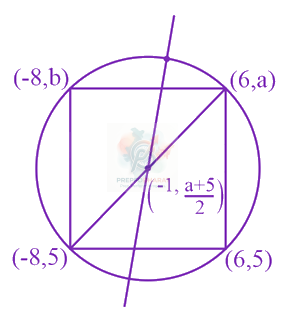
Here, diagonal subtends right angle at the circumference of circle, so its mid-point is the same as centre of circle, which lies on the given diameter.
The mid-point of a line segment joining the points (x1,y1) and (x2,y2) is (2x1+x2,2y1+y2), hence, the mid-point of the diagonal of the rectangle is (2−8+6,2a+5)=(−1,2a+5)
This point lie on the diameter 3y=x+7
So, 23(a+5)=−1+7
⇒a+5=32(6)
⇒a=−1
Hence, the vertices are (−8,5),(6,5),(6,−1) and (−8,−1).
The distance between the points (x1,y1) and (x2,y2) is (x1−x2)2+(y1−y2)2
Thus, the length of sides are 6 and 14 units.
Hence, area =l×b=14×6=84 sq. units