Given, e=21 and ea=4
⇒a=2,
Also, b2=a2(1−e2)
⇒b2=3
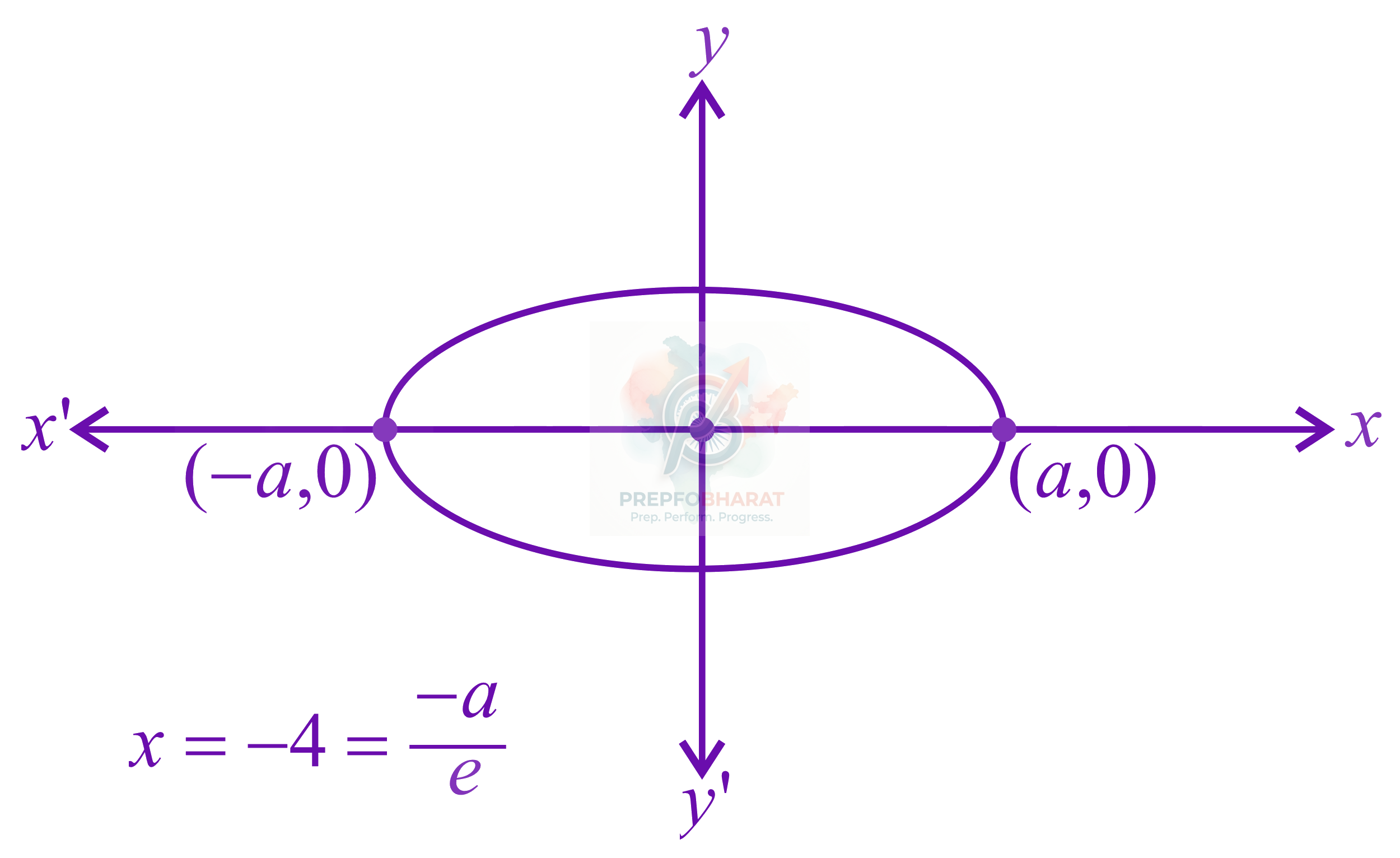
Equation of ellipse is 4x2+3y2=1
We know that, equation of normal to the ellipse a2x2+b2y2=1 at (x1,y1) is x1a2x−y1b2y=a2−b2
So, equation of normal at (1,23) is 14x−3/23y=4−3
⇒4x−2y=1
JEE Main 2017 — Mathematics Coordinate Geometry
The eccentricity of an ellipse whose centre is at the origin is 21 . If one of its directrices is x=−4 , then the equation of the normal to it at (1,23) is:
Held on 2 Apr 2017 · Verified 6 Jul 2026.
2y−x=2
4x−2y=1
4x+2y=7
x+2y=4
Sign in to track your attempts and accuracy.
Sign in to keep a private note on this question. Nothing you write is ever public.
Let $A,B$ be points on the two half-lines $x-\sqrt{3}|y|=\alpha$, $\alpha>0$ at a distance of $\alpha$ from their point of intersection $P$. The line segment $AB$ meets the angle bisector of the given half-lines at the point $Q$. If $PQ=\dfrac{9}{2}$ and $R$ is the radius of the circumcircle of $\triangle PAB$, then $\dfrac{\alpha^2}{R}$ is equal to ______
If a straight line drawn through the point of intersection of the lines $4x+3y-1=0$ and $3x+4y-1=0$, meets the co-ordinate axes at the points P and Q, then the locus of the mid point of PQ is:
Let $C$ be a circle having centre in the first quadrant and touching the $x$-axis at a distance of $3$ units from the origin. If the circle $C$ has an intercept of length $6\sqrt{3}$ on $y$-axis, then the length of the chord of the circle $C$ on the line $x - y = 3$ is :
Let O be the origin, and P and Q be two points on the rectangular hyperbola $xy = 12$ such that the mid point of the line segment PQ is $\left(\dfrac{1}{2}, -\dfrac{1}{2}\right)$. Then the area of the triangle OPQ equals:
Let the vertex $A$ of a triangle $ABC$ be $(1, 2)$, and the mid-point of the side $AB$ be $(5, -1)$. If the centroid of this triangle is $(3, 4)$ and its circumcenter is $(\alpha, \beta)$, then $21(\alpha + \beta)$ is equal to:
Work through every JEE Main Coordinate Geometry PYQ, year by year.