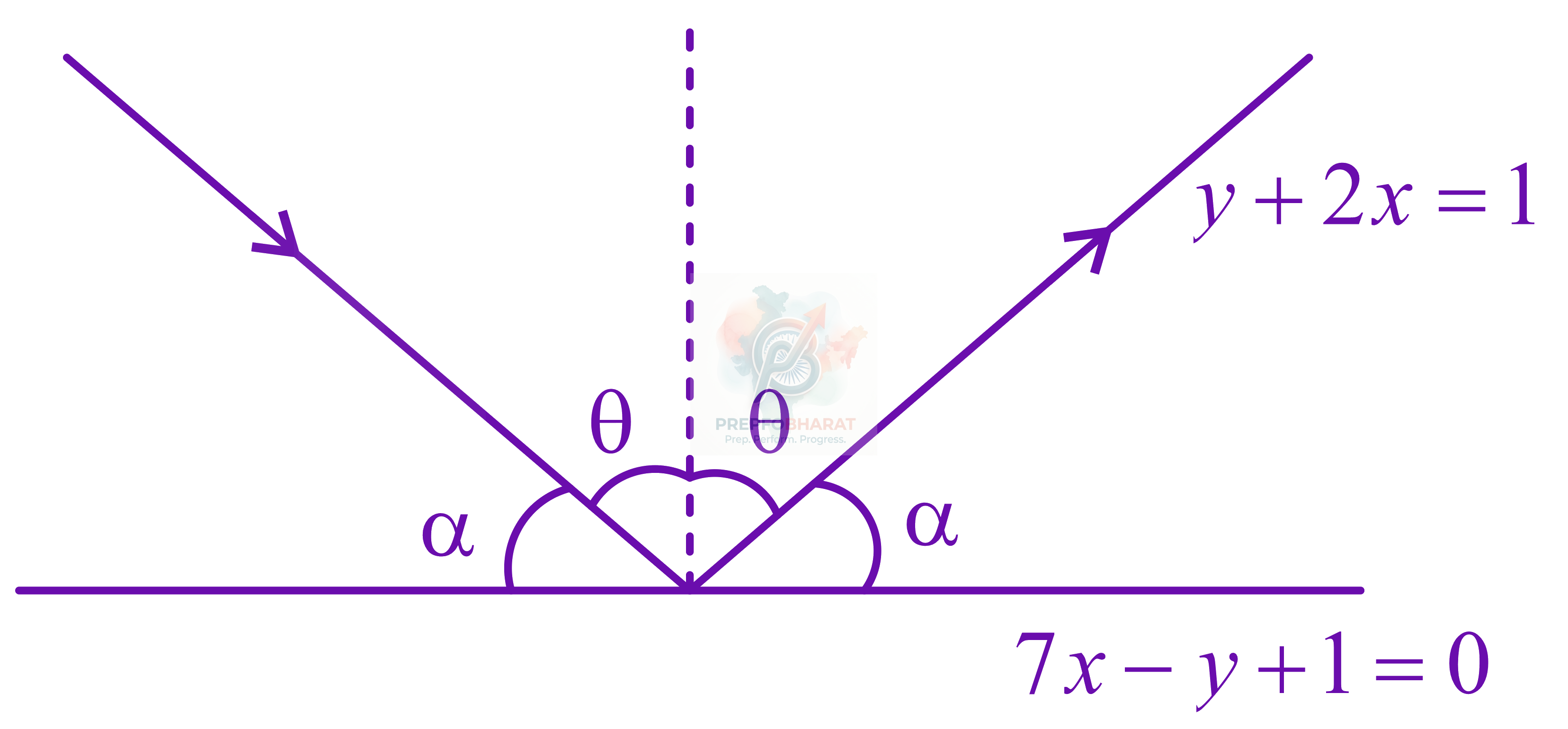
Let slope of incident ray be m.
∴ angle of incidence = angle of reflection
∴ ∣1+7mm−7∣=∣1−14−2−7∣=139
⇒1+7mm−7=139or1+7mm−7=−139
⇒13m−91=9+63m, or13m−91=−9−63m
⇒ m=−2 or m=3841
⇒y−1=3841(x−0)
⇒ 38y−38−41x=0
JEE Main 2016 — Mathematics Coordinate Geometry
A ray of light is incident along a line which meets another line 7x−y+1=0 at the point (0,1). The ray is then reflected from this point along the line y+2x=1. Then the equation of the line of incidence of the ray of light is :
Held on 10 Apr 2016 · Verified 6 Jul 2026.
41x−25y+25=0
41x+25y−25=0
41x−38y+38=0
41x+38y−38=0
Sign in to track your attempts and accuracy.
Sign in to keep a private note on this question. Nothing you write is ever public.
Let $y^{2}=12 x$ be the parabola with its vertex at O. Let P be a point on the parabola and A be a point on the $x$-axis such that $\angle \mathrm{OPA}=90^{\circ}$. Then the locus of the centroid of such triangles OPA is :
The eccentricity of an ellipse $E$ with centre at the origin $O$ is $\dfrac{\sqrt{3}}{2}$ and its directrices are $x = \pm \dfrac{4\sqrt{6}}{3}$. Let $H: \dfrac{x^2}{a^2} - \dfrac{y^2}{b^2} = 1$ be a hyperbola whose eccentricity is equal to the length of semi-major axis of $E$, and whose length of latus rectum is equal to the length of minor axis of $E$. Then the distance between the foci of $H$ is :
The distance between the points (3, 4) and (6, 8) is:
Let the domain of the function $f(x)=\log _{3} \log _{5} \log _{7}\left(9 x-x^{2}-13\right)$ be the interval $(\mathrm{m}, \mathrm{n})$. Let the hyperbola $\frac{x^{2}}{\mathrm{a}^{2}}-\frac{y^{2}}{\mathrm{~b}^{2}}=1$ have eccentricity $\frac{\mathrm{n}}{3}$ and the length of the latus rectum $\frac{8 \mathrm{~m}}{3}$. Then $\mathrm{b}^{2}-\mathrm{a}^{2}$ is equal to :
Let a point $A$ lie between the parallel lines $L_{1}$ and $L_{2}$ such that its distances from $L_{1}$ and $L_{2}$ are 6 and 3 units, respectively. Then the area (in sq. units) of the equilateral triangle $A B C$, where the points $B$ and C lie on the lines $\mathrm{L}_{1}$ and $\mathrm{L}_{2}$, respectively, is :
Work through every JEE Main Coordinate Geometry PYQ, year by year.