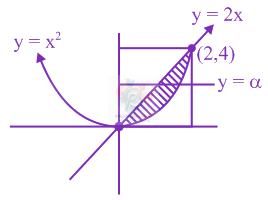
∫04(y−2y)dy=2∫0α(y−2y)dy
(32y3/2−2y2)04=2(32y3/2−4y2)0α
⇒316−4=2(32α3/2−4α2)
⇒34=2(32α3/2−4α2)
⇒32=128α3/2−3α2
⇒8α3/2−3α2=8
⇒3α2−8α3/2+8=0
JEE Main 2020 — Mathematics Calculus
Consider a region R=(x,y)∈R2:x2≤y≤2x. If a line y=α divides the area of region R into two equal parts, then which of the following is true ?
Held on 2 Sept 2020 · Verified 6 Jul 2026.
α3−6α2+16=0
3α2−8α3/2+8=0
3α2−8α+8=0
α3−6α3/2−16=0
Sign in to track your attempts and accuracy.
Sign in to keep a private note on this question. Nothing you write is ever public.
If $\int\left(\frac{1-5 \cos ^{2} x}{\sin ^{5} x \cos ^{2} x}\right) d x=f(x)+\mathrm{C}$, where C is the constant of integration, then $f\left(\frac{\pi}{6}\right)-f\left(\frac{\pi}{4}\right)$ is equal to
If the solution curve $y=f(x)$ of the differential equation $\left(x^{2}-4\right) y^{\prime}-2 x y+2 x\left(4-x^{2}\right)^{2}=0, x>2$, passes through the point $(3,15)$, then the local maximum value of $f$ is $\_\_\_\_$.
Let $[\cdot]$ be the greatest integer function. If $\alpha=\int_{0}^{64}\left(x^{1 / 3}-\left[x^{1 / 3}\right]\right) \mathrm{d} x$, then $\frac{1}{\pi} \int_{0}^{\alpha \pi}\left(\frac{\sin ^{2} \theta}{\sin ^{6} \theta+\cos ^{6} \theta}\right) \mathrm{d} \theta$ is equal to $\_\_\_\_$ .
Let $P_{1}: y=4 x^{2}$ and $P_{2}: y=x^{2}+27$ be two parabolas. If the area of the bounded region enclosed between $P_{1}$ and $P_{2}$ is six times the area of the bounded region enclosed between the line $y=\alpha x, \alpha>0$ and $P_{1}$, then $\alpha$ is equal to :
If $y=y(x)$ satisfies the differential equation $16(\sqrt{x+9 \sqrt{x}})(4+\sqrt{9+\sqrt{x}}) \cos y \mathrm{~d} y=(1+2 \sin y) \mathrm{d} x, x>0$ and $y(256)=\frac{\pi}{2}, y(49)=\alpha$, then $2 \sin \alpha$ is equal to :
Work through every JEE Main Calculus PYQ, year by year.