JEE Main 2002 — Calculus
Mathematics Calculus questions from JEE Main 2002.
Other Years
18 Calculus Questions from 2002
Let $f(x)=4$ and $f^{\prime}(x)=4$. Then $\operatorname{Lim}_{x \rightarrow 2} \frac{x f(2)-2 f(x)}{x-2}$ is given by
$f(x)$ and $g(x)$ are two differentiable functions on $[0,2]$ such that $f^{\prime \prime}(x)-g^{\prime \prime}(x)=0$ $f^{\prime}(1)=2 g^{\prime}(1)=4 f(2)=3 g(2)=9$ then $f(x)-g(x)$ at $x=3 / 2$ is
If $y=\left(x+\sqrt{1+x^2}\right)^n$, then $\left(1+x^2\right) \frac{d^2 y}{d x^2}+x \frac{d y}{d x}$ is
The solution of the equation $\frac{d^2 y}{d x^2}=e^{-2 x}$
The area bounded by the curves $y=\ln x, y=\ln |x|, y=|\ln x|$ and $y=|\ln ||x|$ is
The order and degree of the differential equation $\left(1+3 \frac{d y}{d x}\right)^{2 / 3}=4 \frac{d^3 y}{d x^3}$ are
$\int_{-\pi}^\pi \frac{2 x(1+\sin x)}{1+\cos ^2 x} d x$ is
$\operatorname{Lim}_{x \rightarrow 0} \frac{\log x^n-[x]}{[x]}, \mathrm{n} \in \mathrm{N}([\mathrm{x}]$ denotes greatest integer less than or equal to $\mathrm{x})$
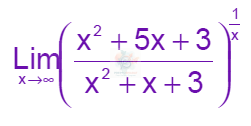
$\int_0^{\sqrt{2}}\left[x^2\right] d x$ is
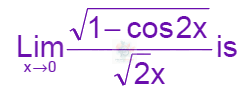
f is defined in [-5, 5] as f(x) = x if x is rational and = -x is irrational. Then
If $y=f(x)$ makes $+v e$ intercept of 2 and 0 unit on $x$ and $y$ axes and encloses an area of $3 / 4$ square unit with the axes then $\int_0^2 x f^{\prime}(x) d x ~~is$
$$ \operatorname{Lim}_{n \rightarrow \infty} \frac{1^p+2^p+3^p+\ldots+n^p}{n^{p+1}} $$ is
If $f(1)=1, f^{\prime}(1)=2$, then $\operatorname{Lim}_{x \rightarrow 1} \frac{\sqrt{f(x)}-1}{\sqrt{x}-1}$ is
$I_n=\int_0^{\pi / 4} \tan ^n x d x$ then $\operatorname{Lim}_{n \rightarrow \infty} n\left[I_n+I_{n-2}\right]$ equals
The maximum distance from origin of a point on the curve $x=a \sin t-b \sin \left(\frac{a t}{b}\right)$ $y=a \cos t-b \cos \left(\frac{a t}{b}\right)$, both $a, b>0$ is
$\int_0^{10 \pi}|\sin x| d x$ is