Organic Chemistry PYQ — Page 66
JEE Main Chemistry — Organic Chemistry previous year questions with solutions.
All Organic Chemistry Questions (1783)
In the reaction, ${\text{CH}}_{3} \text{COOH} \overset{{\text{LiAlH}}_{4}}{\rightarrow } \text{A} \overset{{\text{PCl}}_{5}}{\rightarrow } \text{B} \overset{\text{Alc. KOH}}{\rightarrow } \text{C}$, the product C is :
The final product formed when methylamine is treated with ${ \text{NaNO}}_{\text{2}}$ and $\text{HCl}$ followed by hydrolysis is:
The major product formed when 1, 1, 1- trichloropropane is treated with aqueous potassium hydroxide is :
In a set of reactions p - nitrotoluene yielded a product E 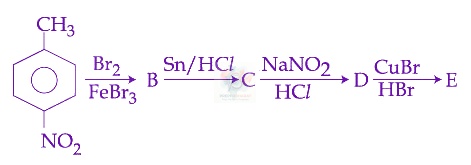 The product E would be :
In S$_{N}$2 reactions, the correct order of reactivity for the following compounds : CH$_{3}$Cl, CH$_{3}$CH$_{2}$Cl, (CH$_{3}$)$_{2}$CHCl and (CH$_{3}$)$_{3}$CCl is :
Which one of the following statements is not correct?
On heating an aliphatic primary amine with chloroform and ethanolic potassium hydroxide, the organic compound formed is :
In the Victor-Meyer's test, the colour given by $1^{\circ}, 2^{\circ}$ and $3^{\circ}$ alcohols are respectively:
Tischenko reaction is a modification of:
Complete reduction of benzene-diazonium chloride with $\mathrm{Zn} / \mathrm{HCl}$ gives:
Williamson synthesis of ether is an example of :
The reason for double helical structure of DNA is the operation of :
Which is the major product formed when acetone is heated with iodine and potassium hydroxide?
The major organic compound formed by the reaction of 1, 1, 1 - trichloroethane with silver powder is :
The following reaction 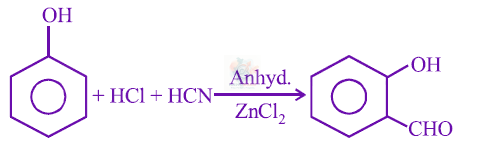 is known as:
The addition of $\mathrm{HI}$ in the presence of peroxide catalyst does not follow anti-Markovnikov's rule because :
Aryl fluoride may be prepared from arene diazonium chloride using :
Rate of dehydration of alcohols follows the order:
A major component of Borsch reagent is obtained by reacting hydrazine hydrate with which of the following ?
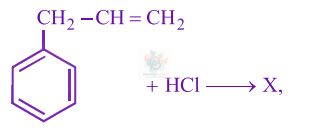 $\mathrm{X} \text { is: }$
A solution of $(-)1-\mathrm{chloro}-1-\mathrm{phenylethane}$ in toluene racemises slowly in the presence of a small amount of SbCl$_{5}$, due to the formation of :
The order of reactivity of the given haloalkanes towards nucleophile is :
In nucleophilic substitution reaction, order of halogens as incoming (attacking) nucleophile is: $\mathrm{I}^{-}>\mathrm{Br}^{-}>\mathrm{Cl}^{-}$ The order of halogens as departing nucleophile should be :
The reaction of phenol with benzoyl chloride to give phenyl benzoate is known as :