Organic Chemistry PYQ — Page 64
JEE Main Chemistry — Organic Chemistry previous year questions with solutions.
All Organic Chemistry Questions (1783)
Accumulation of which of the following molecules in the muscles occurs as a result of vigorous exercise?
A compound $A$ with molecular formula ${C}_{10}{H}_{13}Cl$, gives a white precipitate on adding silver nitrate solution. $A$ on reacting with alcoholic $\mathrm{KOH}$ gives compound $B$ as the main product. $B$ on ozonolysis, gives $C$ and $D$. $C$ gives Cannizaro reaction, but not aldol condensation. $D$ gives aldol condensation, but not Cannizaro reaction. $A$ is
What is the major product expected from the following reaction? 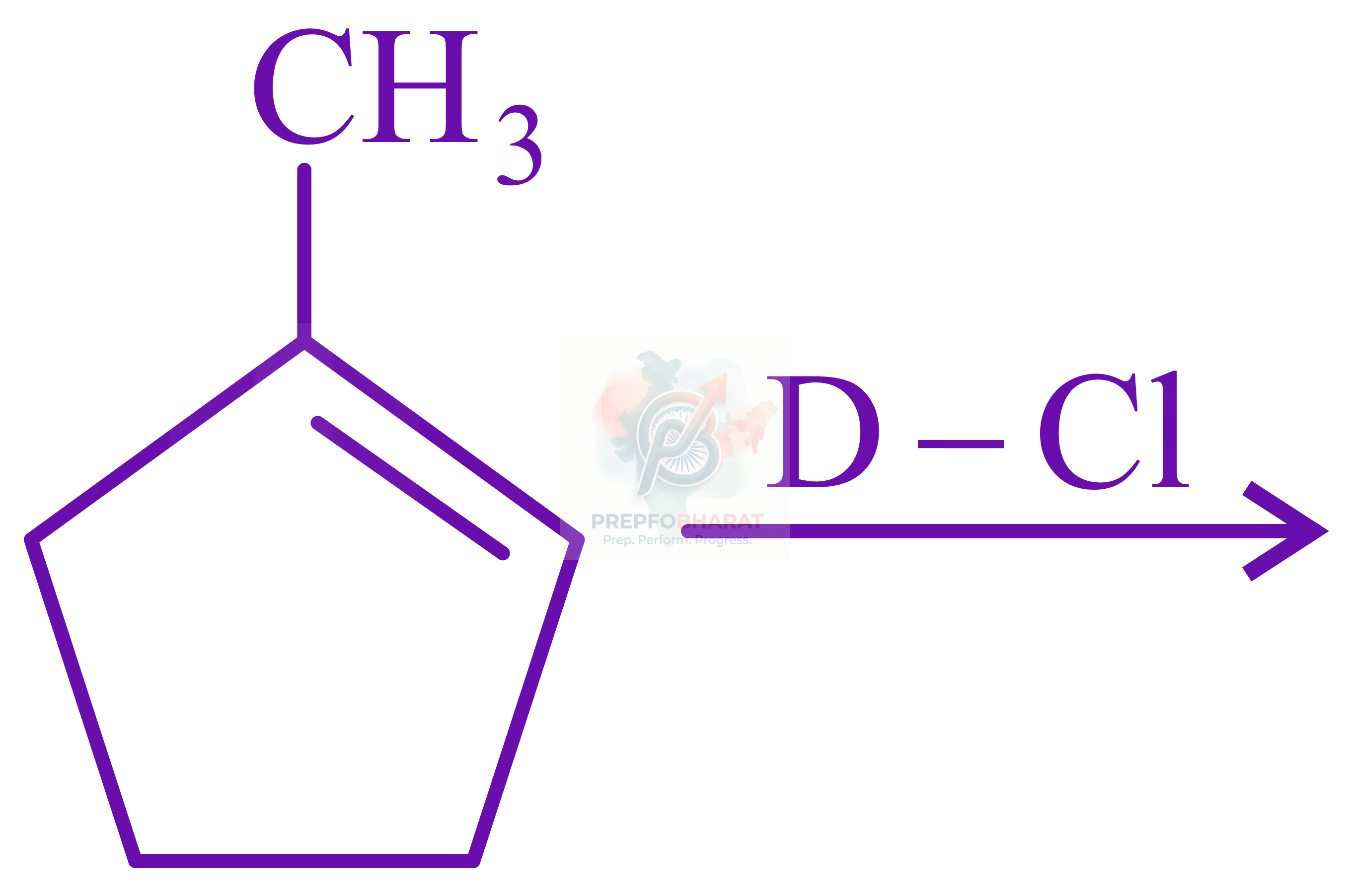 Where D is an isotope of hydrogen.
1.4 g of an organic compound was digested according to Kjeldahl's method and the ammonia evolved was absorbed in 60 mL of M/10 ${H}_{2}S{O}_{4}$ solution. The excess sulphuric acid required 20 mL of M/10 NaOH solution for neutralization. The percentage of nitrogen in the compound is:
In the reaction, 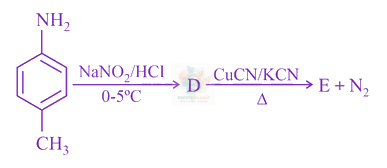 The product $E$ is
The number of structural isomers for ${C}_{6}{H}_{14}$ is:
Which compound would give $5-$keto$-2-$methyl hexanal upon ozonolysis?
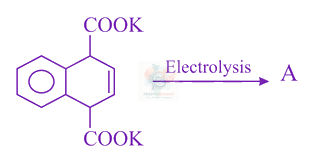 A is :
Which of the following compounds will exhibit geometrical isomerism?
The optically inactive compound from the following is:
The synthesis of alkyl fluorides is best accomplished by:
In the reaction sequence $2C{H}_{3}CHO \overset{O{H}^{-}}{\rightarrow } A \overset{\Delta }{\rightarrow } B$ ; the product B is:
In the presence of a small amount of phosphorous, aliphatic carboxylic acid reacts with chlorine or bromine to yield a reaction in which, $\alpha -$hydrogen is been replaced by halogen. This reaction is known as
Complete hydrolysis of starch gives:
Which of the vitamins given below is water soluble?
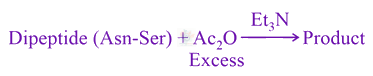
Which of the following pairs of compounds are positional isomers?
In the following sequence of reactions: $\mathrm{Toluene}\overset{{\mathrm{KMnO}}_{4}}{\rightarrow }A\overset{{\mathrm{SOCl}}_{2}}{\rightarrow }B\rightarrow _{{\mathrm{BaSO}}_{4}}^{{H}_{2}/\mathrm{Pd}}C$ The Product $C$ is:
Match the organic compounds in column - $I$ with the Lassaigne's test result in column - $\mathrm{II}$ appropriately: <table class="pyq-table"><tbody><tr><td></td><td>Column – $I$</td><td></td><td>Column - $\mathrm{II}$</td></tr><tr><td>A.</td><td>Aniline</td><td>i.</td><td>Red colour with $FeC{l}_{3}$</td></tr><tr><td>B.</td><td>Benzene sulfonic acid</td><td>ii.</td><td>Violet color with sodium nitroprusside</td></tr><tr><td>C.</td><td>Thiourea</td><td>iii.</td><td>Blue color with and acidic solution of $FeS{O}_{4}$</td></tr></tbody></table>
In Carius method of estimation of halogens, $250\mathrm{mg}$ of an organic compound gave $141\mathrm{mg}\mathrm{AgBr}$. What is the percentage of bromine in the compound (atomic mass of $\mathrm{Ag}=108$ and atomic number of $\mathrm{Br}=80$)?
The correct order of basicity is
The most suitable reagent for the conversion of $\text{R} - {\text{CH}}_{2} - \text{OH} \rightarrow \text{R} - \text{CHO}$ is :
Which of the following will not show mutarotation?
Which one of the following substituents at para-position is most effective in stabilizing the phenoxide 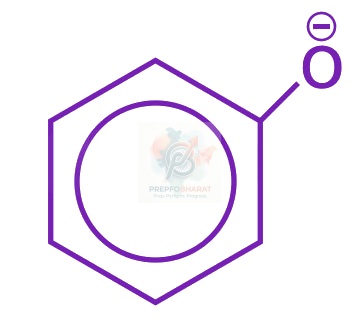 ion ?