Organic Chemistry PYQ — Page 60
JEE Main Chemistry — Organic Chemistry previous year questions with solutions.
All Organic Chemistry Questions (1783)
Arrange the following amines in the decreasing order of basicity. 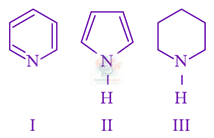
In the following reactions, products $A$ and $B$ are:  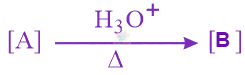
The increasing order of $\mathrm{pKa}$ of the following amino acids in aqueous solution is Glycine, Aspartate, Lysine, Arginine.
Fructose and glucose can be distinguished by:
The correct match between items I and II is : 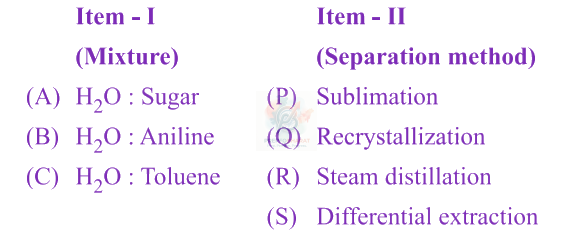
The major product of the f following reaction is: 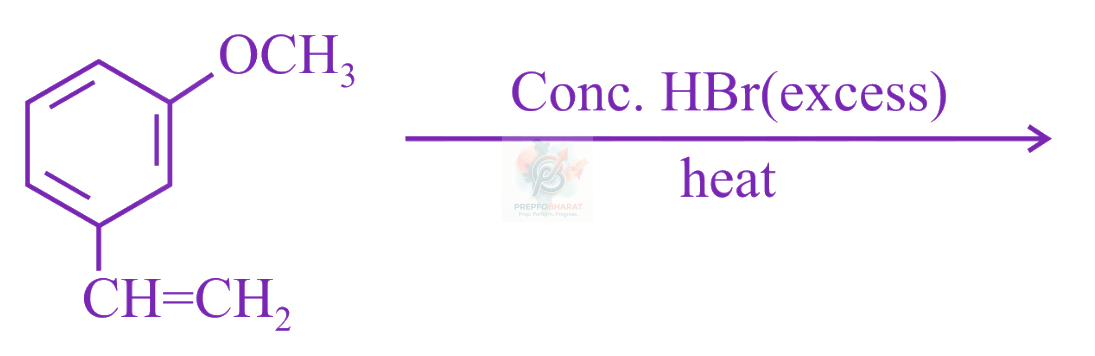
Major product of the given reaction is: 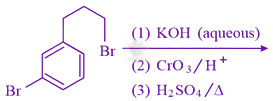
Which of the following is the correct structure of adenosine?
Which of the following will not exist in zwitter ionic form at $\mathrm{pH}=7$ ?
The increasing order of nitration of the following compounds is : 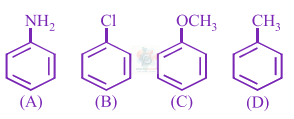
The trans-alkenes are formed by the reduction of alkynes with
The major product of the following reaction is: 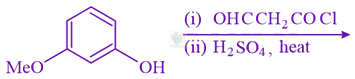
The major product of the following reaction is 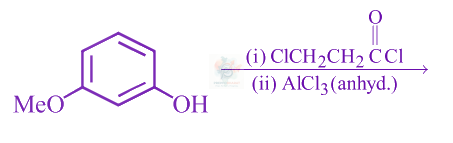
The increasing order of basicity of the following compounds is : 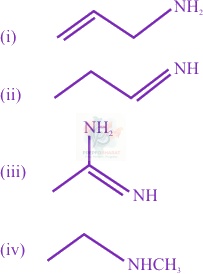
Among the following, the incorrect statement is
Which of the following will most readily give the dehydrohalogenation product?
The increasing order of diazotisation of the following compounds is: (a) 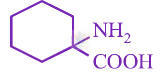 (b)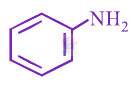 (c)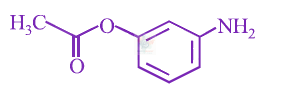 (d)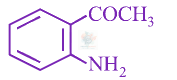
The correct match between items of List-I and List-II is <table class="pyq-table"><tbody><tr><td></td><td>List - I</td><td></td><td>List - II</td></tr><tr><td>(A)</td><td>Coloured impurity</td><td>(P)</td><td>Steam distillation</td></tr><tr><td>(B)</td><td>Mixture of o – nitrophenol and p –nitrophenol</td><td>(Q)</td><td>Fractional distillation</td></tr><tr><td>(C)</td><td>Crude Naphtha</td><td>(R)</td><td>Charcoal treatment</td></tr><tr><td>(D)</td><td>Mixture of glycerol and sugars</td><td>(S)</td><td>Distillation under reduced pressure</td></tr></tbody></table>
Which of the following will most readily give the dehydrohalogenation product?
The major product of the following reaction is: 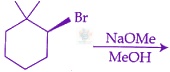
The major product of the following reaction is: 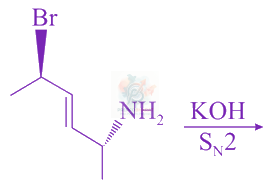
The reagent(s) required for the following conversion are: 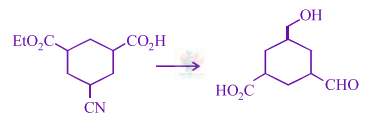
Glucose on prolonged heating with $\mathrm{HI}$ gives
The IUPAC name of the following compound is