Organic Chemistry PYQ — Page 47
JEE Main Chemistry — Organic Chemistry previous year questions with solutions.
All Organic Chemistry Questions (1783)
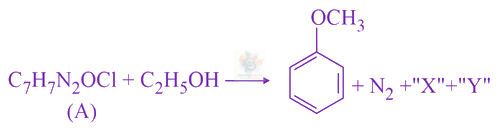 In the above reaction, the structural formula of (A), "X" and "Y" respectively are :
Among the following, the aromatic compounds are : 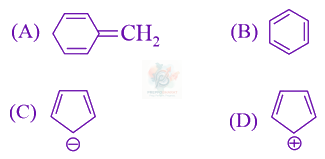 Choose the correct answer from the following options :
Identify $A$ in the given chemical reaction. 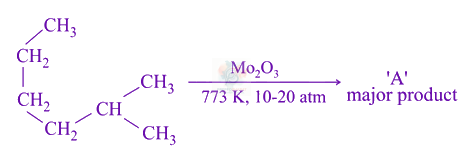
Compound(s) which will liberate carbon dioxide with sodium bicarbonate solution is/are : 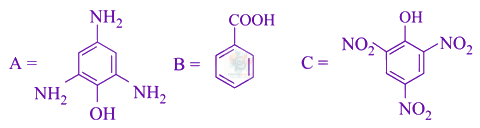
The correct structures of A and B formed in the following reactions are : 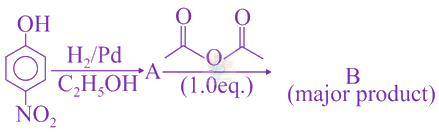
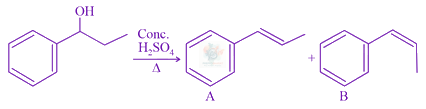 consider the above reaction, and choose the correct statement:
 Major product P of above reaction, is:
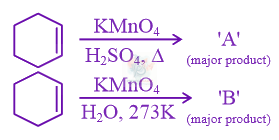 For above chemical reactions, identify the correct statement from the following:
When $0.15g$ of an organic compound was analyzed using Carius method for estimation of bromine, $0.2397g$ of $\mathrm{AgBr}$ was obtained. The percentage of bromine in the organic compound is _________.(Nearest integer) [Atomic mass : Silver $=108,$ Bromine $=80$]
Which one of the following compounds is non-aromatic?
Choose the correct statement regarding the formation of carbocations A and B given :- 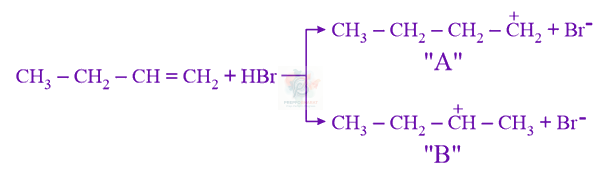
$0.8g$ of an organic compound was analysed by Kjeldahl's method for the estimation of nitrogen. If the percentage of nitrogen in the compound was found to be $42%$, then....... $\mathrm{mL}$ of $1M$ ${H}_{2}{\mathrm{SO}}_{4}$ would have been neutralized by the ammonia evolved during the analysis.
The correct order of the following compounds showing increasing tendency towards nucleophilic substitution reaction is: 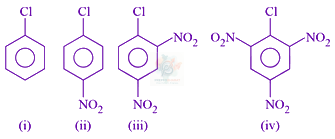
Which among the following pairs of Vitamins is stored in our body relatively for longer duration?
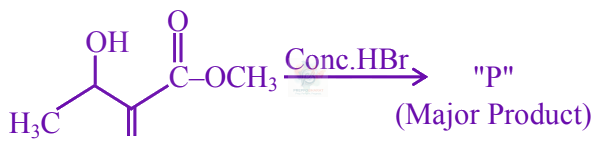 Consider the above reaction, the major product $P$ formed is :-
 Consider the given reaction, Identify ${X'}^{'}$ and ${Y'}^{'}$ :
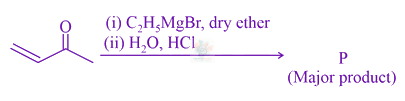 Consider the above reaction, the major product '$P$' is:
A reaction of 0.1 mole of Benzylamine with bromomethane gave $23g$ of Benzyl trimethyl ammonium bromide. The number of moles of bromomethane consumed in this reaction are $n\times {10}^{-1},$ when $n=$_____ (Round off to the Nearest Integer). $(\text{Given : Atomic masses}:C:12.0u,H:1.0u,N:14.0u,\mathrm{Br}:80.0u)$
Hydrolysis of sucrose gives:
The correct order of acid character of the following compounds is :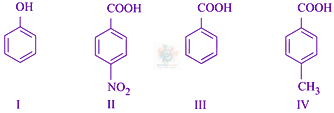
Mesityl oxide is a common name of:
For the given reaction:  What is $A$?
Main Products formed during a reaction of $1$-methoxy naphthalene with hydroiodic acid are:
Carbylamine test is used to detect the presence of primary amino group in an organic compound. Which of the following compound is formed when this test is performed with aniline?