Inorganic Chemistry PYQ — Page 41
JEE Main Chemistry — Inorganic Chemistry previous year questions with solutions.
All Inorganic Chemistry Questions (1476)
The one that is not expected to show isomerism is:
The correct order of the spin-only magnetic moments of the following complexes is: $(I)$ $[Cr{({H}_{2}O)}_{6}]B{r}_{2}$ $(II)$ $N{a}_{4}[Fe{(CN)}_{6}]$ $(III)$ $N{a}_{3}[Fe{({C}_{2}{O}_{4})}_{3}]({\Delta }_{0}>P)$ $(IV)$ ${(E{t}_{4}N)}_{2}[CoC{l}_{4}]$
White phosphorus on reaction with concentrated $NaOH$ solution in an inert atmosphere of $C{O}_{2}$ gives phosphine and compound $(X).(X)$ on acidification with $HCl$ gives compound $(Y).$ The basicity of compound $(Y)$ is:
The dipole moments of $CC{l}_{4},CHC{l}_{3}$ and $C{H}_{4}$ are in the order
On heating, lead (ll) nitrate gives a brown gas (A). The gas (A) on cooling changes to a colourless solid/liquid (B). (B) on heating with NO changes to ablue solid (C). The oxidation number of nitrogen in solid (C) is:
Consider that ${d}^{6}$ metal ion $({M}^{2+})$ forms a complex with aqua ligands, and the spin only magnetic moment of the complex is $4.90 \mathrm{BM}$. The geometry and the crystal field stabilization energy of the complex is :
If ${\mathrm{AB}}_{4}$ molecule is a polar molecule, a possible geometry of ${\mathrm{AB}}_{4}$ is :
The intermolecular potential energy for the molecules$A$ ,$B$ , $C$ and $D$ given below suggests that: 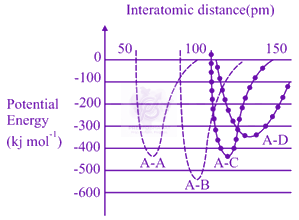
The electron gain enthalpy (in $\frac{\mathrm{kJ}}{mol}$ ) of fluorine, chlorine, bromine and iodine, respectively, are
Among the compounds $A$ and $B$ with molecular formula ${C}_{9}{H}_{18}{O}_{3},$ $A$ is having higher boiling point than $B.$ The possible structures of $A$ and $B$ are:
The INCORRECT statement is :
The molecular geometry of ${\mathrm{SF}}_{6}$ is octahedral. What is the geometry of ${\mathrm{SF}}_{4}$ (including lone pair(s) of electrons, if (any)?
Reaction of an inorganic sulphite $X$ with dilute ${H}_{2}{\mathrm{SO}}_{4}$ generated compound $Y$. Reaction of $Y$ with $\mathrm{NaOH}$ gives $X$. Further, the reaction of $X$ with $Y$ and water affords compound $Z,Y$ and $X$, respectively, are :
Consider the complex ions, trans- ${[\mathrm{Co}(\mathrm{en}{)}_{2}{\mathrm{Cl}}_{2}]}^{*}(A)$ and $\mathrm{cis}-{[\mathrm{Co}(\mathrm{en}{)}_{2}{\mathrm{Cl}}_{2}]}^{+}(B).$ The correct statement regarding them is :
Chlorine reacts with hot and concentrated $NaOH$ and produces compounds $(X)$ and $(Y)$. Compound $(X)$ gives white precipitate with silver nitrate solution. The average bond order between $\mathrm{Cl}$ and $O$ atoms in $(Y)$ is _______________.
The shape of XeF₄ molecule is:
In a molecule of pyrophosphoric acid, the number of $P-OH,P=0\mathrm{and}P-O-P$ bonds/moiety(ies) respectively are :
In the following reactions, products $(A)$ and $(B)$ , respectively, are: $NaOH+C{l}_{2}\rightarrow (A)+sideproducts$ $(hotandconc.)$ $Ca{(OH)}_{2}+C{l}_{2}\rightarrow (B)+sideproducts$ $(dry)$
The elements with atomic numbers $101$ and $104$ belong to, respectively:
The number of $\mathrm{Cl}=O$ bonds in perchloric acid is, $"\ldots \ldots \ldots ..."$
Reaction of ammonia with excess $C{l}_{2}$ gives :
Complexes $(M{L}_{5})$ of metals $Ni$ and $Fe$ have ideal square pyramidal and trigonal bipyramidal geometries, respectively. The sum of the ${90}^{o},{120}^{o}$ and ${180}^{o}$ $L-M-L$ angles in the two complexes is_______
The bond order and the magnetic characteristic of ${CN}^{-}$ are
The predominant intermolecular forces present in ethyl acetate, a liquid, are: