Inorganic Chemistry PYQ — Page 34
JEE Main Chemistry — Inorganic Chemistry previous year questions with solutions.
All Inorganic Chemistry Questions (1476)
The reaction of white phosphorus on boiling with alkali in inert atmosphere resulted in the formation of product $A.$ The reaction $1\mathrm{mol}$ of $A$ with excess of ${\mathrm{AgNO}}_{3}$ in aqueous medium gives ________ mole(s) of $\mathrm{Ag}.$ (Round off to the Nearest Integer).
Identify the element for which electronic configuration in $+3$ oxidation state is $[\mathrm{Ar}]3{d}^{5}:$
Consider the elements $\mathrm{Mg},$ $\mathrm{Al},S,P$ and $\mathrm{Si},$ the correct increasing order of their first ionisation enthalpy is:
The correct order of intensity of colors of the compounds is:
Given below are two statements: Statement $I$ : $o$-Nitrophenol is steam volatile due to intramolecular hydrogen bonding. Statement $\mathrm{II}$ : $o$-Nitrophenol has high melting due to hydrogen bonding. In the light of the above statements, choose the most appropriate answer from the options given below:
Which of the following are isostructural pairs? A. ${\mathrm{SO}}_{4}^{2-}$ and ${{\mathrm{CrO}}_{4}}^{2-}$ B. ${\mathrm{SiCl}}_{4}$ and ${\mathrm{TiCl}}_{4}$ C. ${\mathrm{NH}}_{3}$ and ${\mathrm{NO}}_{3}^{-}$ D. ${\mathrm{BCl}}_{3}$ and ${\mathrm{BrCl}}_{3}$
Given below are two statements:Statement I : ${\mathrm{CeO}}_{2}$ can be used for oxidation of aldehydes and ketones. Statement II : Aqueous solution of ${\mathrm{EuSO}}_{4}$ is a strong reducing agent. In the light of the above statements, choose the correct answer from the options given below:
Given below are two statements: One is labelled as Assertion $A$ and the other labelled as Reason $R.$ Assertion $A$ : Lithium halides are some what covalent in nature. Reason $R$ : Lithium possess high polarisation capability. In the light of the above statements, choose the most appropriate answer from the options given below:
The correct order of bond dissociation enthalpy of halogens is:
Acidic ferric chloride solution on treatment with excess of potassium ferrocyanide gives a Prussian blue coloured colloidal species. It is:
According to the valence bond theory the hybridization of central metal atom is ${\mathrm{dsp}}^{2}$ for which one of the following compounds?
$1$ mol of an octahedral metal complex with formula ${\mathrm{MCl}}_{3}\cdot 2L$ on reaction with excess of ${\mathrm{AgNO}}_{3}$ gives $1\mathrm{mol}$ of $\mathrm{AgCl}.$ The denticity of Ligand $L$ is___________ (Integer answer)
In which one of the following molecules strongest back donation of an electron pair from halide to boron is expected?
According to molecular orbital theory, the number of unpaired electron(s) in ${O}_{2}^{2-}$ is _________ .
Three moles of $\mathrm{AgCl}$ get precipitated when one mole of an octahedral co-ordination compound with empirical formula ${\mathrm{CrCl}}_{3}.3{\mathrm{NH}}_{3}.3{H}_{2}O$ reacts with excess of silver nitrate. The number of chloride ions satisfying the secondary valency of the metal ion is ______ .
The number of ionisable hydrogens present in the product obtained from a reaction of phosphorus trichloride and phosphonic acid is:
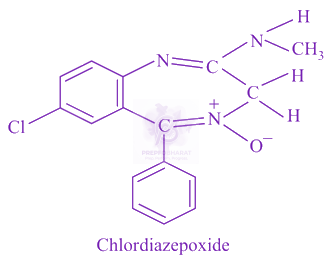 The class of drug to which chlordiazepoxide with above structure belongs is :
Spin only magnetic moment in $\mathrm{BM}$ of ${[\mathrm{Fe}{(\mathrm{CO})}_{4}({C}_{2}{O}_{4})]}^{+}$ is :
Given below are two statements: one is labelled as Assertion A and the other is labelled as Reason R : Assertion A : The $H-O-H$ bond angle in water molecule is $104.5^{\circ}$. Reason R : The lone pair $-$ lone pair repulsion of electrons is higher than the bond pair $-$ bond pair repulsion.
The Crystal Field Stabilization Energy (CFSE) and magnetic moment (spin-only) of an octahedral aqua complex of a metal ion $({M}^{Z+})$ are $-0.8{\Delta }_{0}$ and $3.87$ $\mathrm{BM}$, respectively. Identify $({M}^{Z+}):$
The correct shape and $I-I-I$ bond angles respectively in ${I}_{3}^{-}$ ion are:
${\mathrm{Al}}_{2}{O}_{3}$ was leached with alkali to get $X.$ The solution of $X$ on passing of gas $Y,$ forms $Z.$ $X,Y$ and $Z$ respectively are
The CORRECT order of first ionisation enthalpy is:
Given below are two statements : one is labelled as Assertion (A) and the other is labelled as Reason (R). Assertion (A) : Metallic character decreases and non-metallic character increases on moving from left to right in a period. Reason (R): It is due to increase in ionisation enthalpy and decrease in electron gain enthalpy, when one moves from left to right in a period. In the light of the above statements, choose the most appropriate answer from the options given below :